- USDA forecasts slight rise in global rice consumption
- Rice delivery norms for PDS buying to change from Oct’25
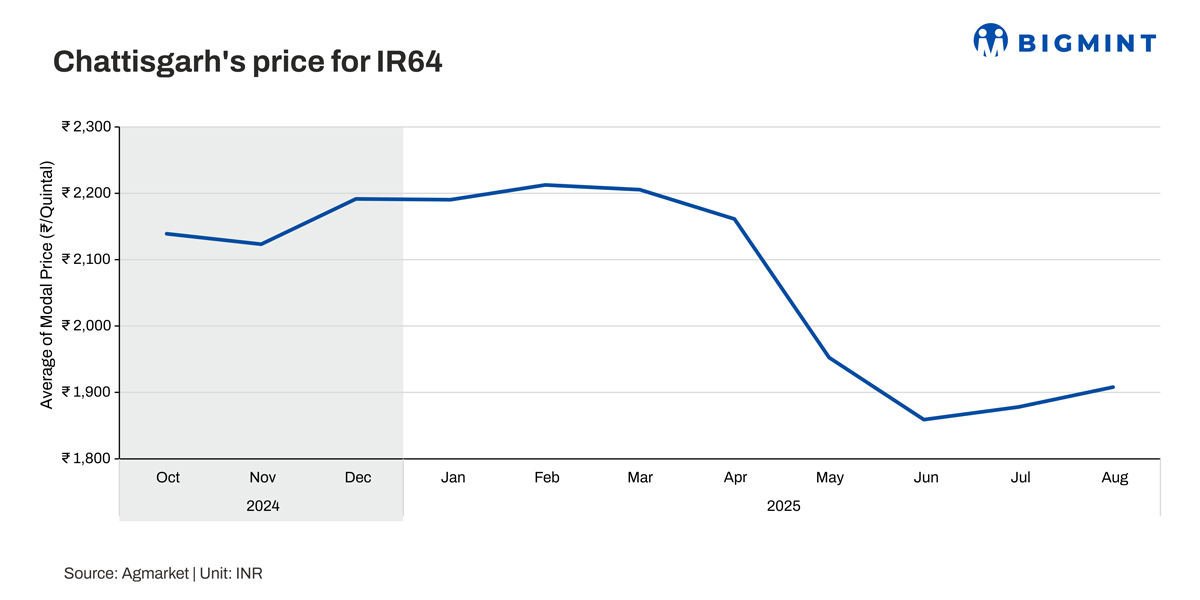
Indian modal prices of the IR64 variety of rice in Chhattisgarh have experienced notable fluctuations over the past year, according to a recent analysis.
Prices remained relatively stable over October 2024 – March 2025, hovering between INR 2,100-2,200 per quintal. This period of stability was followed by a sharp decline starting in April 2025, with prices falling significantly over the next two months.
Prices reached a bottom in June 2025, settling below the INR 1,900 per quintal mark. Since then, the market has shown signs of a slight recovery, with values gradually increasing through July-August 2025.
As of 21st August, this recovery is reflected in Vizag port delivery prices, with IR 64 (5% Broken) quoted at ₹2,950 per quintal and Common Big Grain (10% Broken) at ₹2,850 per quintal.
This recent uptrend suggests a potential stabilization after the mid-year price slump.
Global rice consumption to edge higher
The USDA’s August 2025 report projects global rice production for 2025-26 at a record 541.46 million tonnes (mnt), with consumption slightly higher at 541.97 mnt. Ending stocks are forecast at 186.70 mnt, down from last month, led by declines in Nigeria, the Philippines, and Myanmar.
World rice trade is expected to climb up to 62.04 mnt, driven by stronger exports from Burma (1.8 mnt) and the US (3.1 mnt).
Price trends are mixed: Vietnam and India posted gains on strong demand, while the US, Thailand, and Pakistan saw declines amid softer sales. Iraq’s rice imports are on track for a record 2.225 mnt in 2024-25, up 10% y-o-y, making it the sixth-largest global buyer. Imports are fueled by rising consumption, government procurement programs, and stagnant domestic output, with less than 10% of demand met by local production.
Paddy acreage rises y-o-y
India’s kharif crop sowing has reached over 90% of the normal 1,097 lakh hectares, registering a 4% y-o-y rise to 995.63 lakh hectares as of 8 August, supported by surplus monsoon rains. Paddy, the main kharif cereal, saw the largest expansion, with acreage rising 12.1% to 364.8 lakh hectares compared to last year.

Chhattisgarh’s rice, paddy procurement volumes surge
Chhattisgarh has shown robust performance in its recent procurement efforts, with both paddy and rice acquisition exceeding initial estimates. According to the latest data, the state’s paddy procurement reached a progressive total of 14.93 million tonnes (mnt), a significant 28% increase over the original estimate of 11.64 mnt. This strong showing highlights a successful season for farmers and an effective procurement strategy by the government.
Similarly, the procurement of rice also demonstrated a positive trend. The state’s progressive rice procurement has hit 10.00 mnt, which is 28% higher than the initial estimate of 7.8 mnt. This consistent growth across both commodities underscores the state’s vital role in contributing to the national food security reserves. The figures indicate that the state has successfully managed to procure, mill, and secure a substantial quantity.
 The state’s total rice stock, which combines Food Corporation of India (FCI), state, and central reserves, saw a peak in April 2025 at 2.65 mnt before beginning a steady decline. The combined stock had fallen to 2.39 mnt by August 2025.
Along with the FCI and storage pressure, India currently holds nearly four years’ worth of rice buffer stock in government warehouses. With the kharif marketing season (KMS) inflow expected to add more volumes, storage space remains a critical challenge. Quality issues are emerging in the market due to prolonged storage and delayed milling.
The government’s central-pool rice stocks continue to surge despite record offloading of grain through open market sale, allocation to states, for ethanol manufacturing and the Bharat rice initiative in FY’25.
Furthermore, beginning this KMS in October, millers in five states will be required to deliver rice with no more than 10% broken grains, compared to the current FCI norm of 25%, for procurement under the public distribution system — a move that will free 15% broken rice for ethanol production. The policy and market outlook of the government is considering purchasing up to 10% broken rice to ease millers’ burden, though pilot project discussions are still pending at official level, as cited by the President of Chhattisgarh Rice Association. Without adequate infrastructure for broken rice storage, cost efficiency remains a challenge for MSMEs. Questions remain on the government’s long-term strategy to handle the storage overhang and maintain quality while ensuring market stability.
Leave a Reply