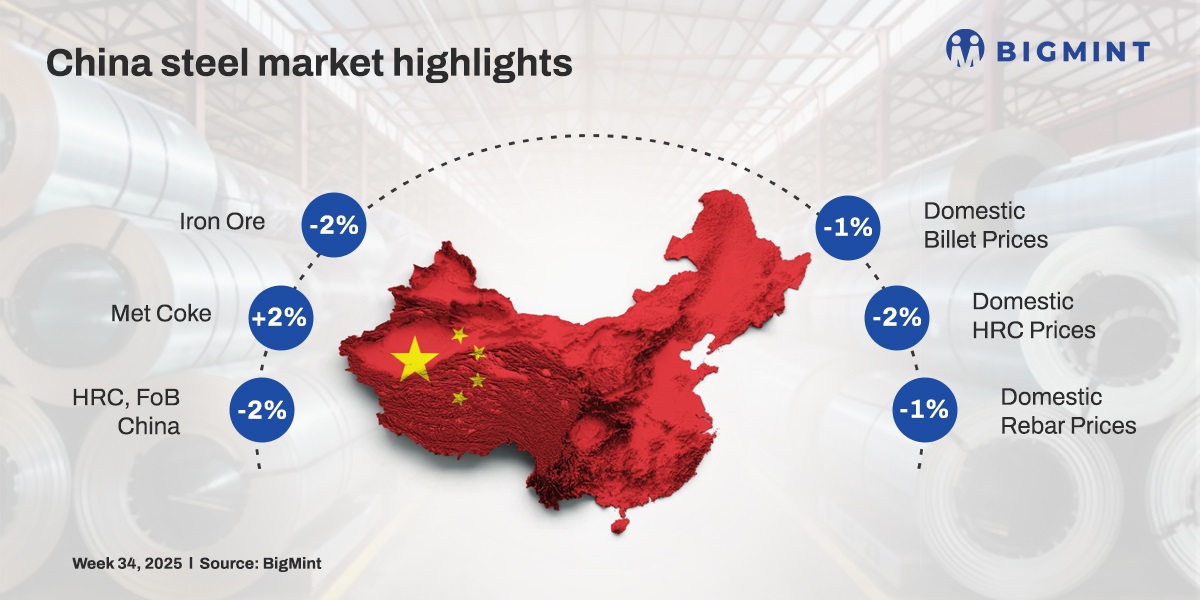
- Rising inventories pull down HRC, rebar prices
- Adverse weather hinders construction activity
China’s steel market exhibited a weaker performance this week, reflecting similar sentiment in the Shanghai Futures Exchange (SHFE). Prices softened w-o-w in both the finished steel and raw material segments. Primarily, the lack of support from the major end-user industries, especially the construction segment, amid adverse weather conditions and the presence of barriers in the global trade platform, added to the pressure on prices.
Updates on steel inventory and production for the first 10 days of August, as per the data released by the China Iron and Steel Association (CISA):
- The total steel inventory at key Chinese enterprises in early-August 2025 stood at 15.07 million tonnes (mnt), stable m-o-m but up by 290,000 tonnes (t) or 2% as compared to 14.78 mnt in late-July 2025.
- The average daily crude steel output of CISA-affiliated mills stood at 2.074 mnt in early-August, up by 4.7% from 1.98 mnt in late-July. Additionally, the same was up by 3.6% y-o-y.
- The average daily finished steel output reached 2.005 mnt in early-August, down by around 4.1% against 2.091 mnt in late-July. However, on a y-o-y basis, the same rose by 9%.
- Average pig iron output stood at 1.914 mnt in early-August, up by 3.2% from 1.856 mnt in late-July. Additionally, on a y-o-y basis, output increased by 3.9%.
1. Iron ore spot prices fell w-o-w: Benchmark iron ore fines spot prices dipped by $2/dry metric tonne (dmt) w-o-w to $100/dmt CFR China on 22 August. Prices fell as portside trades slowed on thin liquidity, with activity centred on medium-grade fines, pressuring spot levels. Trading stayed limited, while demand for October cargoes improved due to restocking ahead of China’s Golden Week. With production easing, mills may scale back spot purchases.
Iron ore inventory at Chinese ports was up by 0.05 mnt w-o-w to 131.1 mnt on 21 August, as per SteelHome data.
a) Spot pellet premiums stand firm w-o-w: The spot pellet premiums for Fe 65%-grade pellets held steady w-o-w at $18.95/t CFR China on 20 August.
b) Spot lump premiums stable w-o-w: The spot lump premiums remained stable at $0.1820/dry metric tonne unit (dmtu) on 22 August.
2. Coking coal prices edge down w-o-w: On 20 August, Chinese producers sought a seventh round of met coke price hikes, but steel mills resisted these amid stable supply, sufficient inventories, and weak margins. On the cost front, Australian premium hard coking coal declined by $4/t w-o-w to $188/t FOB from $192/t in the prior week, reflecting softer buying interest in seaborne markets.
3. Billet prices inch down by RMB 30/t ($4/t): Tangshan billet prices fell by RMB 30/t ($4/t) over the week, closing at RMB 3,030/t ($423/t). SHFE October rebar futures dropped RMB 125/t ($17/t) w-o-w to RMB 3,119/t ($435/t).
Rebar hit a 3-month low earlier in the week before stabilising, while HRC/flat products largely held above RMB 3,400/t ($474/t). Inventories kept rising, reflecting weak demand, although maintenance in northern China provided some supply-side cushion.
Billet exports stayed muted, with mills cautious on offers. However, billet exports may increase to offset domestic rebar weakness.
Raw material prices eased overall: Iron ore slipped to a 2-week low, while coke producers attempted their seventh price hike, though demand remained fragile.
Sentiments were further dampened by fresh US tariff measures and sluggish global trade flows. Looking ahead, participants expect September demand recovery to provide some support, though near-term pressure persists.
4. Domestic HRC prices decrease w-o-w: China’s HRC offers dropped by RMB 60/t ($8/t) w-o-w to RMB 3,220/t ($449/t) against RMB 3,280/t ($458/t), following a drop in SHFE futures. SHFE HRC futures also declined by RMB 68/t ($9/t) w-o-w to RMB 3,351/t ($468/t) on 22 August against RMB 3,426/t ($478/t) on 15 August.
The decline was driven by a rise in inventory levels and higher production volumes, which signalled subdued demand from local construction and manufacturing sectors. Relatively low volatility in the raw material prices helped support the market, preventing sharper declines, yet fundamental weakness persisted. Mill destocking, regional logistical challenges, and slow downstream orders further contributed to price volatility across major Chinese hubs.
However, Chinese HRC export offers decreased by $10/t w-o-w to $485/t against $495/t a week ago. Trade was marked by cautious optimism and underlying market weaknesses.
5. Domestic rebar prices fall w-o-w: China’s rebar prices also fell marginally by RMB 40/t ($6/t) w-o-w to RMB 3,280/t ($458/t) against RMB 3,320/t ($463/t) a week ago. SHFE rebar futures (October 2025 contract) dropped by RMB 67/t ($9/t) w-o-w to RMB 3,116/t ($435/t) on 22 August.
The slump in prices was primarily driven by rising inventories and persistently tepid demand from the construction sector, heavily affected by ongoing high temperatures and rainy weather that curtailed building activity. Most downstream buyers limited their purchases to a just-in-time basis, amplifying the pressure on both mill and social inventories.
Meanwhile, China’s Shagang Steel has kept its rebar and wire rod prices unchanged for late-August 2025 sales, as per sources. Revised prices of rebars, coiled rebars, and wire rods were as follows:
- Rebars (16-25 mm): RMB 3,550/t ($494/t)
- Coiled rebars (8-10 mm): RMB 3,710/t ($517/t)
- Wire rods (6-10 mm): RMB 3,620/t ($504/t)

Outlook
China’s steel market prices may remain under pressure amid the ongoing supply-demand imbalance and cautious market sentiment. Raw material prices, such as iron ore, softened w-o-w, limiting cost support. Production cuts are expected around the September events, primarily the China Victory Day Parade on 3 September 2025. However, any demand recovery in the near term remains modest given subdued construction and manufacturing activity. On similar lines, export offers are also likely to stay range-bound or show some downward movement amid subdued demand in importing countries and the impact of trade barriers.
Leave a Reply