- Govt to announce green steel share in public infra projects
- Premiums to have unequal impact across downstream sectors
- Rising carbon compliance, prices to mitigate impact of premiums
Morning Brief: What is green steel? While there is no globally accepted definition, it is clearly understood as steel with near-zero or very negligible carbon footprint. As current production processes rely on fossil fuels and are emissions-intensive, the production of green steel would require adoption of disruptive technologies to minimise emissions through energy efficiency measures, switching from fossil fuels to low-carbon fuels or zero-carbon fuels such as electrolytic hydrogen, and carbon capture, utilisation and storage.
According to estimates by the Ministry of Steel, the use of renewable energy and energy efficiency measures leads to an increase in the cost of steel production by about 10-15%. Energy efficiency and renewable energy can reduce the emission intensity of steel only by 25% for the BF-BOF process and 30% for the coal DRI-IF process.
Further reduction in emissions intensity is only possible through other decarbonisation options like the use of alternative fuels and CCUS. It is seen that ~56% of the total emissions from the current production pathways can be abated only through CCUS, as per estimates by the ministry.
Green steel premium
So, the premium of low-emissions steel from the BF-BOF pathway will depend on the cost of carbon capture and storage. Similarly, green hydrogen-based steel has a 50-70% premium over conventionally produced steel. This is expected to reduce to 20-29% by 2030, according to the ministry. Therefore, decarbonising steel, by whatever pathway one chooses, calls for significant capital expenditure and investments. So, green steel must have a premium attached.
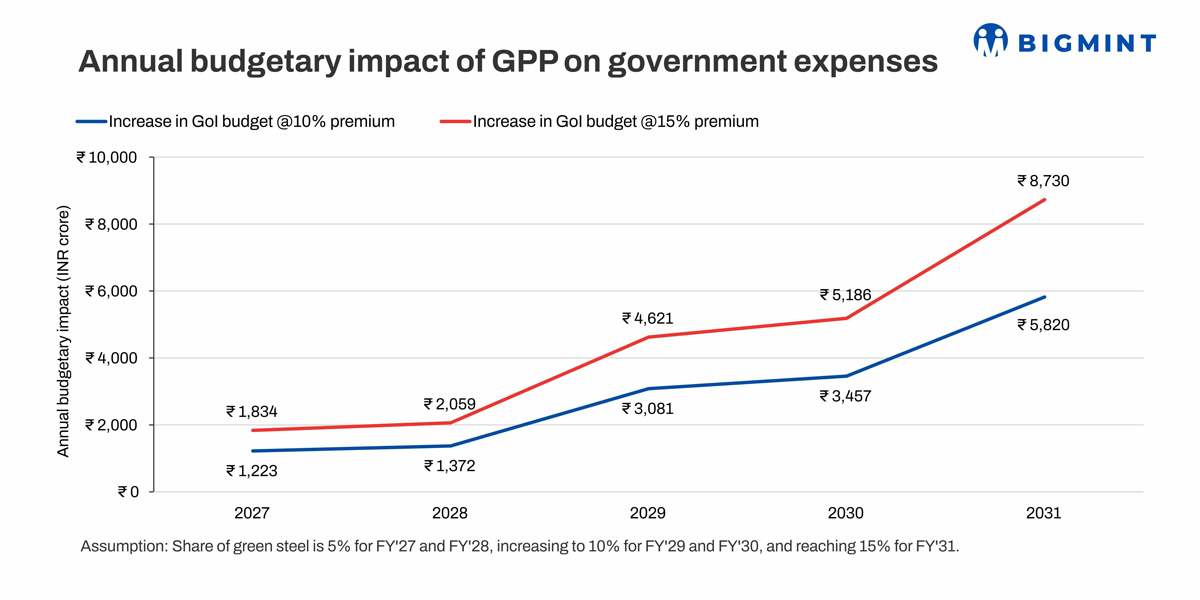
The Ministry of Steel is working on the green public procurement policy (GPPP) and has projected the impact of green steel premiums on the public sector. Assuming that the government slowly increases the percentage share of green steel and other green products such as cement and aluminium in the construction of public infrastructure projects, the total budgetary allocation would correspondingly rise.
Different budgetary models have been designed. However, the impact of green steel premium would depend on the total share of steel use in the different downstream sectors and the cost of steel in each sector. The impact of premiums is expected to be different for the different downstream sectors.
Premium & green demand
Of course, the GPPP is a major step forward in generating demand for green steel in India. The green steel certification scheme spearheaded by the National Institute of Secondary Steel Technology (NISST) is already awarding certifications to low-emission producers, as per the government’s Green Steel Taxonomy.
However, green shoots of demand are also appearing in the private sector. As industry experts pointed out recently at BigMint’s India Ferrous Week (BIFW 2025) held in Kolkata, around 399 companies operating across sectors in India have a net-zero target. This will drive demand for green steel from the engineering, energy, mobility and software and electronics sectors.
In the construction sector, the shift in criteria for green building norms signal a positive transformation in terms of green steel adoption. Kilogram of CO2 per metre square is the yardstick by which construction companies assess their carbon footprint. This will drive demand for CFP reduction per metre square and boost demand for green raw materials.
Moreover, major domestic auto producers such as Tata Motors have announced their net-zero targets. These are positive signals of emerging green steel demand from the private sector.
The emerging carbon market is also expected to drive incremental CO2 reduction measures in the industry to comply with BEE targets for upcoming fiscals. The price of carbon will be a key factor in assessing green steel premium going forward and, as that price slowly surges with the inclusion of more and entities in the compliance cycle, it will automatically mitigate the impact of premiums.
Leave a Reply