- Only 37 out of 138 auctioned mines currently operational
- Unrealistic premiums lead to production delays at auctioned mines
- Regulatory provisions lack legal teeth in dealing with production delays
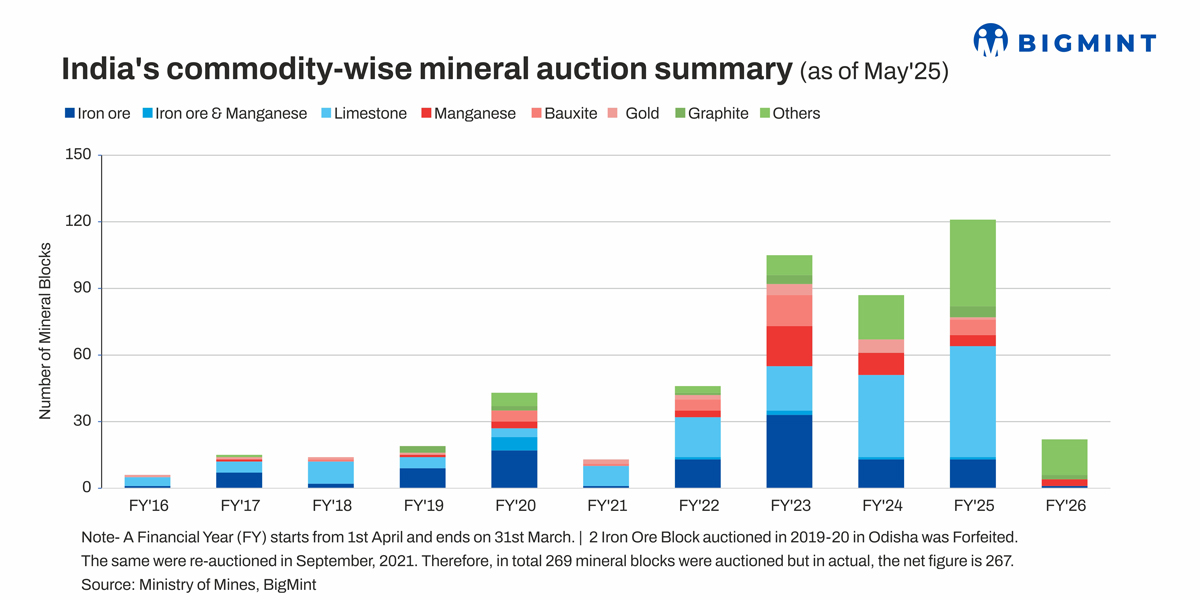
Morning Brief: Auctioned mines constitute about 30% of domestic iron ore production which reached 289 million tonnes (mnt) in FY’25. However, out of the 138 mines auctioned since the amendment of the MMDR Act 1957 in 2015, only 37 have started operations. This is putting immense pressure on iron ore supplies at a time of burgeoning domestic steel capacity, experts observed during panel discussions at BigMint’s India Ferrous Week (BIFW).
Notably, India’s imports of iron ore and high-grade pellets are surging. As per BigMint projections, imports are expected to climb to 20 mnt by FY’30 from 6 mnt in FY’25. Higher imports are a direct consequence of the requirement of higher ore grades by domestic manufacturers and logistical problems and costs within the country. But non-operationalisation of auctioned mines and, particularly, auctioned greenfield mines, is triggering supply concerns which might lead to higher imports going forward, experts observed, while dwelling on the supply scenario in the country.
Delay in mine operationalisation
If India has to reach 300 mnt of production, at least 30-35 mnt of capacity will need to be added annually. However, the burden of auction premiums and higher taxes overall, as well as inordinate delay in issuing of environment and forest clearances by central and state authorities are roadblocks in the path toward operationalisation.
In fact, many mines had expired in Odisha and other states prior to the 2020 mineral auctions which were awarded to new lessees after the auctions. However, bringing greenfield mines into operation has been the biggest challenge. As a result, there has been no improvement in domestic supplies, especially in view of increasing steel capacity. So, while finished steel prices have edged lower over the past year, iron ore prices have stayed firm.
Regulatory vacuum
The operationalisation of auctioned thermal coal mines has also been a challenge. The government has set up scrutiny committees to oversee the fixed timelines for mine operationalisation. This model is sought to be replicated for iron ore, too, as the MMDR Amendment Bill 2025 proposes. However, there is only provision for penalising lessees in case of delay in the form of forfeiture of performance security.
“There is no legal teeth in these regulations as the main onus of operationalising of greenfield mines lies with different government agencies in the Centre and the states. There is no provision in law to make these agencies accountable for delay. Non-performance can directly be attributed to delay in issuing of clearances and land acquisition by government agencies,” said Sauvick Mazumdar, COO, Mining, JSW Steel.
After 2020, and largely due to the expiry of many key leases and loss of production, auction premiums surged, with the average premium post-2020 being around 118%. Before that average premiums were around 50-60%.
“Even if the premium is 100% and 16.8% of royalty and other taxes are added and then production cost, it becomes impossible to run mines in a commercially viable way,” observed Mazumdar.
Repeat of 2020?
Seeking to regulate bidding in mineral block auctions or trying to artificially regulate premiums will go against the ethos of competitive auctions. So, in order to prevent delays in mine operationalisation the government has to crack down on erring miners who purposefully delay production to evade paying high premiums to the concerned state governments, as well as government agencies that can be charged with unacceptable delay in doling out clearances, experts said.
A 2020-like scenario may re-emerge in 2030, cautioned experts, with many legacy mines coming to the end of their life. Just as such a situation had triggered supply concerns and led to astronomical premiums in succeeding auctions, concerns related to tightening of supplies may again lead to unrealistic premiums in auctions.
It is important to ensure that a repeat of 2020 is avoided and the purpose of auctions – maximising domestic iron ore supplies – is upheld rather than maximisation of revenues for the state governments, industry leaders said.
Leave a Reply