- Fixed anti-dumping duty to be imposed for 5 years
- Exporters’ dumping margins calculated at 20-30%
India’s Directorate General of Trade Remedies (DGTR) has recommended an anti-dumping duty of $121.5/tonne (t) on imports of hot-rolled flat products of alloy or non-alloy steel from Vietnam, following the final findings of its investigation, as announced on 13 August 2025. The DGTR has recommended a fixed anti-dumping duty for imports from Vietnam for 5 years.
The outcome marks a decisive development for the Indian steel sector, following months of scrutiny and stakeholder engagement.
Scope, product coverage
The investigation covers hot-rolled flat steel products, both alloy and non-alloy — but not clad, plated, or coated — with a thickness up to 25 mm and width up to 2,100 mm. These products are utilised across core industries, including automotive, oil and gas, capital goods, construction, and engineering. Specifically excluded from this scope are hot-rolled flat products of stainless steel.
Background, process
Triggered by a petition from the Indian Steel Association (ISA), representing key domestic players such as JSW Steel Limited and ArcelorMittal Nippon Steel India Limited, the investigation was formally initiated in August 2024. The period of investigation (POI) was set for 1 January 2023-31 March 2024. The broader injury analysis includes four years prior, from April 2020.
The DGTR followed established procedures, issuing questionnaires to Vietnamese producers and Indian importers, allowing for public submissions and multiple oral hearings. Notably, the investigation also analysed transaction-level import data obtained from official Indian customs systems.
Key findings
- Dumping margin: The DGTR concluded that imports from Vietnam (excluding Hoa Phat Dung Quat Steel JSC) were being dumped at a significant margin, with the calculated dumping margin for non-cooperating producers/exporters ranging between 20-30%. Hoa Phat Dung Quat Steel JSC, however, demonstrated a dumping margin in the range of 0-10%.
- Injury to domestic industry: The authority found clear evidence of material injury to Indian producers, citing declining profitability, suppressed returns on capital employed, and price undercutting by imports from Vietnam.
- Threat of further injury: The report highlights a risk of aggravated injury in the absence of remedial action, given the rapid capacity expansion planned by Vietnamese mills and ongoing trade remedy measures against Vietnamese exports in other major steel-consuming markets.
- Market share and supply: Imports from Vietnam accounted for around 21% of total Indian hot-rolled flat product imports in the POI, even as the domestic industry maintained adequate capacity to meet national demand.

Anti-dumping duty recommendation
In response, the DGTR has recommended a definitive anti-dumping duty for five years, calculated as the lower of the dumping margin or injury margin. The duty applies to all imports of the subject goods from Vietnam except those produced by Hoa Phat Dung Quat Steel JSC, which is exempt due to its low margin of dumping and verified cooperation.
Implications for market participants
Support for domestic prices: The imposition of anti-dumping measures is expected to lend support to domestic flat steel prices, which have experienced downward pressure amid increased imports.
Continued import options: Downstream users retain the option to source flat steel from other countries not subject to the duty, mitigating supply chain risks.
Minimal end-user price impact: The authority estimates the impact on downstream product prices will be negligible — ranging within 0.002-0.5% — countering assertions of significant harm to the consuming industry.
Import trends
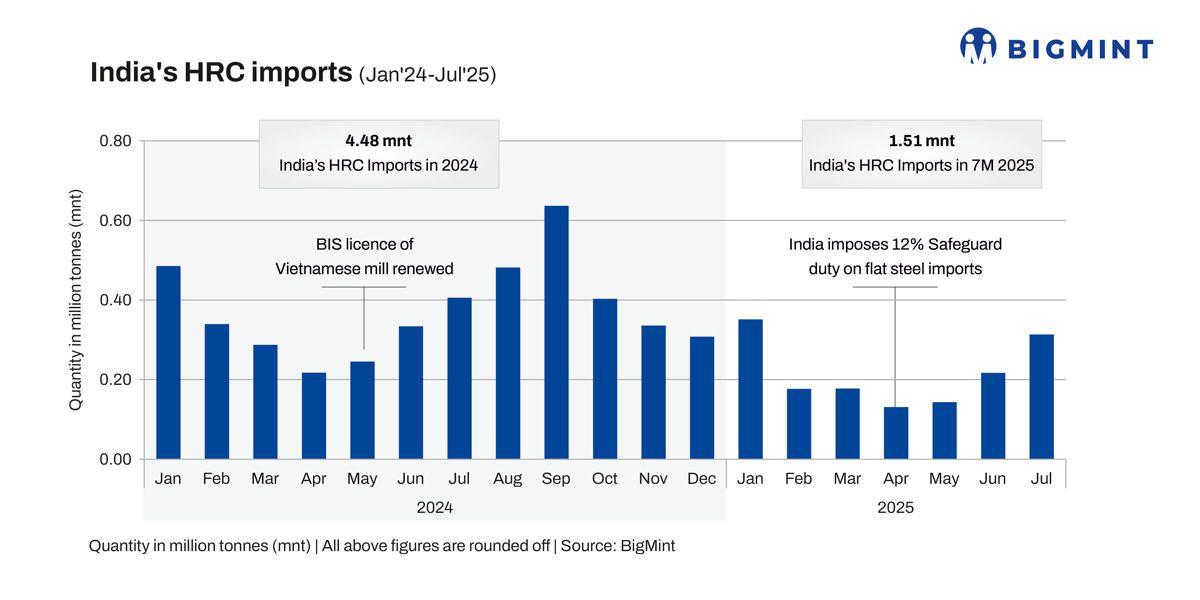
India imported approximately 593,288 t of finished flat steel from Vietnam in CY’24, down by 40% from 988,797 t in CY’23. Moreover, India imported approximately 467,032 t of HRC from Vietnam in CY’24. However, no HRC imports from were recorded for H1CY’25.
Outlook
The recommendation is expected to provide relief to Indian steelmakers facing pricing pressure from low-cost imports, while signalling India’s continued vigilance in using trade remedies to protect strategic industries. At the same time, importers relying on Vietnamese hot rolled coils may face higher landed costs once duties are enforced.
Leave a Reply