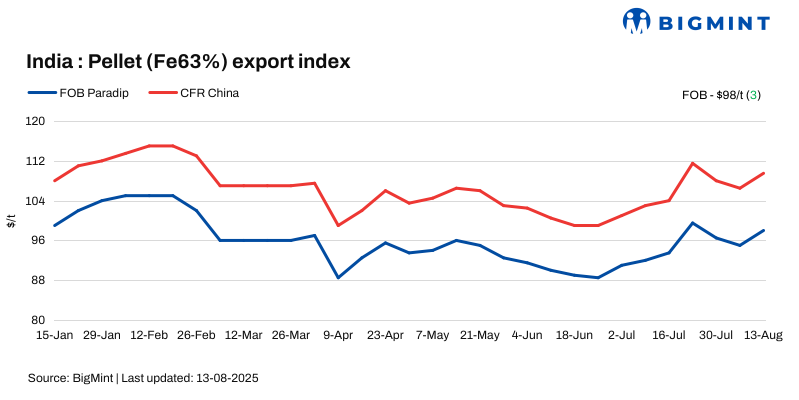
- Muted trade sentiments in export market
- Domestic pellet demand, prices remain strong
Pellet export prices from India witnessed an improvement this week, tracking the rise in global iron ore prices in the seaborne market. However, actual deal activity remained muted as buying interest from overseas markets was limited, with fewer inquiries being reported.
Price update
BigMint’s India pellet (Fe 63%, 3-3.5% Al) export index (FOB east coast) increased by $3/tonne (t) w-o-w to $98/t on 13 August 2025 against 6 August. Notably, no confirmed pellet export deal was reported from India’s eastern coast this week.
Market comments
Market participants highlighted that major Indian pellet exporters adopted a cautious approach toward concluding export deals, as the widened gap between bid and offer levels made transactions unviable. A pellet producer mentioned, “Our production cost has gone up significantly due to higher raw material prices, but the current export realisations do not match the costs.”
Meanwhile, sources noted that strong domestic demand and attractive price levels in India diverted suppliers’ focus away from exports. A trader informed, “Some bulk deals in the domestic market have given better returns, so exporters prefer catering to local buyers rather than competing in a weak export market.”
Adding to the supply constraints, several prominent exporters have refrained from offering in the overseas market, citing raw material shortages. Their pellet plants are currently operating to meet captive and domestic market requirements only.
On the global front, Chinese steelmakers are adjusting production schedules in Tangshan, China’s major steel hub, ahead of the early September military parade. Production curbs aimed at improving air quality have temporarily supported steel prices and triggered some restocking of raw materials, which in turn boosted iron ore prices.
Nonetheless, Indian pellet offers remain unattractive to Chinese mills, who are sourcing cheaper low-alumina material from alternative regions. A prominent exporter said, “Given the price gap and availability of cost-effective cargoes elsewhere, Indian material is not competitive at the moment.”
With the disparity between bids and offers persisting and domestic demand staying strong, market participants expect Indian pellet export deals to remain subdued in the near term.
Domestic vs export gap widens
Domestic prices exceeded export offers by around INR 1,700/t ($19.5/t), narrowing by INR 200-300/t with rise in export prices. Pellet (Fe 63%) prices in Odisha’s Barbil were recorded at INR 8,250/t ($94/t) exw, unchanged w-o-w. Meanwhile, the ex-plant realisation in exports from Barbil rose INR 250/t ($2.5/t) w-o-w to INR 6,550/t ($75/t) exw.
Rationale
- No confirmed deals from India’s east coast were recorded in this publishing window for T1 trade. Thus, this category was not taken into consideration for today’s price calculations and accorded 0% weightage in the index calculation. Click here for the detailed methodology.
- Thirteen (13) indicative prices were received, and ten (10) were considered for the calculation of the index and given 100% weightage.
Factors impacting pellet exports
Chinese iron ore fines prices up w-o-w: The benchmark iron ore fines index rose $2/t w-o-w to $104/t CFR China on 12 August. The uptrend was fuelled by active trading due to the 90-day US-China tariff extension. Firmer steel prices also lifted iron ore tags. Meanwhile, port-stock prices also climbed up with coking coal’s rally, though high rates kept liquidity thin as mills bought only when needed.
DCE iron ore futures firm w-o-w: Iron ore futures on the Dalian Commodity Exchange (DCE) for the January 2026 contract opened at RMB 795/t ($111/t) on 13 August, showing an uptrend w-o-w.
Outlook
According to BigMint’s analysis, the recent bid-offer disparity may weigh on export trade sentiments while prices are expected to remain volatile.

Leave a Reply