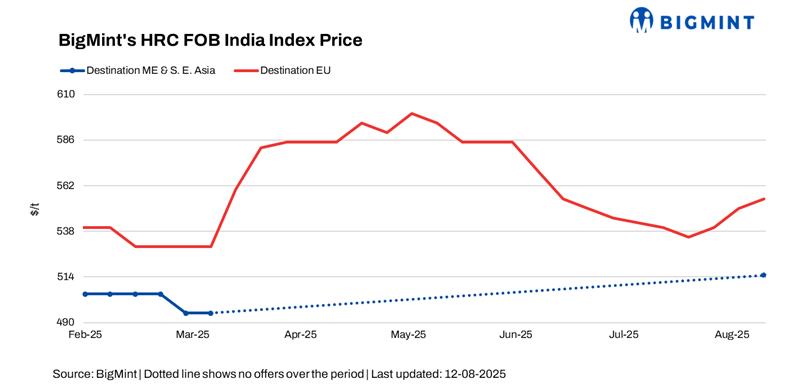
- Indian HRC export offers to EU up w-o-w
- Chinese HRC prices in Middle East rise
BigMint’s India hot-rolled coil (HRC, S275) export index rose by $5/tonne (t) w-o-w to $555/t (FOB main port). The increase in offers was driven by higher tags from global competitors, such as China.
Furthermore, Indian mills resumed HRC (SAE1006) export offers to the Middle East (ME) after a long pause, influenced by increasing Chinese offers. However, a market participant noted, “Sentiment in the Middle East remains sluggish due to the ongoing summer season.”
Despite the increase in prices, domestic demand in the EU remained moderate amid the ongoing summer break in the region. Market participants in the EU are reportedly optimistic about the expected effects of the Carbon Border Adjustment Mechanism (CBAM).
1. Indian HRC export offers to EU rise w-o-w: Indian HRC export offers to the EU increased by $5/t w-o-w to $605/t CFR Antwerp ($555/t FOB main port India) as compared to $600/t CFR Antwerp last week. The EU’s summer holidays led to sluggish market activity and reduced trade volumes. Moreover, buyers remained cautious, hesitant to purchase imports due to concerns over the CBAM’s impact.
2. Chinese HRC prices in Middle East rise: Chinese HRC export offers to the Middle East rose by $5/t w-o-w to $515/t CFR UAE, from $510/t CFR UAE a week ago. Furthermore, Japan’s steelmakers concluded a deal of around 28,000 t at $510-515/t CFR UAE to Dammam for end-October and early-November shipments.
Indian HRC export offers to the Middle East were quoted at around $530-535/t CFR UAE, while no deal was heard concluded.
HRC futures on the Shanghai Futures Exchange (SHFE) surged by RMB 81/t ($11/t) w-o-w to RMB 3,474/t ($483/t) as compared to RMB 3,393/t ($472/t) a week ago. Moreover, d-o-d, futures rose by RMB 38/t ($5/t) against RMB 3,436/t ($478/t).

Outlook
Indian HRC exports to the Middle East resumed, driven by a sharp rise in Chinese prices and decreased Chinese competition. However, European summer vacations and a cautious market outlook are expected to limit demand, with significant restocking unlikely until after the holidays.
Leave a Reply