- Adverse weather hinders construction activity, caps steel demand
- Australian PHCC rises $6/t on firm demand, tight vessel supply
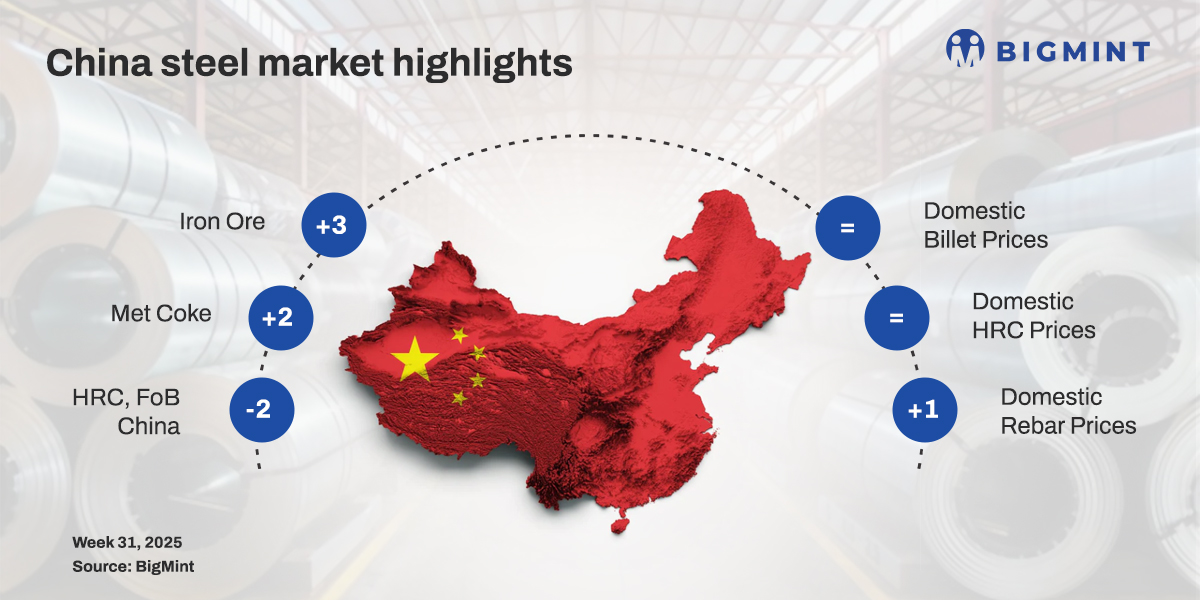
China’s steel market exhibited a mixed performance this week, reflecting similar sentiment in the Shanghai Futures Exchange (SHFE). In the finished steel segment, domestic prices of key products such as hot-rolled coils (HRCs) and rebars registered w-o-w gains. On the raw materials front, prices of iron ore and coking coal also posted an increase over the same period.
1. Iron ore spot prices inch up w-o-w: The benchmark iron ore fines spot price rose by $3/dry metric tonne (dmt) w-o-w to $102/dmt CFR China on 8 August, supported by speculative inflows after a sharp rally in coking coal futures. Medium-grade fines led the gains on steady demand and ahead of the upcoming holidays. Portside prices stayed firm on active buying, with mills preferring high-grade ores and lumps ahead of planned sintering cuts.
Iron ore inventory at Chinese ports fell slightly by 0.2 mnt w-o-w to 130.1 mnt on 7 August, as per SteelHome data.
a) Spot pellet premiums edge up w-o-w: Spot pellet premiums for Fe 65% grade pellets held stable w-o-w at $18.65/t CFR China on 6 August.
b) Spot lump premiums dip w-o-w: Spot lump premiums fell marginally to $0.1790/dmtu on 8 August.
2. Coking coal prices edge up w-o-w: China’s high imported coking coal prices led to cost pressure on steel producers, while the met coke market stayed firm after a fifth consecutive domestic price hike, with Rizhao FOB up RMB 50/t w-o-w to RMB 1,370/t. Shanxi, Shaanxi, and Inner Mongolia plants ran at 70-80% of their capacity, supported by low inventories and strong steel demand. In the seaborne market, Australian premium hard coking coal (PHCC) rose $6/t w-o-w to $183/t FOB on firm Asian demand and tight vessel supply, sustaining high import costs for Indian buyers.
3. Billet prices inch down by RMB 20/t ($3/t) amid weak demand: Steel billet prices in Tangshan fell by RMB 20/t ($3/t) w-o-w to RMB 3,070/t ($427/t, including VAT) as of 8 August. The week began with a sharp drop on 4 August, before a mid-week rebound pushed prices to RMB 3,100/t ($432/t). The recovery was supported by a rally in coking coal futures – driven by rumours of production controls – which lifted steelmaking costs and improved sentiment.
However, towards the weekend, prices slipped again as sluggish demand and steady raw material costs weighed on buying activity. Mills focused on output cuts rather than raising finished steel prices, capping any sustained uptrend.
4. Domestic HRC prices increase w-o-w: China’s HRC offers inched up by RMB 10/t ($1/t) w-o-w to RMB 3,250/t ($453/t) against RMB 3,240/t ($451/t), following the rise in SHFE futures. SHFE HRC futures edged up by RMB 13/t ($2/t) w-o-w to RMB 3,421/t ($477/t) on 8 August against RMB 3,408/t ($475/t) on 1 August.
However, Chinese HRC export offers decreased by $10/t w-o-w to $480/t against $490/t a week ago. Chinese HRC exports remained slow this week, as sharply higher prices dampened buying interest in the global market.
5. Domestic rebar prices rise w-o-w: China’s rebar prices were up marginally by RMB 20/t ($3/t) w-o-w to RMB 3,290/t ($458/t) against RMB 3,270/t ($455/t), a week ago. SHFE rebar futures (October 2025 contract) remained range-bound w-o-w at RMB 3,215/t ($448/t) on 8 August. China’s rebar prices rose despite weak demand and falling futures prices, as adverse weather conditions, including heavy rainfall and high temperatures, hindered construction activity and reduced end-user demand.

Outlook
China’s steel market may remain under pressure in the near term as adverse weather continues to disrupt construction activity, curbing demand for finished steel. While iron ore and coking coal prices show strength on speculative and supply factors, weak downstream consumption and muted export orders are likely to limit significant price gains in the coming weeks.
Leave a Reply