- Manufacturing PMI hits 14-month high in June
- Coal production drops 7% amid monsoon disruption
- Auto sales may see sustained growth ahead of festive season
Morning Brief: The Indian economy continued to show resilience in June 2025, with all key macroeconomic parameters pointing to sustained growth momentum in sync with the RBI’s forecast of 6.5% GDP growth in 2025-26 despite global headwinds and increasing trade frictions with major countries such as the US.
Notably, the manufacturing PMI rose to a 14-month high in June even as the Index of Industrial Production (IIP) edged up, led by manufacturing and capital goods, reflecting healthy investment activity. WPI inflation continued to fall, reaching a 15-month low of -0.1%, driven by a decline in food and fuel prices. CPI inflation, on the other hand, eased to a 6-year low of 2.1% in June.
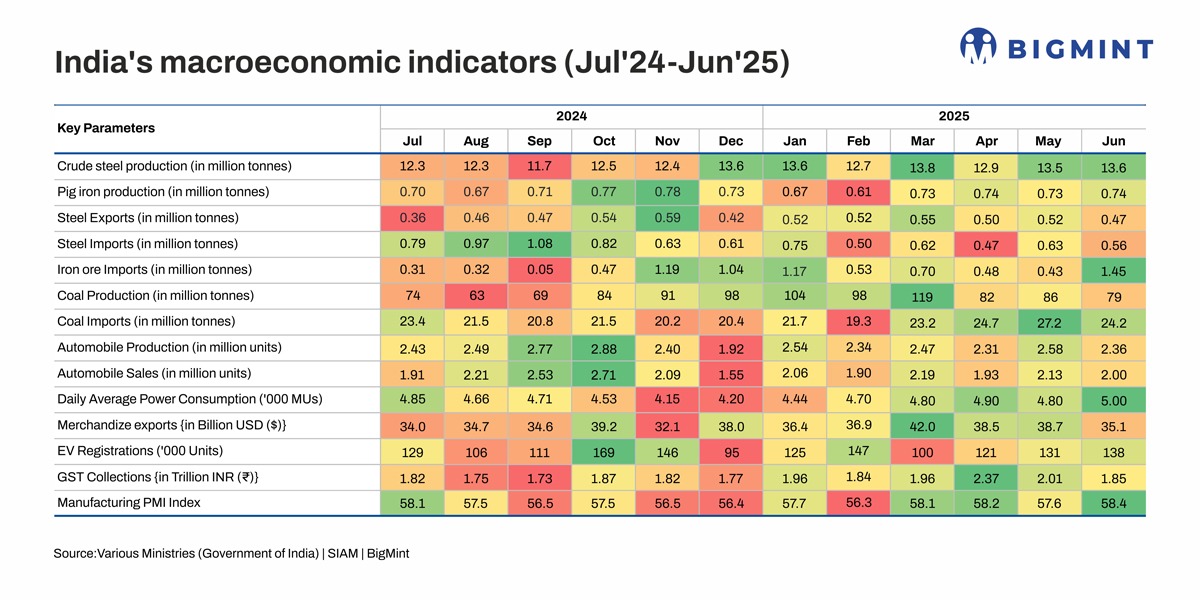
BigMint tracks key economic indicators:
Crude steel output rises m-o-m: India’s crude steel production stood at 13.55 mnt in June, a marginal increase from 13.54 mnt recorded in May. Provisional figures released by the Ministry of Steel show that crude steel production in the April-July period of the current fiscal increased by an impressive 11% y-o-y to over 54 mnt. Similarly, finished steel production rose by 8.8% y-o-y to over 51 mnt.
Steel consumption, on the other hand, also recorded a marginal m-o-m growth in June. Consumption was recorded at 13.178 mnt in June, an increase of 0.7% m-o-m.
Pig iron production, too, posted marginal growth in June compared with May. India’s pig iron production has increased significantly compared to last year, thanks to new mills coming on stream. Government data show that pig iron output in the April-July period increased by over 10% y-o-y to nearly 3 mnt.
Steel imports dip but India still net importer: India’s steel imports in June dropped 11% m-o-m to 0.56 mnt from 0.63 mnt in May. However, exports also fell by nearly 10% m-o-m to 0.47 mnt. Therefore, India remained a net steel importer in June despite the pace of imports falling significantly y-o-y.
India was a net steel importer in H1CY’25, with the trade deficit standing at 0.7 mnt, up from 0.3 mnt in H1CY’24. Steel exports were affected due to weakened global demand, geopolitical conflicts and disruptions in logistics, competitive export prices offered by China and tariff-related uncertainties.
Imports fell 14% y-o-y in H1 to 4.4 mnt, with the provisional 12% safeguard duty succeeding in halting arrivals.
Iron ore imports up sharply: India’s imports of iron ore and pellets increased manifold in June, reaching 1.45 mnt compared with just 0.43 mnt in May. Imports hit a multi-year high in June due to competitive prices of high-grade material from the Middle East amid declining global iron ore prices as well as paucity of premium grades in the domestic market. Supply bottlenecks in key production hubs and high inland freight costs, too, were major factors boosting imports.
Coal production, imports edge down: Coal production in the country fell by over 7% m-o-m in June to 78.9 mnt from over 86 mnt in May. In June, CIL, SCCL and captive and other mines registered a negative growth of 8.47%, 6.17% and 0.39% by producing 57.75 mnt, 5.17 mnt and 16.06 mnt of coal respectively, as per MoC data. CIL subsidiaries, especially CCL and BCCL fell way short of their targets for the month.
The decline in production was largely due to heavy monsoon rainfall in different parts of the country, which affected mining and logistics operations.
Coal imports, however, dropped m-o-m in June despite shrinking domestic production and dispatches, although dispatches fell at a slower pace compared with production. This signals a continued trend of lower coal imports on strong domestic supply fundamentals and sufficient stocks at power plants.
Coking coal imports, too, fell marginally in June to below 5 mnt due to subdued domestic steel market sentiments amid shrinking producer margins and decline in steel prices and profits.
Auto output, sales drop m-o-m: Total automobile production in the country decreased to 2.36 million units (MU) in June from 2.58 MU in May. Similarly, sales dropped to 2 MU from 2.13 MU in May.
Production was moderated as manufacturers aligned output with softer retail sales, especially in PV and 2-wheeler segments. Higher inventory levels prompted controlled production schedules despite stable exports.
On the other hand, passenger vehicle and two-wheeler sales dropped due to high base effect, uneven monsoon onset, and subdued rural purchasing power. Tractor sales, however, improved with early kharif sowing and better farm income outlook.
EV registrations increase: Electric Vehicle (EV) registrations in June increased compared to May. Notably, registrations surged 43% y-o-y due to favourable state incentives, expanding charging infrastructure, and rising consumer acceptance, especially in the two-wheeler and fleet segments.
Daily average power demand edges up: Daily average power consumption in June increased to the highest monthly level in the last one year of 5 MU on higher industrial production and demand. Power demand remained strong, driven by summer cooling needs, robust industrial activity, and higher commercial usage. Seasonal peak demand supported steady load factors for utilities.
Merchandise exports down m-o-m: Merchandise exports dropped m-o-m to $35.1 bn. While exports held steady, global demand uncertainty and softer commodity shipments capped growth. Engineering goods and electronics provided some offset to weaker textiles and gems and jewellery exports.
GST collections drop: GST collections fell to a 4-month low of INR 1.85 lakh crore, mainly due to lower IGST from reduced imports and a higher base effect from record highs seen last year, though domestic compliance remained healthy.
Manufacturing PMI shows strong positive sentiment: Manufacturing PMI hit a 14-month high in June on the back of robust export orders, improved supplier performance, and softer input cost pressures, signalling continued expansion in manufacturing activity.
Outlook
The Indian economy maintained a strong growth momentum in July. The manufacturing sector showed a solid performance in July, with the HSBC India Manufacturing Purchasing Managers’ Index (PMI) rising to a 16-month high of 59.1, up from 58.4 in June. The Central government’s gross revenue from the Goods and Services Tax (GST) grew to INR 1.96 lakh crore in July, up 7.5% from collections in July last year, and 6% higher than the collections in June.
While steel production and consumption are expected to post robust growth on strong fundamentals, iron ore imports reached a multi-year high in July, as per BigMint data. Moreover, finished steel imports, though up m-o-m, plunged 36% y-o-y in July.
Auto production and sales showed marginal growth, pointing to the possibility of a sustained recovery ahead of the festive season.

Leave a Reply