- Exports to Japan up 3.5%, China boosts intake
- Port-wise volumes mixed amid shifting buying trends
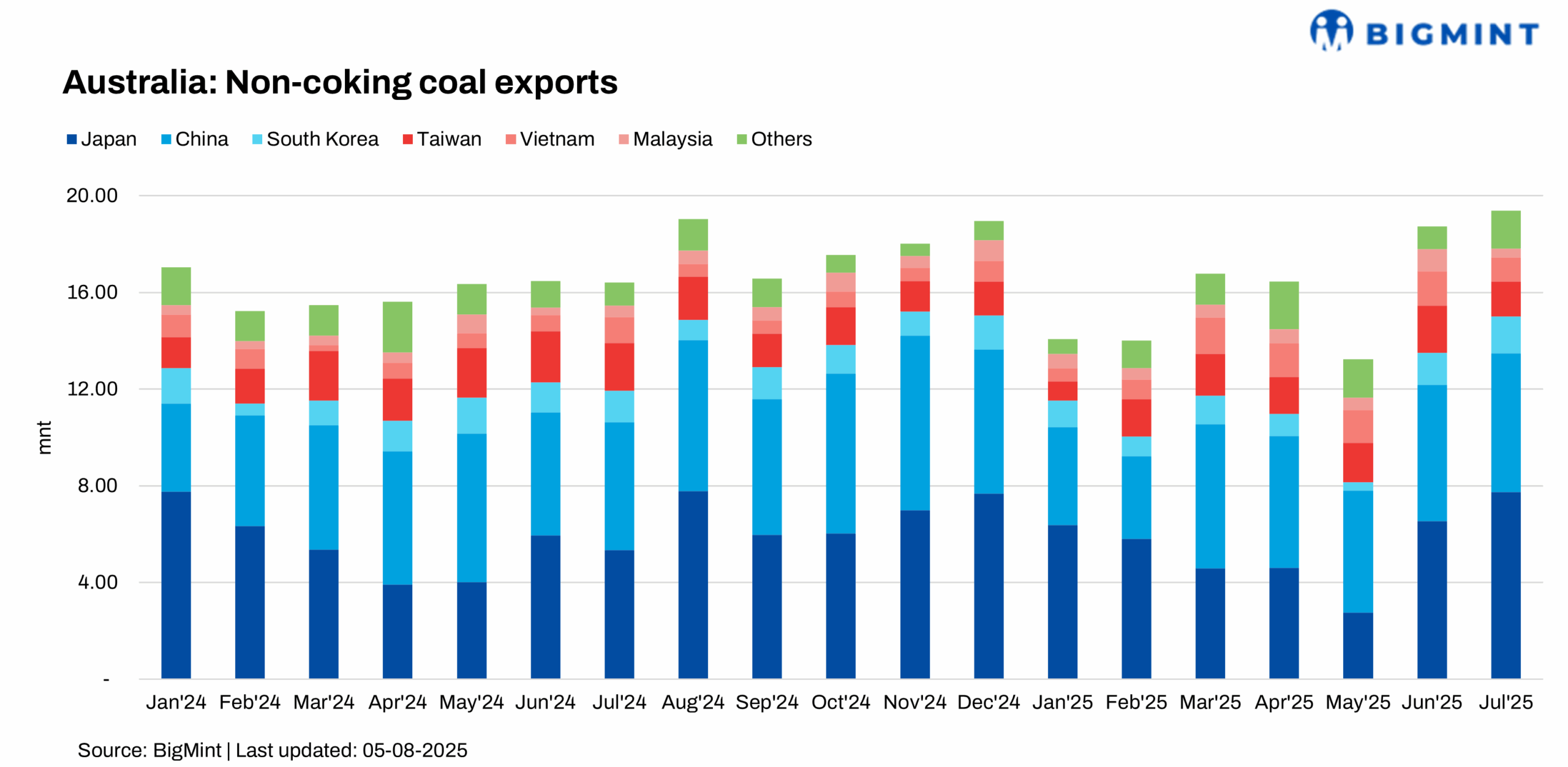
Australia’s non-coking coal exports registered a notable rise in Jul’25, reaching 19.4 million tonnes (mnt), marking a 3.5% increase from 18.74 mnt in Jue’25. On a y-o-y basis, the growth was even more substantial at 18.1%, compared to 16.4 mnt exported in Jul’24.
The growth largely reflects a recovery in demand from key Asian markets, reaffirming Australia’s position as a key supplier of thermal coal in the region.
Asian demand drives export growth despite divergence in import trends
The overall rise in exports during July was underpinned by increased buying from major Asian economies, though import trends remained mixed across the region. Japan, Australia’s top non-coking coal buyer, raised its imports by 18.2% m-o-m, reaching 7.74 mnt, reflecting strong summer demand and steady power sector requirements.
China also recorded a marginal 1.7% increase in intake at 5.73 mnt, supported by stock replenishment amid domestic logistical constraints. South Korea’s imports surged significantly by 17.7% to 1.54 mnt, likely aided by lower Australian coal prices and increased power demand during the peak summer season. In contrast, other Asian buyers scaled back their purchases.
Malaysia recorded the steepest monthly decline of 59.4%, with imports dropping to 0.37 mnt, possibly due to higher inventories and reduced spot demand. Vietnam’s intake fell by 29.5% to 1 mnt, and Taiwan’s imports declined by 27% to 1.43 mnt, indicating a broader regional recalibration of procurement strategies.
Port performance reflects export realignment
Export volumes across Australia’s key coal ports displayed mixed performance, mirroring the variability in destination-wise demand. Newcastle Port, the country’s largest coal export hub, handled 13.29 mnt during July, down 2.7% from June, suggesting logistical constraints or shifting vessel schedules.
Dalrymple Bay Coal Terminal (DBCT) saw a sharper decline of 21.2%, falling to 1.15 mnt. Similarly, Brisbane Port and Port Kembla recorded declines of 6.7% and 53.4%, respectively.
Conversely, Gladstone Port saw robust growth, with exports rising 34.7% to 1.88 mnt, supported by increased shipments to East Asian markets. Abbot Point posted the strongest performance, with a 76% m-o-m increase to 2.36 mnt, potentially reflecting redirection of cargoes and better weather and port handling conditions.
Outlook
Australia’s non-coking coal exports are expected to remain stable, supported by demand from Japan and South Korea. However, weaker intake from other Asian buyers and mixed port performance may limit growth, keeping the near-term outlook cautiously optimistic.

Leave a Reply