- NEA’s crackdown finds limited overproduction across major regions
- Thermal coal supply to see only minor disruptions from inspections
Mysteel Global: Most thermal coal mines in China’s key producing regions maintained disciplined production during this year’s first half, the results of a new Mysteel survey show. The study was conducted amid market fallout from the recent National Energy Administration (NEA) announcement of a crackdown on coal overproduction.
Last week, the NEA issued a notice formally launching an inspection campaign in eight coal-producing regions whose purpose, it warned, was to identify and penalise any coal mine whose monthly output had exceeded its approved capacity by more than 10% during the first half of the year. Mines found in violation must immediately suspend operations for rectification and will not be permitted to resume production until further inspections show corrective measures are in place.
News of the campaign quickly raised concerns that domestic coal supply could potentially be impacted, as it was during Beijing’s supply-side structural reform movement starting in 2016, when several hundred million tonnes (mnt) of outdated mining capacity were eliminated over subsequent years at a cost of supply disruption.
To identify how large the impact might be this time, Mysteel conducted a survey last week, whose findings turned out to be quite surprising.
In Inner Mongolia, northern China, Mysteel surveyed 141 operational thermal coal mines, among which only 11 had received official notices requiring self-inspections. According to surveyed miners, overproduction was rare in the first half of the year, as most mines had aligned output with sales amid the softening market trend for steam coal during the period.
Similarly, only two out of 42 surveyed mines in neighbouring Shanxi province responded that they had received such notices. Most mining firms maintained that they had operated within their approved capacity during H1. As of 25 July, only one among the surveyed mines had suspended production due to a longwall face change, while four had scaled back output due to poor underground conditions, leaving overall supply largely unaffected.
In Shaanxi, northwestern China, 56 of the 100 surveyed mines acknowledged receiving orders to conduct self-inspections. Only a few admitted to producing beyond their approved capacity during H1, confirming that they were currently in communication with authorities, though specific penalties were yet to be finalised.
Most surveyed mines in Shaanxi reported compliant operations in H1, with the inspection notice having little impact on them, the survey results showed. Currently, most in the region are operating normally, aside from occasional suspensions for safety checks and longwall face changes, Mysteel Global understands.
Meanwhile, all 30 sampled mines in Xinjiang, northwestern China, received notices to conduct self-inspections, though no on-site inspections by authorities have been reported so far. Some miners noted that their H1 production even fell short of approved capacity due to weaker prices and thin profit margins, suggesting the NEA’s campaign is unlikely to significantly affect regional supply.
Based on the responses from miners in the four producing regions, Mysteel expects most coal mines to produce as scheduled during the current half, with the result that the severity of any supply reduction caused by this campaign could be limited. However, it noted that recent strong rainstorms and safety checks may slow the y-o-y growth in July’s coal production.
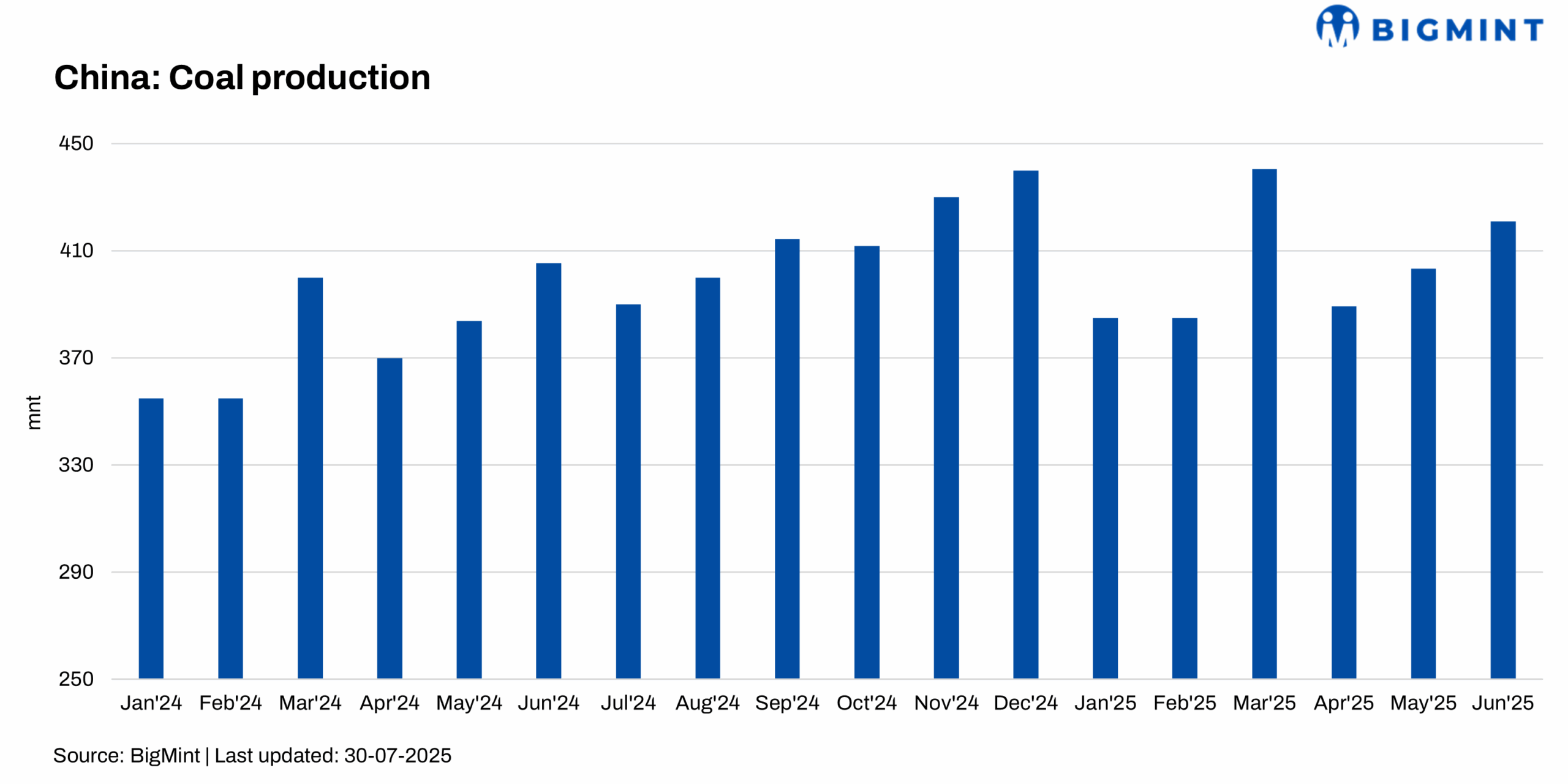
During this year’s January-June half, China’s raw coal production reached 2.4 billion tonnes, a 5.4% rise compared with the same period last year, the National Bureau of Statistics data showed. The top four regions accounted for 81.1% of the national total.
Note: This article has been written in accordance with a content exchange agreement between Mysteel Global and BigMint.
Leave a Reply