- Over 5.5 mnt of steel production currently ‘green’, as per govt’s taxonomy
- Green procurement policy, CCTS to translate into monetary benefits
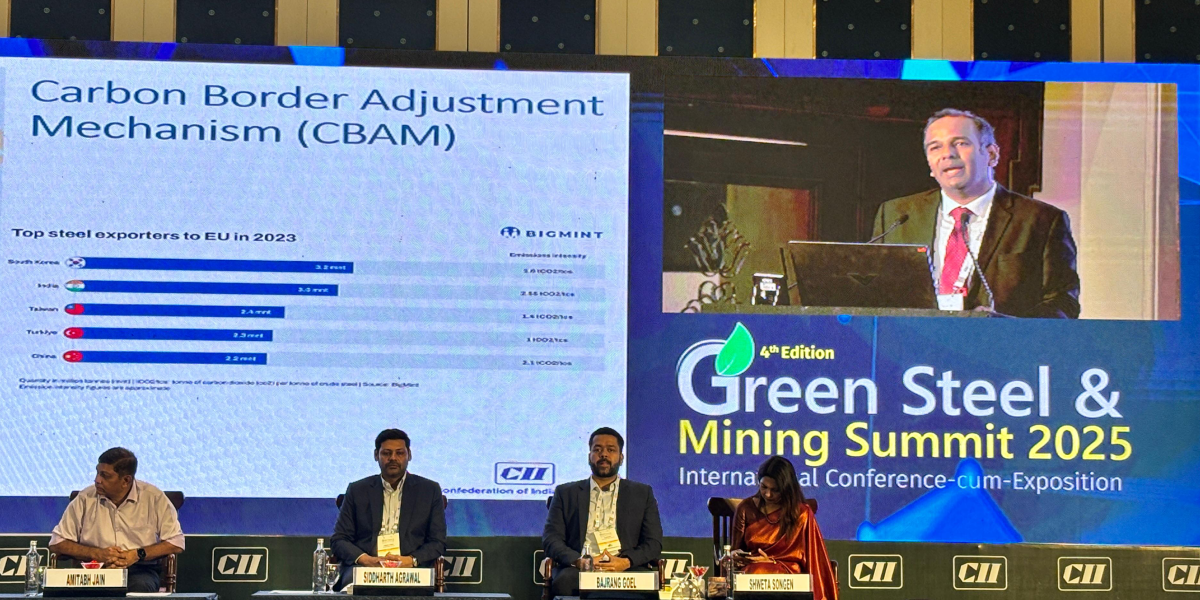
The secondary steel sector in India, which forms around 40% of the country’s total steel production of over 150 million tonnes (mnt), is uniquely positioned to reap benefits from the government’s green steel taxonomy and star-rated classification system for low-carbon emissions steel, averred experts at the 4th edition of CII’s ‘Green Steel & Mining Summit 2025’ held in Raipur, Chhattisgarh, on 28 July 2025.
Analysing data from the BEE’s draft notification of the emerging Carbon Credit Trading Scheme (CCTS), CII’s Deputy Executive Director, P.V. Kiran Ananth, said that although the integrated steel producers are at a comparative disadvantage in terms of their CO2 footprint, many secondary players in different regions of the country, and especially Chhattisgarh, have far lower CFP compared to the ISPs.
GPP to drive further emissions cuts
The government is purportedly working on a green public procurement (GPP) scheme to drive sustainable steel production in the country and is developing a policy to procure a fixed share of green steel (according to the classification system) for public infrastructure projects.
Naturally, steelmakers with lower emissions would make the cut, as per the government’s star-rated classification system.
The numbers reveal an interesting reality: despite their advanced technologies, processes and systems, the integrated producers are at a distinctive disadvantage compared to scores of smaller producers in the secondary steel sector.
This is because steel production through the electric route, especially for producers that have access to renewable electricity, ferrous scrap, or high-grade virgin raw materials is far lower in emissions intensity compared to BF-BOF technology.
32 low-emissions producers
Notably, as many as 32 steel secondary steel units in the country, with cumulative production of over 5.6 mnt in the current financial year, have emissions below 1.6 tCO2/tfs or within 1.6-2.2 tCO2/tfs (tonne of finished steel). Out of these, three are already eligible for 5-star rating (below 2.2 tCO2/tfs), 15 for 4-star and 14 for 3-star rating, according to CII’s presentation.
What’s more, by financial year 2026-27, cumulative steel production of over 14 mnt will be in a position to be classified as green steel (as per the government’s classification system). Interestingly, while currently none of the ISPs feature in the list of low-emissions producers, by FY’27, at least one steel major will be included in the 3-star category, with emissions reaching below 2.2 tCO2/tcs.
Outlook
Green public procurement, largely of long steel products used in construction and infrastructure, will be based on a percentage share of low-carbon steel sourcing. The secondary steel producers with low emissions profile, particularly those with easy access to scrap or renewable power, are expected to gain a major advantage in this regard.
The majority of the secondary steel units in India were not part of the BEE’s successive Perform, Achieve and Trade (PAT) cycles and the Ministry of Steel is working to include them in the emerging CCTS.
Therefore, government procurement apart, low-emissions producers in the secondary sector will now get a direct opportunity to derive monetary benefits from lower emissions and a stronger ESG profile.
Leave a Reply