- Pre-monsoon stockpiling boosts domestic demand
- Scrap inflows pick up on QCO compliance issues
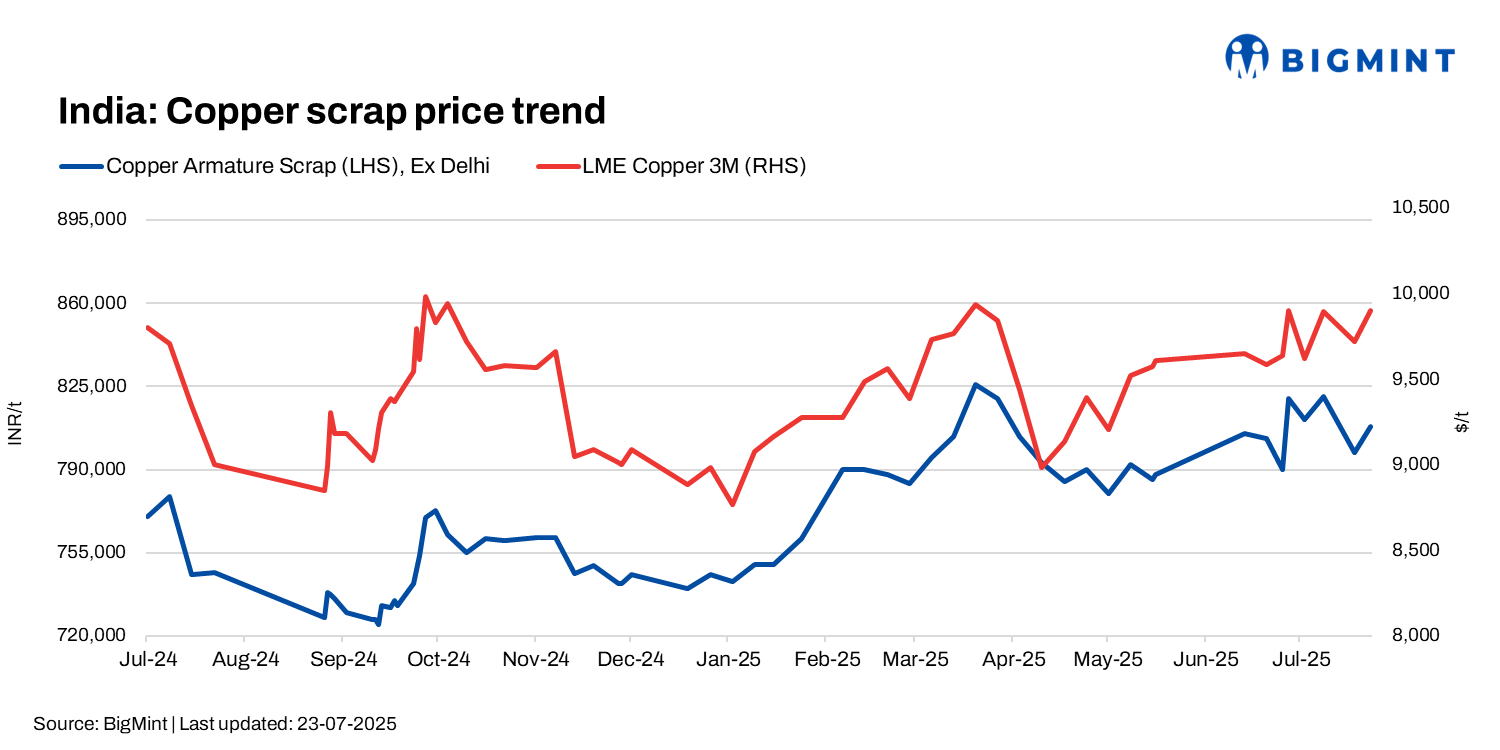
Indian copper scrap prices inched up w-o-w, as London Metal Exchange (LME) futures rose by a minor 3% w-o-w to $9,877/tonne (t), supported by persistent supply constraints and growing uncertainty over potential US import tariffs. However, futures remained lower than the three-month high of $10,005/t recorded on 3 July, and this downtrend from early-July highs pressured domestic prices somewhat.
Copper armature scrap was assessed at INR 808,000/t ex-Delhi, up by 0.4% w-o-w, while USA motors mix stood at $1,170/t, up by $20/t.
Secondary continuously cast rods (CCRs) (99.90%) were assessed at INR 870,000/t ex-Delhi, up 0.9% w-o-w. Meanwhile, primary CCR prices stood at INR 900,000/t, up 1.1% w-o-w.
Copper scrap imports rise 25% m-o-m
According to BigMint’s assessment, India’s copper scrap imports rose sharply by 25% m-o-m in June 2025 to 42,620 t from 34,130 t in May. The jump reflects continued substitution for refined copper, driven by regulatory hurdles and firm downstream demand.
The increase reflects strong and sustained demand from wire and cable manufacturers, who continue to prioritise scrap due to its cost advantage and availability. Additionally, delays and compliance issues stemming from the Quality Control Order (QCO) have kept refined copper inflows in check, further boosting scrap substitution.
Domestic market sees strong demand
Scrap grades such as armature and cable and CCR rods remained in active demand across major trading hubs such as Delhi, Ahmedabad, Chennai, and Bhavnagar, with prices generally holding steady or increasing modestly despite minor day-to-day fluctuations.
Pre-monsoon stockpiling and expectations of a post-monsoon price uptick encouraged buying, although monsoon-related logistical challenges limited spot availability temporarily, especially for premium scrap grades such as Millberry and Berry.
India is on track to become one of the fastest-growing copper scrap consumers in the Asia Pacific. Domestic scrap generation alone will be insufficient to meet demand, necessitating growing imports. By 2030, India’s scrap demand is expected to soar substantially, fuelled especially by the expansion of electric arc furnace (EAF) steelmaking and green infrastructure projects. Industry estimates project that India may need to import up to 30 million tonnes (mnt) of scrap annually by 2030 to fill the growing supply gap.
Outlook
Despite the monsoon season, India’s copper scrap market has remained relatively firm, supported by steady demand from key downstream sectors such as wire and cable manufacturing. High-grade materials such as Berry and Millberry continue to attract buying interest, buoyed by tight refined copper availability. However, broader trading activity may see intermittent slowdowns due to seasonal factors, with a more pronounced recovery expected post-monsoon.
Leave a Reply