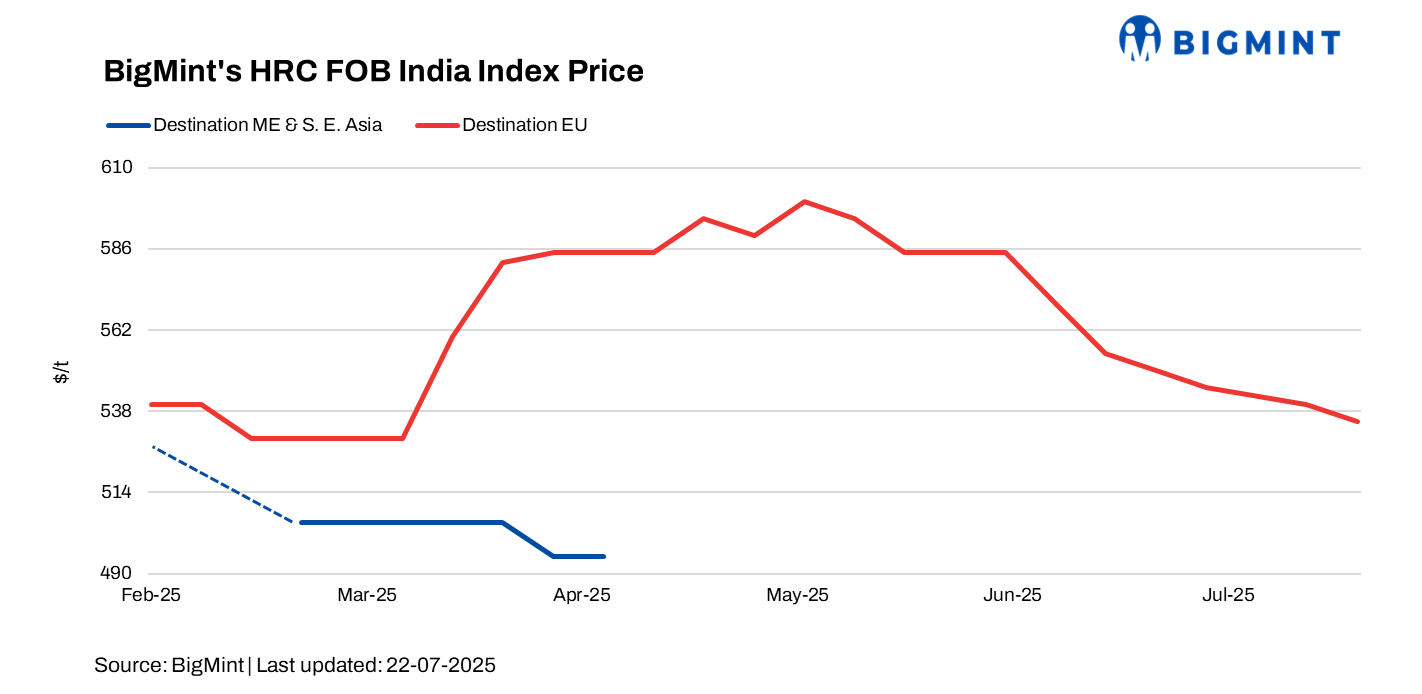
- EU buyers exercise caution, citing high Indian offers
- Chinese steel tags hit 4-month peak on output curbs
BigMint’s India hot-rolled coil (HRC, S275) export index fell by $5/tonne (t) w-o-w to $535/t (FOB main port) due to weak demand amid Europe’s summer break. Meanwhile, Indian mills continued to avoid actively offering to the Middle East amid stronger domestic prices and competitive offers from China.
1. Indian HRC export offers drop w-o-w: Indian HRC export offers to the EU dropped by $5/t w-o-w to $585/t CFR Antwerp ($535/t FOB main port India) as compared to $590/t CFR last week, amid sluggish demand. According to BigMint’s sources, buyers remained cautious, citing current offers as uncompetitive. Moreover, the ongoing summer holidays in Northern Europe further dampened inquiries. Buyers chose to stay on the sidelines, waiting for clearer market direction following the summer break in the EU.
2. Chinese HRC offers to Middle East rise w-o-w: Chinese HRC (S235 and S275) export offers to the Middle East rose by $15/t w-o-w to $490/t CFR UAE as compared to $475-480/t a week ago. Moreover, a Middle East-based tube maker booked around 13,000 t of HRCs from China at $480-485/t for end August-early September shipments. Furthermore, a re-roller in the Middle East reportedly secured around 25,000 t of HRCs from Japan at $488/t CFR UAE for October shipments.
Steel prices in China rose sharply to a four-month high, driven by the government’s plans to control production capacity and eliminate outdated steel facilities. This policy announcement boosted prices, alongside the start of key infrastructure projects. As a result, domestic HRC prices rose, and export offers climbed up in tandem.
HRC futures on the Shanghai Futures Exchange (SHFE) surged by RMB 122/t ($17/t) w-o-w to RMB 3,381/t ($471/t) as compared to RMB 3,259/t ($454/t) a week ago. However, d-o-d, contracts remained stable.

Outlook
India’s steel exports are expected to face near-term challenges due to weak demand from Europe’s summer break, leading to a wait-and-watch approach by buyers. However, rising Chinese offers in the global market could create opportunities for Indian mills to reassess their pricing strategy.
Leave a Reply