- Raw material prices firm up, support billet tags
- Finished steel demand remains weak in Raipur
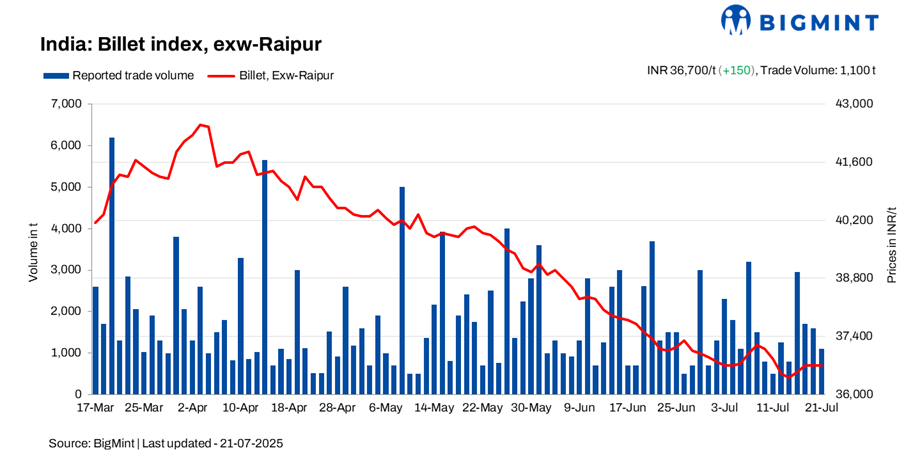
BigMint’s billet index increased by INR 150/tonne (t) d-o-d, settling at INR 36,700/t exw-Raipur on 21 July 2025. The upward trend was primarily driven by continued raw material cost pressure, even as buying activity in the semi-finished steel segment remained subdued.
Spot offers in the billet market moved up slightly, supported by firming up of iron ore and sponge iron prices. However, finished steel demand stayed subdued, with a significant gap between billet procurement and finished steel sales.
Commodity snapshots
- Rebar: Prices stayed range-bound amid cautious sentiments.
- Wire rod: Prices dropped by INR 100/t with approximately 1,600 t of deals concluded.
- Sponge iron: Prices increased by INR 150/t backed by supply tightness and rising input costs.
The conversion spread from sponge iron (PDRI) to billets in the Raipur induction furnace steel hub narrowed further to INR 12,850/t, squeezing margins of producers due to rising input costs.
Rationale
This index is derived based on transactions, offers, bids, and indicative price data sets. Transactions are considered T1 and given a weightage of 50%, whereas other data sets are considered as T2 and given a weightage of the balance 50%.
- Transactions (T1) – One trade at INR 36,700/t were recorded during the 2:30 pm to 5:30 pm BigMint trading window and conesidered for final price calculation as T1 inputs. The average of these transactions was INR 36,700/t, which was given a 50% weightage in the final price calculation.
- Other price indicators – bids/offers/indicatives (T2) – Twelve offers were reported in the trading window and considered as T2 inputs. The average price of these twelve was INR 36,725/t and given a 50% weightage in the final price calculation.
The final price of billets was INR 36,712/t exw-Raipur, rounded off to INR 36,700/t exw.
Click here for detailed methodology


Leave a Reply