- PV sales hit 2-year low in Jun’25
- Supply chain issues challenge auto production outlook
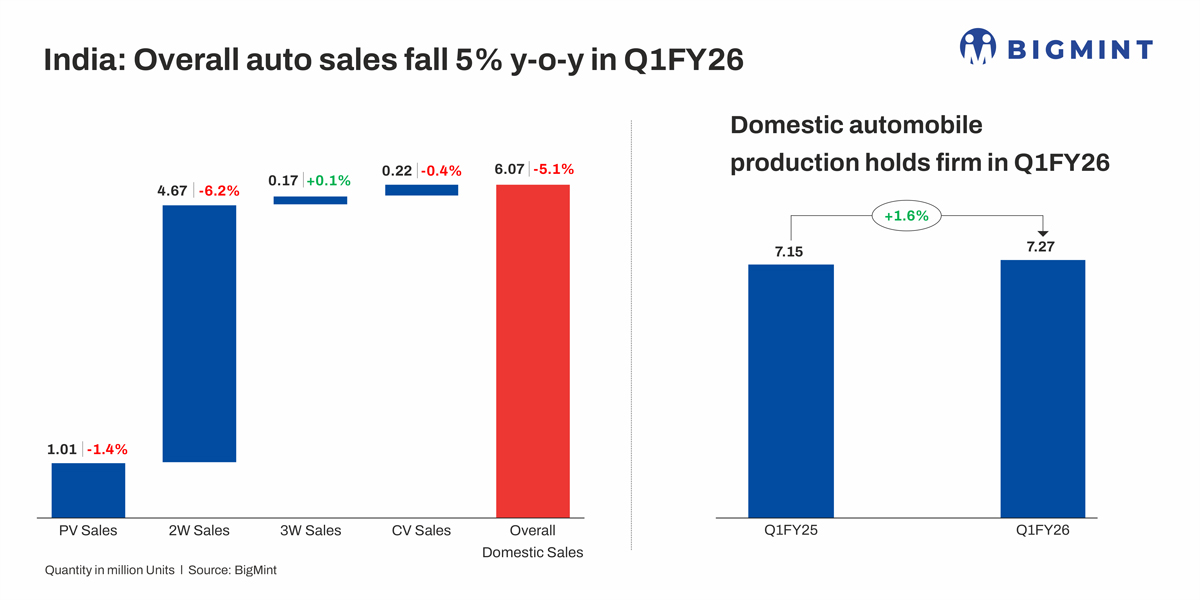
India’s total vehicle sales dropped by 5.1% settling at 6.07 mnt y-o-y in the first quarter (April-June) of FY’26, though there were modest gains in exports and utility vehicles (UVs). However, this was offset by weaker domestic demand in key categories, such as passenger vehicles (PVs), according to new data from the Society of Indian Automobile Manufacturers (SIAM).
Meanwhile, overall auto production remained firm at 7.27 million units in Q1FY’26 against 7.15 million units in Q1FY’25, reflecting a marginal 1.6% rise y-o-y.
PV sales reached 1.01 million units, down 1.4% y-o-y, marking a subdued start to FY’26. Urban consumers in India are tightening discretionary spending as wage growth moderates, putting pressure on household budgets. This shift in sentiment is reflected in wholesale passenger car sales. Additionally, in June 2025, PV sales hit a 2-year low.

Sequentially, the drop was sharper at 13% compared to the January-March quarter, though part of this decline aligns with seasonal trends. Automakers typically boost end-of-year sales through discounts in Q4, followed by a softer start in the new fiscal year. However, the magnitude of the decline signals deeper fatigue in the market.
India, the world’s third-largest car market, had posted record sales for three consecutive years. However, that momentum has now eased. Passenger vehicle sales grew just 2% in FY’25, down from 8.7% in FY’24 and 27% in FY’23.
Adding to the headwinds, auto dealers last week raised concerns about an emerging shortage of rare earth materials — critical for manufacturing EV and hybrid components. The supply constraints are beginning to impact production, leading to reduced availability at the retail level.
Despite the broader dip, utility vehicles accounted for 66% of PV sales, posting a 3.8% y-o-y increase as buyers favoured premium, feature-rich models.
June’s wholesale dispatches fell 7.4% y-o-y to 312,849 units, with manufacturers adjusting stock levels amid sluggish momentum at dealerships.
Strong Q1 exports across categories
India’s auto exports remained a key bright spot. Passenger vehicle exports hit a Q1FY’26 record of 204,000 units, up 13.2% y-o-y, supported by improved demand in the Middle East, Latin America, and recovering Asian markets, including Sri Lanka, Nepal, and Japan.
Two-wheeler exports rose 23.2% to 1.14 million units, while three-wheeler shipments jumped 34.4% to approximately 100,000 units. Commercial vehicle (CV) exports rose 23.4% to approximately 20,000 units, even as domestic CV sales dipped 0.6% to 223,000 units.
Domestic sales trends diverge
Two-wheeler (2W) sales declined 6.2% y-o-y to 4.67 million units in Q1FY’26, due to wholesale corrections, though retail registrations rose 5% during the quarter, driven by the wedding season and improved rural sentiment. Scooters gained share, rising 2.15% within the segment.
Three-wheelers posted record Q1 sales at 165,000 units, up marginally by 0.1%, as urban mobility demand and financing availability supported growth. Passenger carriers led demand, while cargo 3Ws saw steady retail traction.
The CV segment remained flat, with a modest decline in goods carriers offset by improving sales in passenger sub-categories.
Outlook
Industry participants expect a gradual recovery in Q2FY’26 (July-September), aided by the upcoming festive season, improved rural incomes following a favourable monsoon, and support from recent repo rate cuts.
However, market players flagged potential production constraints linked to export licensing controls from China on rare earth magnets, which could impact EV and high-efficiency motor production. This may also influence demand for aluminium die-casting alloys such as ADC12, A356, and LM25 used in light-weighting vehicle components.
Leave a Reply