- Coking coal prices decline, iron ore props up
- All yes on upcoming conference on urban issues
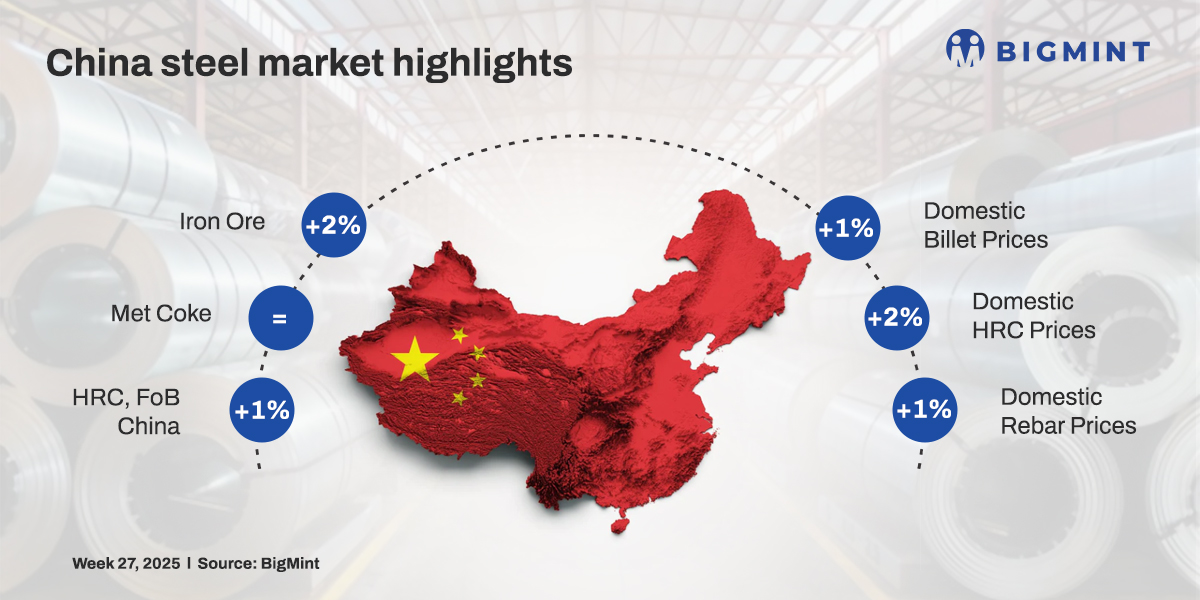
The Chinese steel market saw uptrends in prices this week. Domestic steel prices, including billets, rebar and hot-rolled coils (HRCs), increased w-o-w. However, in the raw material segment, price of coking coal fell w-o-w, while iron ore saw a hike.
1. Iron ore spot prices surge w-o-w: The benchmark iron ore fines spot prices climbed up by $2/t w-o-w to $98/t CFR China on 11 July supported by fresh bookings. Prices found further support from improved futures sentiment, and positive policy cues, with low port-side inventories expected to sustain near-term buying interest.
As per reports, next week, a highly anticipated conference will address urban issues in China. On the day of the announcement, property prices increased, leading to a rally in the iron ore swaps market.
Iron ore inventory at Chinese ports dropped by 1.5 mnt w-o-w to 131.9 mnt on 10 July, as per data published by SteelHome.
a) Spot pellet premium rises w-o-w: Spot pellet premium for Fe65% grade pellet inched up by $1.2/t w-o-w to $15.30/t CFR China on 9 July. Pellet premium touched a four-month high level with the last being recorded in February 2025.
b) Spot lump premium stable w-o-w: Spot lump premium held firm at $0.1680/dmtu on 11 July.
2. Coking coal prices inched down w-o-w: Australian premium hard coking coal (PHCC) prices declined by $5/t to $178/t FOB amid ongoing global uncertainty. Meanwhile, the Chinese met coke market stabilised due to higher coal costs and moderate steel demand, with constrained production and lower inventories. However, significant price gains remain unlikely given weak steel conditions and gradual coal supply recovery.
3. Chinese billet prices inch up by RMB 20/t ($3/t) w-o-w: Steel billet prices in Tangshan, China, surged by RMB 20/t ($3/t) w-o-w to RMB 2,960/t ($413/t), including 13% VAT, on 11 July 2025. Billet prices showed strength boosted by positive macro-economic news, spike in raw material tags and slightly better demand in the finished segment. Meanwhile, SHFE rebar futures (October 2025 delivery) rose w-o-w by RMB 61/t ($9) to RMB 3,133/t ($437/t) on 11 July 2025.
4. Domestic HRC prices rise w-o-w: China’s HRC offers edged up by RMB 60/t ($8/t) w-o-w to RMB 3,140/t ($438/t) against RMB 3,080/t ($430/t) following the increase in SHFE futures. SHFE HRC futures surged by RMB 62/t ($9/t) w-o-w to RMB 3,273/t ($457/t) on 11 July against RMB 3,211/t ($448/t) on 4 July. This increase is attributed to speculation over significant property stimulus measures and production cuts, which could reduce steel supply and boost prices.
Moreover, Chinese HRC export offers went up by $5/t w-o-w to $450/t against $445/t a week ago.
The world’s top steel manufacturer, Baosteel, has raised HRC prices by RMB 100/t ($14/t) m-o-m for August 205 sales, after keeping them unchanged in July. The hike follows an increase in HRC futures (October 2025) on the Shanghai Futures Exchange (SHFE).
5. Domestic rebar prices edged up w-o-w: China’s rebar edged up by RMB 20/t ($3/t) w-o-w to RMB 3,160/t ($441/t) against RMB 3,140/t ($438/t). SHFE rebar futures (October 2025 contract) stood at RMB 3,133/t ($437/t) on 11 July, climbing up by RMB 51/t ($7/t) as compared to RMB 3,082/t ($430/t) on 4 July. China’s rebar prices rose on speculation of government-mandated production cuts to curb pollution and manage capacity, potentially reducing supply and driving prices up further.
China’s Shagang Steel has increased its rebar and wire rod prices by $7/t for mid-July 2025 sales after keeping them stable for the past three consecutive rounds, as per sources. Prices of rebars, coiled rebars, and wire rods are as follows:
- Rebars (16-25 mm): RMB 3,300/t ($460/t)
- Coiled rebars (8-10 mm): RMB 3,460/t ($483/t)
- Wire rods (6-10 mm): RMB 3,370/t ($470/t)

Outlook
China’s steel market might stay range-bound in the near term, supported by strong futures and supply-demand dynamics. However, any changes in raw material prices or new government policies could affect the market’s momentum in the future.
Leave a Reply