- Australia’s Jun’25 coking coal exports surge
- Exports to key importing countries edge down
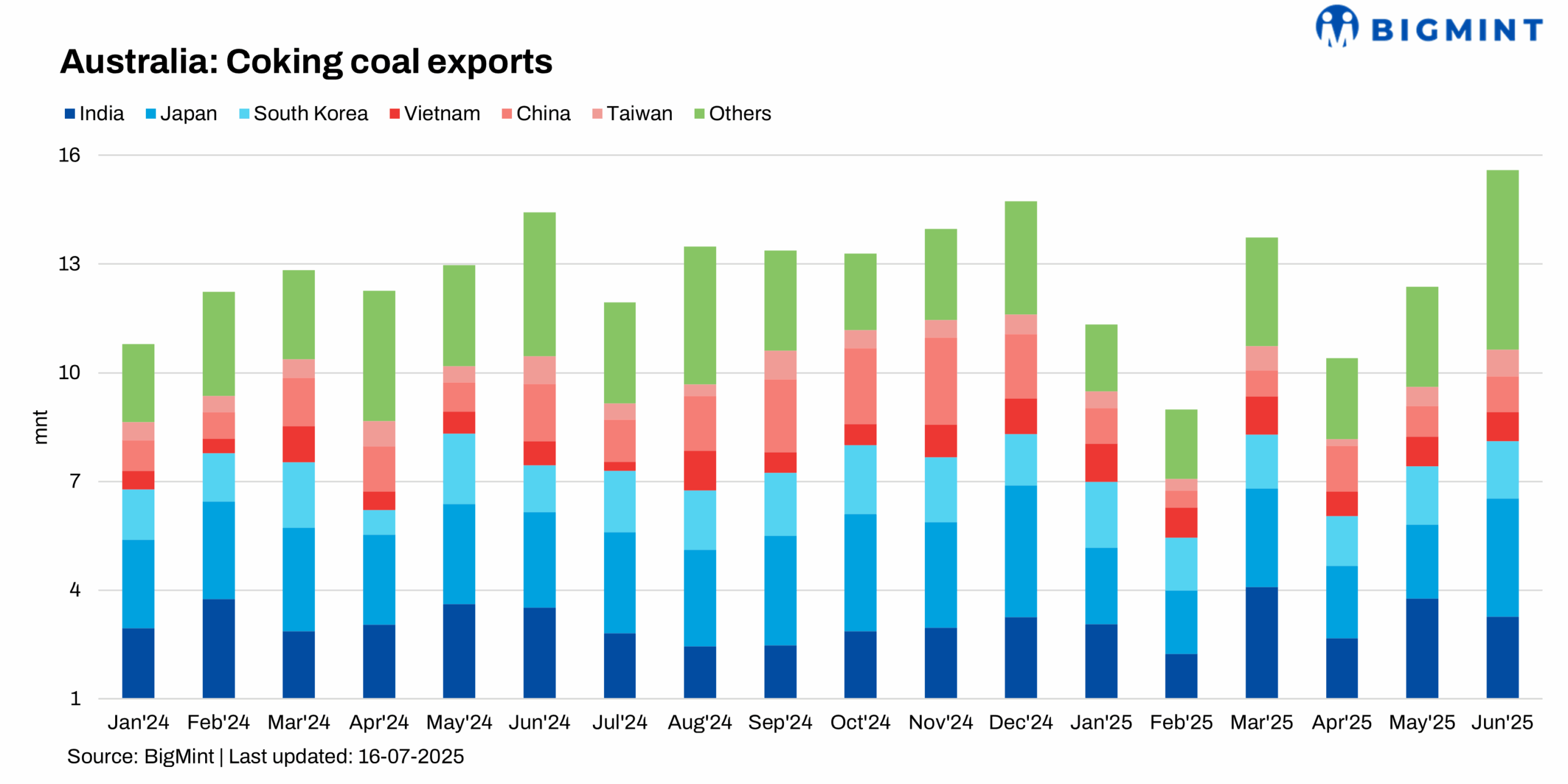
Australia’s coking coal exports surged 26.1% month-on-month (m-o-m) in June 2025, reaching 15.6 million tonnes (mnt) compared to 12.37 mnt in May.
Despite the strong June figures, Australia’s coking coal exports for the first half of 2025 (H1CY’25) fell by 4% y-o-y to 72.44 mnt, down from 75.52 mnt in H1CY’24. The steepest decline occurred in shipments to China, which contracted by 19.8% to 5.26 mnt.
Except decreased demand from the major buyers, as well as China, Australian shipments also dropped partly due to the key Queensland coal ports experiencing a decline in exports in February, coinciding with heavy rainfall in North Queensland.
In H1CY’25, exports to India declined 3.4% to 19.11 mnt, while Japan and Taiwan saw decreases of 13% and 12% respectively, with shipments falling to 13.8 mnt and 2.9 mnt. Indian BF-based steel producers are diversifying sources of imports, especially with Russia offering extremely competitive prices due to sanctions, and reducing reliance on Australian PHCC. Some mills are also investing in overseas coking coal mines to secure supplies of this critical resource.
Vietnam bucked the trend with a significant 42.8% increase in imports to 5.26 mnt. South Korea recorded a 10% increase to 9.31 mnt.
Y-o-y, shipments increased by 8.1% from 14.43 mnt in June, indicating a rebound in demand after a relatively subdued start to the year.
Divergent demand patterns
The export performance to major markets in June showed mixed results. Exports to Japan soared by 59% to 3.26 mnt from 2.05 mnt the previous month, while Taiwan increased imports by 39% to 0.74 mnt. China also posted a 17% rise in shipments, totaling 0.98 mnt.
In contrast, India experienced a decline in m-o-m imports by 13%, dropping to 3.27 mnt from 3.77 mnt in May. Exports to South Korea decreased by 1% to 1.59 mnt.
Export volumes reflect higher port activity
Port operations reflected the increased export momentum in June. The Dalrymple Bay Coal Terminal (DBCT) posted a 33% m-o-m increase in shipments to 4.8 mnt, while Gladstone Port and Hay Point Port recorded rises of 32% and 24.6%, reaching 4.74 mnt and 4.33 mnt, respectively.
Abbot Point Port saw a marginal 1% increase, at 1.34 mnt. Meanwhile, Newcastle Port experienced a sharp 188% surge to 0.24 mnt. However, Port Kembla saw a 48% decline, handling only 0.15 mnt.
Prices soften on weakening steel, coke demand
Australian coking coal prices declined by $13/t m-o-m in June. The downward pressure on prices stemmed from falling steel production margins and weaker metallurgical coke prices globally. Notably, China’s met coke market registered its fourth consecutive price reduction, with cuts of RMB 50-55/t ($7-8/t) reflecting ongoing softness in the steel sector.
Outlook
Australia’s coking coal exports face near-term volatility, with rising demand in Japan and Taiwan offset by declines in China and India. Price pressures persist amid weak steel output and coke oversupply, though growth in Vietnam and strong port capacity provide some support.

Leave a Reply