- Price reduction direct response to subdued demand
- Major mills roll over HRC prices for Jul’25 despite muted trades
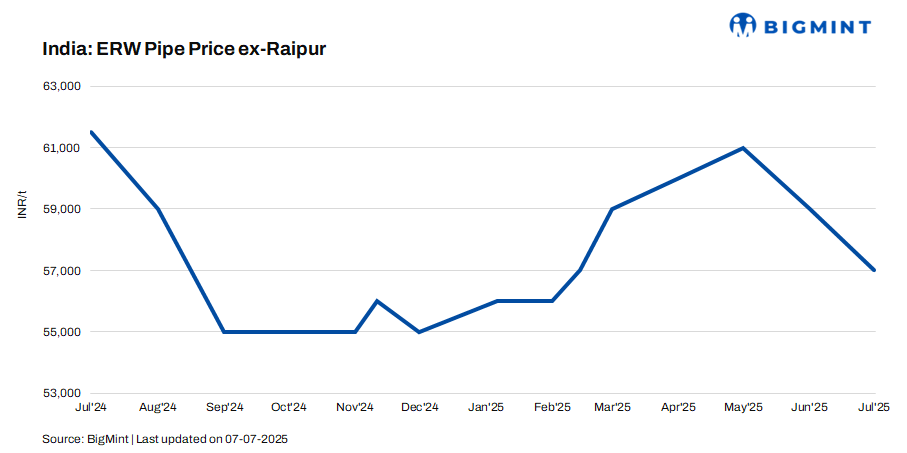
A major Indian ERW pipe manufacturer, specialising in HRC (hot-rolled coils) -based products, has decreased prices of its base-grade pipes (25-125 NB, 2.2-6 mm) by INR 2,000/tonnes ($23/t) for early-July 2025 sales, sources informed BigMint.
Post-revision, prices stood at INR 57,000/t ($663/t) exw-Raipur, excluding 18% GST, reflecting a drop of INR 2,000/t ($23/t) m-o-m against INR 59,000/t ($687/t) in early-June.
Revised prices for Raipur, Pune, Bangalore, Delhi and Mumbai will be effective from 1 July.
The price decline is a direct response to subdued demand and buying activity. However, primary mills have kept HRC prices unchanged for July sales.
Moreover, the manufacturer decreased tags by INR 2,000/t ($23/t) m-o-m for July sales. Post-revision, prices stood at INR 59,000/t ($687/t) exw, exclusive of 18% GST, in Bangalore, Delhi, Mumbai and Pune against INR 61,000/t ($710/t) in early-June.
Meanwhile, distributor-level monthly average prices of ERW pipes in Raipur fell by INR 1550/t ($18/t) m-o-m to INR 56,000/t ($652/t) exy-Raipur in July against INR 57,550/t ($670/t) in June.
Indian mills roll over HRC list prices
Indian steel producers have maintained list prices for hot-rolled coils (HRCs) and cold-rolled coils (CRCs) for July sales. While most mills officially held prices steady, market participants suggest price support or reduction of INR 1,000-2,000/t ($12-23/t).
List prices of HRCs (2.5-8 mm, IS2062, Gr E250 Br) ranged within INR 52,150-54,000/t ($611-633/t) ex-Mumbai.
Trade-level HRC prices drop m-o-m
In June, average trade-level HRC prices fell by INR 900/t ($11/t) m-o-m to INR 51,100/t ($599/t) against 52,000/t ($605/t), exy-Mumba, and excluding 18% GST. Additionally, domestic demand was limited as buyers only purchased as-needed, expecting prices to drop further.
Outlook
The recent price reduction by a major manufacturer reflects dampened market sentiment due to weakened demand and liquidity constraints. The decline in raw material prices has further pressured margins.
Leave a Reply