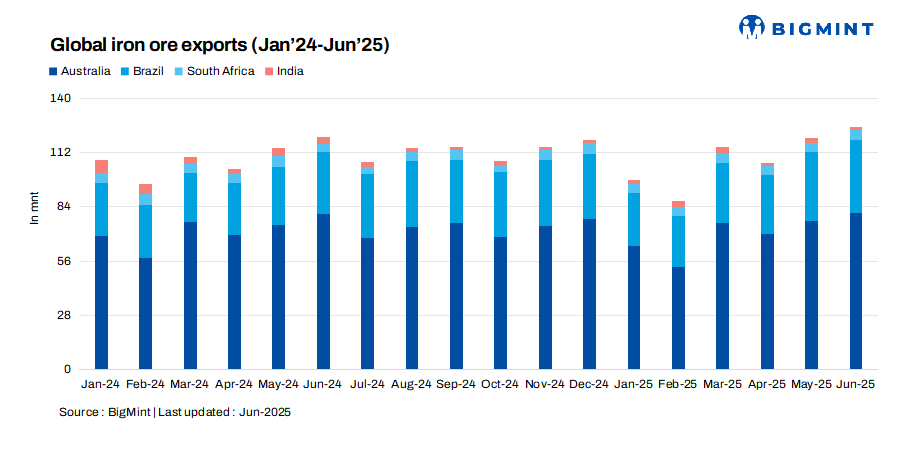
- Sustained demand from China boosts volumes
- Major Australian miners ramp up operations
Global iron ore exports from major producing regions increased slightly in June 2025. Exports from Australia and Brazil showed gains m-o-m, while those from South Africa remained stable. In contrast, exports from India declined, as sellers were unwilling to conclude deals amid weak global pricing.
Australia’s exports rise 5% amid steady sourcing
Australia’s iron ore and pellet export shipments rose by 5.3% to 80.82 million tonnes (mnt) in June from 76.73 mnt in May, according to vessel line-up data compiled by BigMint.
China remained the top importer, receiving 69.2 mnt, followed by Japan at 5.2 mnt and South Korea with 3.5 mnt.
Rio Tinto was the leading exporter with 28 mnt, closely trailed by BHP at 27.4 mnt.
The uptick was supported by consistent demand from Chinese buyers, who focused on stocking up low- and mid-grade fines as cost-effective feed options to protect mill margins. Increased export momentum was also aided by post-cyclone recovery and stable demand from South Korea. Major miners such as Rio Tinto, BHP, and Fortescue (FMG) ramped up operations following the cyclone season, leveraging improved weather and smoother port logistics to boost shipments.
Export shipments from Brazil increase m-o-m
Brazil’s iron ore exports edged up by 6% m-o-m to 37.74 mnt in June, compared to 35.63 mnt in May. Additionally, exports rose sharply by 18% from 32.08 mnt in June 2024.
China remained the largest importer, taking in 21.81 mnt, followed by Malaysia at 2.22 mnt and Oman at 1.36 mnt.
June saw the highest-ever figures recorded, according to data from BigMint. Chinese pig iron production stayed relatively strong through late June, sustaining demand for imported iron ore despite the usual summer lull. Meanwhile, Brazilian miner Itaminas began leveraging its 10-year agreement with Porto Sudeste, signed in March, to export iron ore directly. This move has improved logistics efficiency, reduced dependency on third-party handlers, and accelerated shipments via a more streamlined terminal route.
South African iron ore exports remain stable, inch up y-o-y
South Africa’s iron ore exports held firm m-o-m at 4.92 mnt in June compared to 4.94 mnt in May, as per vessel line-up data maintained by BigMint. Despite the m-o-m drop, export volumes were higher by 14% y-o-y, compared to 4.34 mnt in June 2024.
China remained the leading importer with 2.86 mnt, followed by the Netherlands at 0.76 mnt.
South Africa’s iron ore exports increased recently, aided by smoother logistics at Richards Bay. South Africa’s rail and port infrastructure functioned smoothly in June, ensuring stable rail-to-port flows and uninterrupted iron ore shipments. At the same time, steady demand from key importers such as China helped maintain consistent export volumes without any major fluctuations.
India’s exports fall by 9% m-o-m
India’s iron ore and pellet exports witnessed a drop of 9% m-o-m to 2 mnt in June from 2.2 mnt in May. However, shipments saw a decline of 45% against 3.64 mnt in the year-ago period.
China remained the largest importer with 1.56 mnt, followed by Malaysia with 0.08 mnt.
The drop in demand for Indian iron ore came as Chinese mills sought cheaper alternatives for cost-effectiveness. These mills are primarily purchasing low-alumina silica material from other regions. Meanwhile, Indian exporters chose to adopt a wait-and-watch approach, hesitating to sell their materials in the hope of better prices in the near future.
The competitiveness of mainstream iron ore fines for Chinese buyers was affected by widening discounts, and the decline in the Fe 62% index led to reduced imports from India.

Leave a Reply