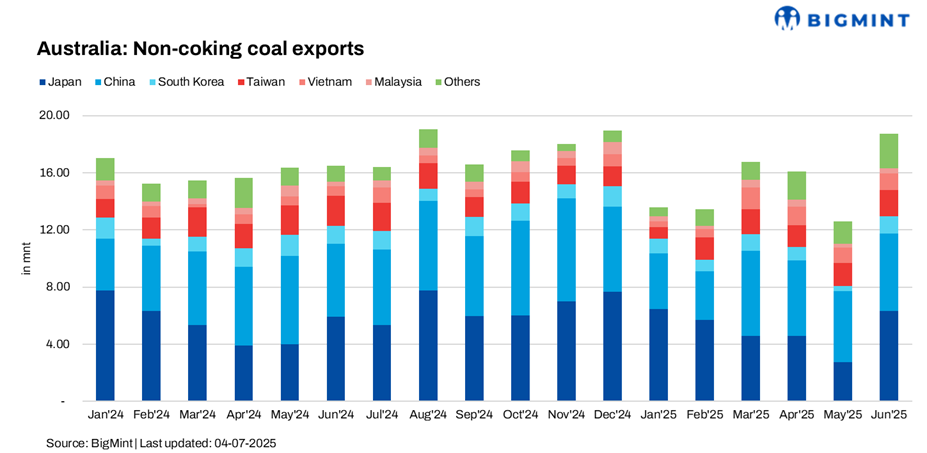
- Despite rise in Jun’25, exports drop in H1CY’25
- Japan boosts intake by 130%, China sees 7% rise
Australia’s non-coking coal exports witnessed a significant upswing m-o-m in June 2025. Volumes reached 18.74 million tonnes (mnt), marking a 48.5% rise from 12.6 mnt in May. On a y-o-y basis, exports also rose by 13.7% compared to 16.48 mnt in June 2024. The sharp m-o-m increase reflects a short-term rebound in regional energy demand, particularly from key Asian markets.
H1 exports reflect decline despite recovery in Jun’25
Despite the significant rise m-o-m, cumulative exports of non-coking coal in the first half of calendar year 2025 (H1CY’25) stood at 91.96 mnt. This represents a 4.4% decline from 96.24 mnt in the corresponding period of 2024.
The overall drop signals ongoing challenges for Australian coal exporters, influenced by softening global demand and a gradual shift towards alternative energy sources in major consumer countries.
Asian markets drive Jun’25 export growth
The surge in June exports was largely driven by renewed buying activity from major Asian importers. Japan led the increase, boosting its intake by 130% to 6.35 mnt from 2.76 mnt in May. China followed with a 7.1% rise in imports, totalling 5.39 mnt.
South Korea registered the most notable m-o-m growth of 247% to 1.24 mnt. Taiwan also contributed to the uptrend, increasing its imports by 12.2% to 1.83 mnt. These figures reflect a short-term recovery in regional coal demand, likely influenced by seasonal consumption needs and supply adjustments.
However, not all major Asian buyers expanded their imports. Vietnam’s intake declined by 14% to 1.17 mnt, while Malaysia saw a substantial 34.1% drop, importing just 0.34 mnt in June.
Export terminals see strong uptick in cargo volumes
Australian coal export terminals reported robust operational performance during June. Newcastle Port, the country’s largest coal export hub, handled 13.67 mnt of non-coking coal – a 57% increase from May. Dalrymple Bay Coal Terminal (DBCT) recorded the sharpest growth, with volumes more than doubling to 1.45 mnt (up by 102% m-o-m).
Gladstone Port saw a more moderate increase of 5.5% m-o-m, handling 1.40 mnt, while Abbot Point shipped 1.34 mnt, reflecting a 3.8% rise. Brisbane Port also showed strong performance, with exports reaching 0.63 mnt, a notable 95% increase from the previous month.
In contrast, Port Kembla registered a marginal 3.8% decline in volumes to 0.24 mnt.
Outlook
The significant rise in June reflects a momentary rebound in demand, largely from Asian power and industrial sectors. However, the decline in H1 exports highlights ongoing market fragility and uncertainty over long-term demand.

Leave a Reply