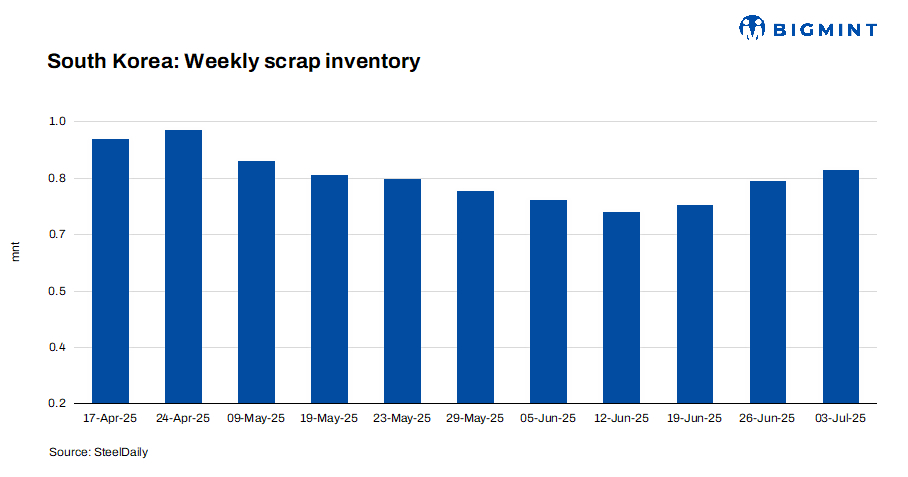
- Inventories now 15% higher than mid-Jun’s low levels
- Central region mills prep for summer production cuts
SteelDaily: The cumulative ferrous scrap inventory at eight major South Korean steel mills increased for the third straight week, by 30,000 tonnes (t) (3.6%). As of the first week of July, inventories totalled 822,000 t against 793,000 t in the previous week.
Compared to the low of 711,000 t in the second week of June, inventories have now surged by 111,000 tonnes (15%).
This steady build-up reflects typical seasonal trends, as mills stockpile scrap ahead of scheduled summer production cuts – mirroring patterns observed during the same period last year.
This increase is significant because it is not merely a temporary fluctuation; it mirrors the pattern seen last year, when inventories also rose sharply over a three-week period from late June to early July.
Region-wise inventory
The overall increase in national steel scrap inventory has largely been fuelled by a significant build-up in the central territory, outpacing the southern region.
Central region: The central region’s steel scrap inventory increased by approximately 6% w-o-w to 505,000 t from 476,000 t.
The average amount of scrap received daily has consistently been outpacing consumption, leading to continued inventory accumulation as mills prepare for summer production cuts.
Southern region: The southern region’s scrap inventory held largely steady at around 292,000 t versus 296,000 t last week, a slight drop of 1%, though individual companies saw minor fluctuations up and down.
Market update
According to a market participant, “This is a period when consumption slows ahead of production cuts, so if inflows continue, inventories naturally accumulate.”
A participant noted, “Scrap steel supply and demand depend heavily not just on how much material is generated, but also on fluctuations in steelmakers’ consumption. The temporary stock build-up seen before production cuts and routine maintenance starting mid-July is a pattern that has been consistently repeated in the past years.”
Note: This article has been written in accordance with a content exchange agreement between SteelDaily and BigMint.
Leave a Reply