- Russian billet bucks downtrend due to appreciating trouble
- Seasonal slowdown in China pressures HRC, iron ore tags
- Turkish imported scrap declines on lacklustre rebar sales
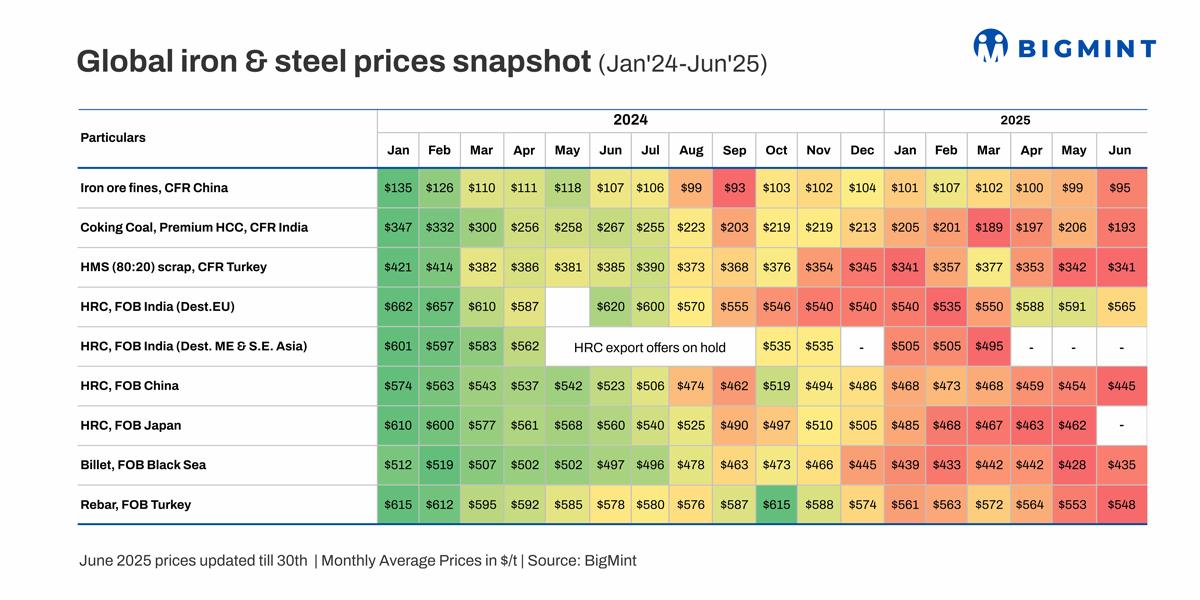
Morning Brief: Global steel and raw material prices continued to dive in June 2025, with several commodities near or at intra-year lows. Chinese hot-rolled coil (HRC) export offers (monthly average, FOB Rizhao) hit a five-year low too.
Seasonal market slowdowns, stemming from the arrival of the summer or monsoon or festive holidays, dampened demand in several regions. US tariffs on steel imports, which were doubled to 50% in late-May, and the Iran-Israel conflict also heightened market uncertainty. Overall, trade momentum was listless, particularly as downstream sentiment remained weak.
Only Russian billet prices increased, primarily due to a hike in the currency exchange rate rather than a demand uptick.
Factors influencing global steel, raw material prices in Jun’25
Chinese iron ore prices drop on soft downstream demand: Falling rebar demand, the seasonal steel market slowdown, and the ongoing property crisis suppressed demand for Fe62% iron ore fines and led to a $4/tonne (t) drop m-o-m to $95/t CFR in June. Additionally, mills favoured mid-grade fines to optimise costs and protect margins and drew upon portside inventories, which remained high. According to SteelHome data, iron ore port stocks stood at 133.6 mnt on 26 June.
Falling met coke prices weigh on coking coal tags: Premium hard coking coal (PHCC) fell $13/t m-o-m to $193/t CFR India amid sluggish demand, driven by elevated port inventories, lower bids, and declining met coke prices, which hit a five-year low in eastern India. China also witnessed a fourth consecutive price cut in met coke, and the Indian buyers mostly stayed on the sidelines.
Slow rebar offtake caps Turkish scrap demand: Heavy melting scrap (HMS) 80:20, CFR Turkiye, dipped by $1/t m-o-m to $341/t in June, as poor rebar demand limited scrap consumption. Initially, prices fell ahead of the Eid-al-Adha holidays. However, following a brief period of stability, prices rebounded by the month-end, as mills cautiously started replenishing their inventories. The availability of competitively priced Chinese billets and high interest rates also affected trade activity.
HRC export offers decline on weak market cues: Chinese HRC export offers were down by $9/t m-o-m at $445/t in June 2025, to levels last seen in June 2020, driven by lacklustre demand, inventory build-up, and a volatile global trade landscape. A bearish domestic market – due to the seasonal slowdown and a lack of strong demand drivers – also contributed to lower offers. Chinese exporters saw muted sales in Vietnam, as most buyers sourced domestic HRCs, though some deals were concluded for re-export purposes.
In June, Indian mills were more focused on the domestic segment due to better realisations, continuing to abstain from the Middle East market due to rock-bottom prices from competitors such as China. Meanwhile, Indian HRC offers to the EU fell by $26/t m-o-m to $565/t, under strain from sluggish demand, regional summer holidays, and cautious sentiment.

Currency appreciation lifts Russian billet prices: The strengthening of the rouble against the USD to 78.7 from 80.8 pushed Russian exporters to raise billet prices by $7/t m-o-m to $435/t FOB Black Sea, to preserve profit margins. However, demand from Turkiye and Egypt was weak, especially due to the Eid-al-Adha holidays.
Turkish rebar sales remain depressed: Turkish rebar prices weakened by $7/t m-o-m to $548/t FOB amid tepid sales in both domestic and export markets. While there was a lack of clarity among European buyers regarding import quotas, economic pressures, policy uncertainty, and the Eid holiday period limited domestic offtake. Additionally, firm scrap prices squeezed producers’ margins.
Outlook
The short-term outlook for the global steel market remains bleak, with supportive few supportive factors. Slowing crude steel production, with a 1.3% drop in January-May, will likely curb raw material demand, while the US tariffs may continue to keep demand fragile and market participants jittery. Given that China remains mired in recessionary risks, it would be safe to conclude that a global market recovery is still a long way ahead.
Leave a Reply