- Govt infra, housing initiatives to be primary drivers of steel demand
- Bridging rural-urban consumption divide a major growth opportunity
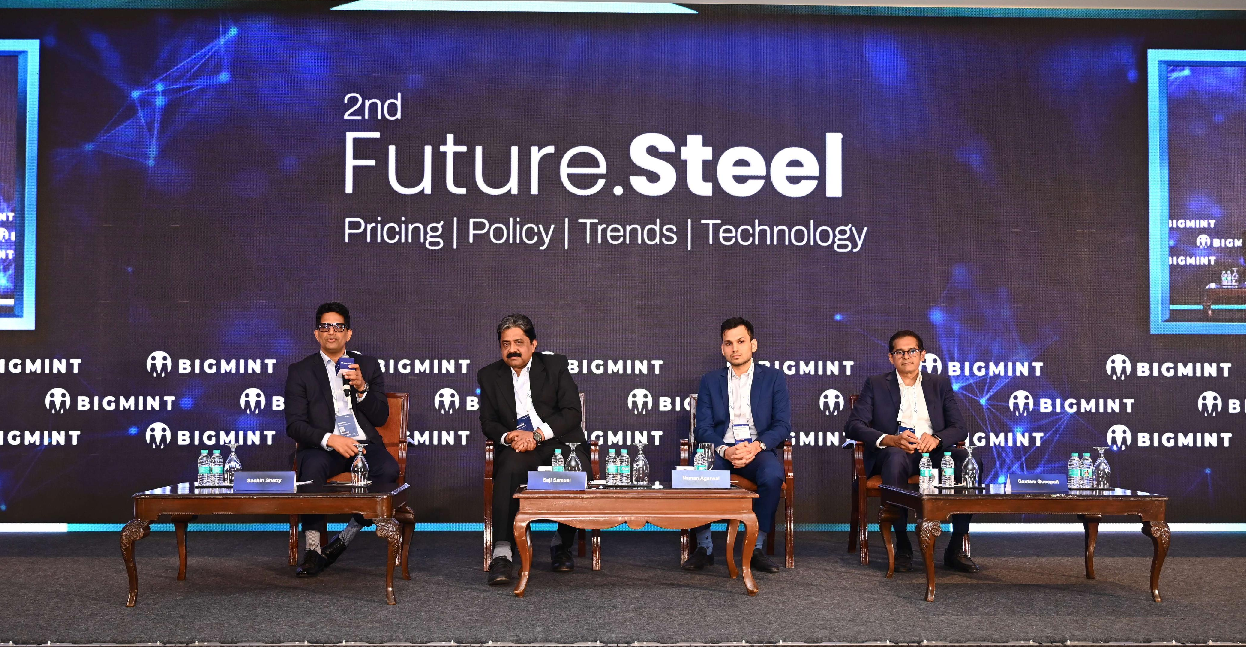
BigMint’s Future.Steel South conference, held on 18 June 2025 in Chennai, India, featured an insightful panel discussion on India’s steel demand and product diversification. Moderated by Sachin Shetty, CEO of Quesrow Research and Strategy, the discussion featured industry leaders Gautam Reddy Gunapati of iSteel, Naman Agarwal of Suryadev Alloys and Power, and Saji Samuel of JSW Steel.
The session covered critical themes including infrastructure growth, regional demand shifts, rural consumption challenges, and the need for service-led innovation.
Key takeaways
India’s steel demand to reach 152-160 mnt in FY’26
India’s steel demand continues to be driven primarily by infrastructure and construction, which account for nearly 70% of total consumption. Despite a slower first quarter due to global uncertainties, annual demand is projected to reach 152-160 million tonnes (mnt), supported by large-scale government initiatives such as road construction and housing schemes.
However, a stark rural-urban divide remains: while urban steel consumption is nearing global averages, rural consumption lags significantly at just 11 kg per capita. Bridging this gap is seen as a major growth opportunity.
Innovative products find good reception in south India
South India emerged as a focal point of the discussion. Tamil Nadu, with over 35 regional TMT brands, sees strong local demand for premium steel products. Innovations such as the 550D grade, corrosion-resistant steel, and galvanised rebars have seen high acceptance in the region, thanks to environmental factors such as coastal humidity and a better-informed customer base.
Additionally, with strategic access to ports and a more quality-conscious consumer base, the region is well-positioned for export-oriented growth and product innovation.
Increased focus on value addition to boost growth
Panellists also emphasised the need to move from volume to value creation. Unlike global peers, that earn around 14% of their revenues from services and customised offerings, most Indian producers are still product-centric. Consequently, there is an urgent need to offer holistic, value-added solutions such as construction kits, pre-formed stirrups, and cut-and-bend services. These not only offer convenience but can significantly enhance margins.
However, slow adoption due to a lack of awareness and infrastructure was identified as a key challenge.
Govt initiatives to drive rural steel consumption
To truly expand steel consumption, especially in rural areas, stronger policy support, dealer network expansion, and consumer education are required. Programmes such as the PM Awas Yojana and the Kalaignarin Kanavu Illam (KKI) housing initiative were seen as potential catalysts.
Outlook
India’s next phase of steel growth will be driven by distribution depth, product innovation, and customer alignment, and the discussion closed with a clear call to action: Indian steelmakers must innovate, localise, and align closely with policy and market needs so as to stay competitive and drive the next phase of growth.
To this end, south India presents a replicable model – where awareness, quality, and strategic localisation converge. As the country targets 160 mnt of consumption by FY’26, the path lies in regional demand tailoring, rural consumption growth, and service-centric delivery.
A notable uptick in demand for processed, pre-fabricated, and value-added steel is expected as India embraces modern construction and infrastructure imperatives.

Leave a Reply