- Global fines spot, future indices fall w-o-w
- Weak demand leads to widened bid-offer gap
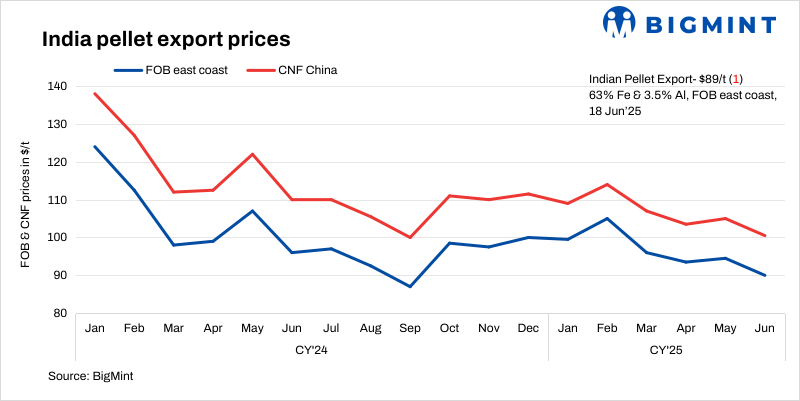
The Indian pellet export market has seen a significant downturn as prices dropped to a two-month low, to levels last seen in mid-April 2025. The decline is primarily attributed to falling global iron ore fines prices and futures and subdued market sentiment due to prevailing geo-political tensions.
Price update
BigMint’s India pellet (Fe 63%, 3-3.5% Al) export index (FOB east coast) decreased by $1/t w-o-w to $89/t on 18 June 2025 against 11 June. The BigMint pellet index fell two month’s low since April 2025. Notably, no pellet export deals were reported from India’s eastern coast in the recent week, highlighting the sluggishness in trade activity.
Indian pellet-maker concluded a deal for 50,000 t (Fe63%, 2.5% alumina) via an export tender this week. According to sources, the deal was closed at around $96/t FOB India.
Market commentary
The gap between bids and offers has widened considerably, making export sales economically unviable for most Indian producers. The export realisation has fallen below domestic levels, creating an unfavourable margin environment. Pellet producers, especially from the eastern coast, are facing a cost crunch due to persistently high iron ore prices, further squeezing profitability.
An export trader informed, “There is no buying interest for eastern coast cargoes from Chinese buyers, as they are actively seeking low alumina pellets at much lower prices.”
Another market participant noted, “With current export margins turning negative, many sellers are now shifting focus to domestic tenders to keep dispatches steady. The export market is simply not viable at present.”
Sellers remain cautious and are exploring alternative sales routes, given the absence of firm inquiries from overseas buyers. As a result, prices are expected to stay under pressure in the near term, and no major pellet shipments from the eastern coast are anticipated.
An Odisha supplier commented: “The gap between the bids and offers in the sea market is approximately $10-15/t. With the current iron ore prices in Odisha, the production cost of pellets has increased, making deals in the sea market unviable at present export prices. However, we are finding better opportunities in domestic sales and tenders.”
Domestic vs export market
Meanwhile, the OMC (Odisha state miner) has recently dropped the fines base prices for the 19 June auction by INR 500-700/t which may reduce the pellet production cost and offer the miner scope to sell in regions beyond Odisha.
Domestic prices exceeded export offers by around INR 1,850/t ($21/t), widening w-o-w amid the drop in export and domestic prices. Pellet (Fe63%) prices in Odisha’s Barbil were recorded at INR 7,550/t ($90/t) exw, and remained stable w-o-w. Meanwhile, the ex-plant realisation in exports from Barbil stood at INR 5,700/t ($68/t) exw.
Rationale
- No confirmed deals from India’s east coast were recorded in this publishing window for T1 trade. Thus, this category was not taken into consideration for today’s price calculations and accorded 0% weightage in the index calculation. Click here for the detailed methodology.
- Twelve (12) indicative prices were received, and ten (10) were considered for the calculation of the index and given 100% weightage.
Factors impacting pellet exports
Chinese iron ore fines prices fall w-o-w: The benchmark iron ore fines index fell by $2/t w-o-w to $93/t CFR China on 17 June. Weak fundamentals and increased trading in medium-grade fines prompted the steep drop. A sluggish property sector, disappointing crude steel data, and high iron ore supply also pressured prices.
DCE iron ore futures down w-o-w: Iron ore futures on the Dalian Commodity Exchange (DCE) for the May 2025 contract dropped by RMB 11.5/t ($1.5/t) w-o-w to RMB 695.5/t ($96/t) on 18 June. Meanwhile, prices were largely stable d-o-d today.
Outlook
As per BigMint’s analysis, the export deals will remain absent in the near term following the market dynamics, and prices may fluctuate due to the current geopolitical tensions.

Leave a Reply