- High-, mid-CV grades fall to lowest since Mar’25
- ESDM raises HBA-II, HBA-III prices marginally
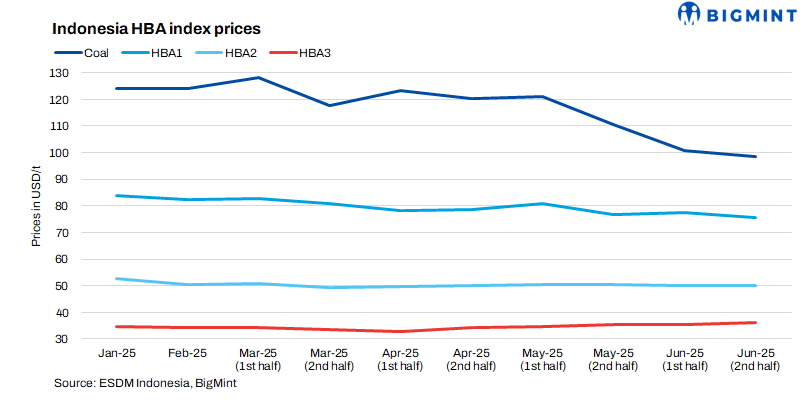
Indonesia’s Ministry of Energy and Mineral Resources (ESDM) has announced the updated benchmark thermal coal prices (Harga Batubara Acuan or HBA) for the latter half of June 2025. The latest figures reveal divergent pricing movements across coal grades, driven by changing global market dynamics, including fluctuations in demand and supply across key importing regions. Both high-calorific value (CV) and mid-CV prices were reduced sharply, while low-CV tags were raised.
High-CV price reduced sharply
The benchmark price of high-calorific value (CV) coal (6,322 kcal/kg GAR), Indonesia’s top grade, dropped sharply by $2.36/tonne (t) to $98.61/t. This marks the lowest level since the derivative price series began in March 2025. The price decline is largely attributed to weakening international demand, particularly from major buyers such as China and India, as well as a potential oversupply in the high-grade coal segment.
Mid-CV coal also sees steep drop
The HBA-I benchmark for mid-range thermal coal (5,300 kcal/kg GAR) fell by a steep $1.95/t to $75.64/t from earlier in the month. This price is also the lowest since March, with the latest downtrend indicating softened demand for mid-CV coal.
Low-CV prices edge up
Price movements in the lower calorific value coal categories were modest in comparison, suggesting relatively stable market conditions. The HBA-II price, of 4,100 kcal/kg GAR coal, edged up by just $0.17/t to $50.25/t. Meanwhile, the HBA-III benchmark for the lowest grade (3,400 kcal/kg GAR) rose by $0.67/t to $36.14/t. These slight increases reflect steady demand from domestic and regional utilities that continue to rely on low-CV coal due to cost considerations and availability.
Outlook
The updated HBA figures illustrate a narrowing price gap across higher and lower coal grades, driven by varied demand fundamentals. While premium high-CV and mid-CV variants face downward pressure from softening global demand, low-grade coals are benefiting from continued utility-driven consumption and regional market stability.
Leave a Reply