- Limited scrap supply drives ADC12 prices higher
- US tariffs strain global scrap supply chains
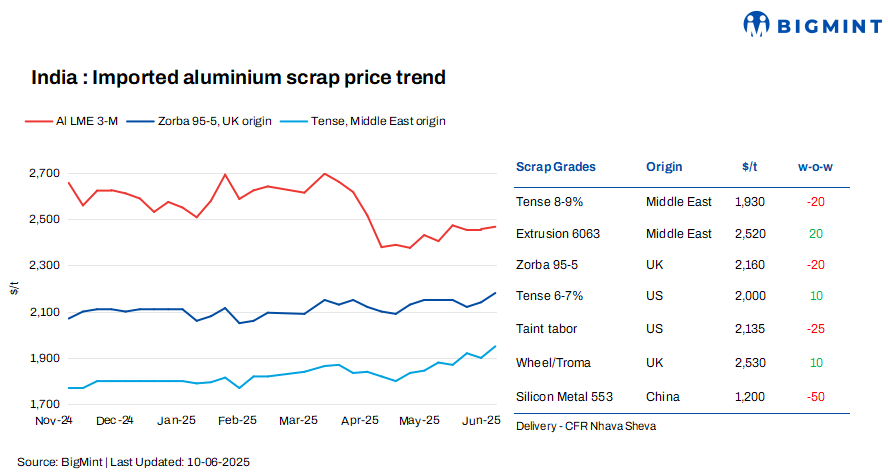
India’s imported aluminium scrap prices remained largely range-bound w-o-w, influenced by robust global demand, fluctuating LME prices, and ongoing supply constraints. Tight raw material availability and firm price settlements by a major automaker underpinned the price uptrend.
BigMint assessed Tense scrap from the US at $2,000/t, up by $10/t w-o-w, while Wheels from the UK were up $10/t w-o-w to $2,530/t, both CFR west coast, India. At the time of reporting, London Metal Exchange (LME) aluminium prices stood at $2,482/t, largely stable w-o-w.
Market sentiments
Tight local scrap supply pushes up ADC12 prices in India
Imported aluminium scrap prices remained firm, supported by stable LME levels and a persistent shortage in the market. This constrained supply along with rising raw material costs also bolstered prices of ADC12 aluminium alloy ingots. India’s leading automaker settled ADC12 prices at INR 226,750/t.
According to market participants, demand for ADC12 remained strong and the shortage of alloy-making raw materials is expected to persist through Q2 FY ’26. Select scrap grades such as Wheels from the UK and Extrusion from the Middle East were offered at a premium owing to improved market demand. A shortage of imported Taint Tabor and Tense scrap in the local market further tightened supply and contributed to higher ADC12 prices.
US tariffs spark global scrap clash
The US has doubled aluminium import tariffs to 50 % while exempting scrap to protect its domestic industry. This loophole has triggered a massive influx of scrap from Canada, Mexico and increasingly from Europe. As a result, the US aluminium premium has surged to a record $1,325/t. Domestic mid‑stream processors, including can manufacturers, are capitalizing on this distortion by outbidding global competitors even when sourcing local scrap.
Europe is raising the alarm over a mounting “scrap leakage” as valuable recyclables are sent to the US, threatening its circular economy ambitions. The European Aluminium association is urging Brussels to impose export duties to halt the outflow.
Meanwhile, China-the world’s largest aluminium scrap importer is caught between Europe’s tightening measures and growing US demand in Asia. A global scrap battle is emerging as nations scramble to secure vital recycling material.
Additionally, India imported around 1.7 mnt of aluminium scrap in 2024, mainly from the US, UK, UAE, and Saudi Arabia. However, this supply chain faces growing pressure as the US has reduced exports due to higher domestic demand, and other major suppliers are expected to impose export restrictions to support their own industries, threatening India’s scrap availability
Chinese secondary aluminium stays steady
China’s secondary aluminium market remains largely stable, with tight supply of tense scrap supporting ADC12 alloy prices at around RMB 19,900-20,100/t ($2,770-2,780/t). Negative import margins have curbed inbound volumes, while inventories of secondary alloy ingots have risen slightly in major recycling hubs like Jiangsu, Zhejiang, and Guangdong signalling softer end‑user demand .
Looking ahead, aluminium prices are expected to remain range‑bound, with low stocks and increased molten aluminium output providing some support. However, ongoing seasonal demand weakness and macroeconomic uncertainty are likely to restrain any substantial price upside.

Silicon price trends
According to BigMint’s assessment, silicon 553 prices from China dropped by $50/t to $1,200/t CFR Mundra on a w-o-w basis.
Outlook
With higher tariffs on imports, demand for aluminium scrap in the US may rise, since scrap is exempt from these duties. As manufacturers turn to scrap as a cost-effective alternative to imported primary aluminium, this shift could push scrap prices higher in the coming months.
Leave a Reply