- Domestic demand still on slow lane
- Export demand under tariff cloud
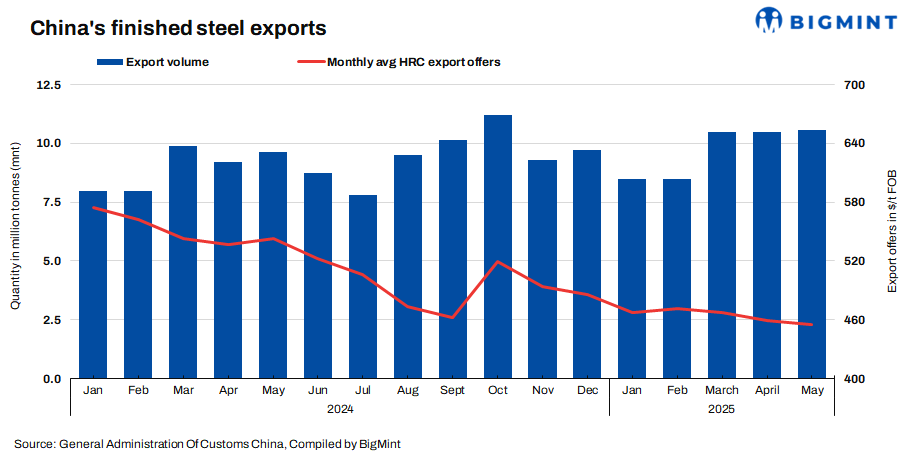
China’s steel exports for May 2025 increased by 9.8% y-o-y to 10.57 million tonnes (mnt) as compared to 9.63 mnt in May 2024, as per General Administration of Customs. In January-May 2025, exports stood at 48.46 mnt, up by 8.9% y-o-y against 44.63 mnt in the same period a year ago. On a m-o-m basis, export volumes went marginally up by 1.1%. against 10.462 mnt in April 2025.
Factors driving China’s steel exports
Subdued domestic market sentiment after holidays: China’s domestic steel market sentiment remained weak following the Labour day holidays (1 May 2025–5 May 2025), with limited market activity. Moreover, concerns over subdued end-user demand, seasonal slowdown in construction and renewed tariff uncertainties further impacted steel consumption. Amid these challenges, mills are gradually shifting focus towards exports.
Competitive Chinese offers against other exporting nations: Imported HRC offers to Middle East (ME) from China held steady m-o-m at around $485/t CFR UAE. Moreover, a deal for 15,000 t was heard concluded from China to Middle East (ME) at around $480/t CFR Oman for June shipment.
Another deal of around 30,000-35,000 t was concluded with a tube maker at $477/ CFR UAE for July shipments and a significant deal for 40,000-45,000 t of Japanese HRCs was reportedly concluded for the ME at $500-505/t CFR for end-July shipment, as per sources.
Meanwhile, Indian mills have continued to hold their HRC offers due to competitive offers.
Notably, China’s HRC FOB export offers remained competitive at $455/t FOB in May. Japanese HRC offers were at $463/t FOB. However, India’s HRC FOB offers were on hold and last-heard offers stood at $495/t. China’s competitive export offers compared to other nations drove an increase in its steel export volumes.
Outlook
China’s steel exports are expected to remain strong in the short term, supported by subdued domestic demand and competitive pricing, as mills continue to prioritise overseas markets.
However, a growing wave of anti-dumping (AD) measures from different regions is creating headwinds. These developments are starting to slow China’s HRC export momentum and may reshape its global competitiveness in the near term.
Leave a Reply