- Offers from key suppliers US, Japan remain firm
- Mills stay cautious, hold back on fresh bookings
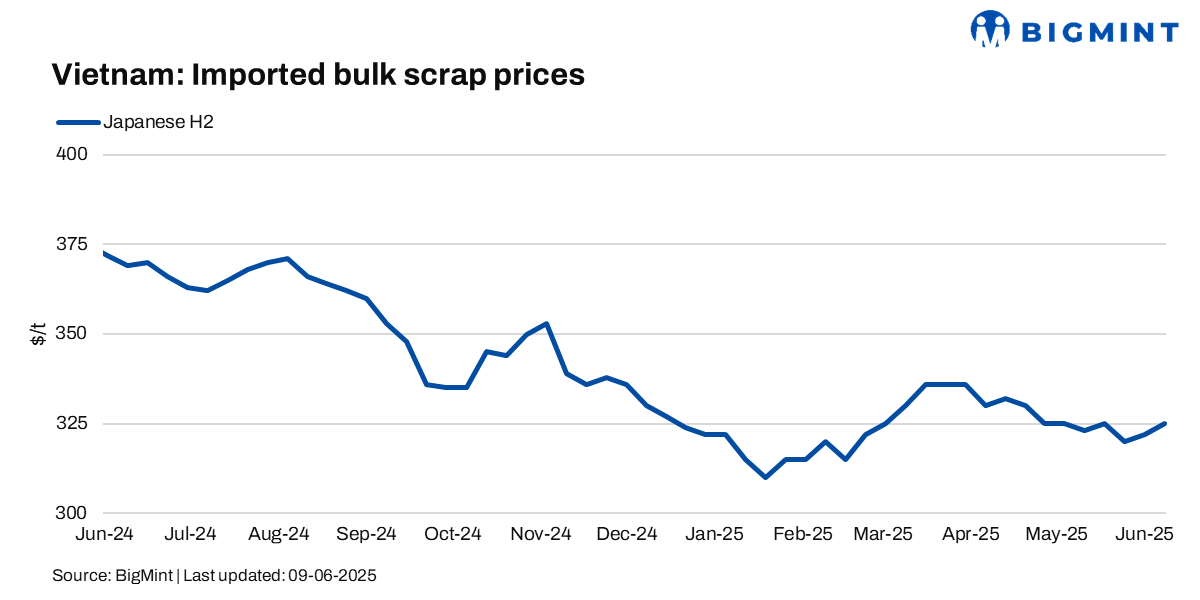
Imported ferrous scrap prices in Vietnam see a modest rise this week, though buying remains limited amid cautious sentiment.
The uptick of $3-5/t w-o-w was driven by firmer offers from key origins, particularly the US and Japan, although most mills remained hesitant to book large volumes.
According to a market participant, Southeast Asian market dynamics are shifting, with more Japanese and Korean scrap moving toward India. However, end-users in the region are increasingly preferring Chinese billets. While some Japanese material still flows into Vietnam, the volumes are noticeably lower than before.
Weekly assessments
- Japanese H2 was assessed at $325/t CFR, slightly up by $3/t w-o-w.
- US-origin HMS 80:20 bulk was assessed at $340/t CFR Vietnam, up by $5/t w-o-w.
Recent deals
- A bulk deal for 9,000 t of Singapore-origin HMS 80:20 was concluded at $328/t CFR Vietnam.
Market commentary
A mill-side participant informed that offers for Japan-origin H2 scrap in bulk were heard at $325-330/t CFR. The tradable level was slightly lower at $320-325/t CFR.
Meanwhile, US-origin HMS 80:20 in bulk was offered at $350-360/t CFR Vietnam, with indicative bids at $340-350/t CFR Vietnam.
A Vietnam-based trader noted, “Mills are staying on the sidelines, waiting for a more favorable exchange rate or a drop in domestic scrap prices in Japan.”
A Japanese supplier added that HS scrap offers softened to $355-360/t CFR, while bids remained at around $340-345/t CFR.
Domestic market scenario
- South Vietnam: Domestic HMS (3-6mm thick) bids were reported at VND 7,850-8,200/kg, delivered to a southern mill, excluding VAT.
- North Vietnam: Bid levels for domestic HMS (3-6mm thick) rose to VND 8,700-9,100/kg, delivered to a northern mill, excluding VAT.
US tariff pause puts Vietnam trade at risk
Vietnam’s trade surplus with the US reached over $125 billion, prompting a 46% tariff in April, now temporarily paused. The American Chamber of Commerce in Hanoi warned the tariff could damage US-Vietnam relations and deter investment. With the US accounting for nearly one-third of Vietnam’s exports, both sides aim to resolve the issue by mid-June.
Outlook
Looking ahead, market participants remain cautious amid ongoing currency fluctuations, soft regional demand, and trade policy uncertainty. Buying interest may stay muted unless exchange rates stabilise or Japanese domestic scrap prices ease further. The outcome of US-Vietnam trade negotiations will also play a key role in shaping import sentiments going forward.

Leave a Reply