- Non-coking coal exports edge lower on weak demand
- Asian buyers cut imports; export hubs show mixed performance
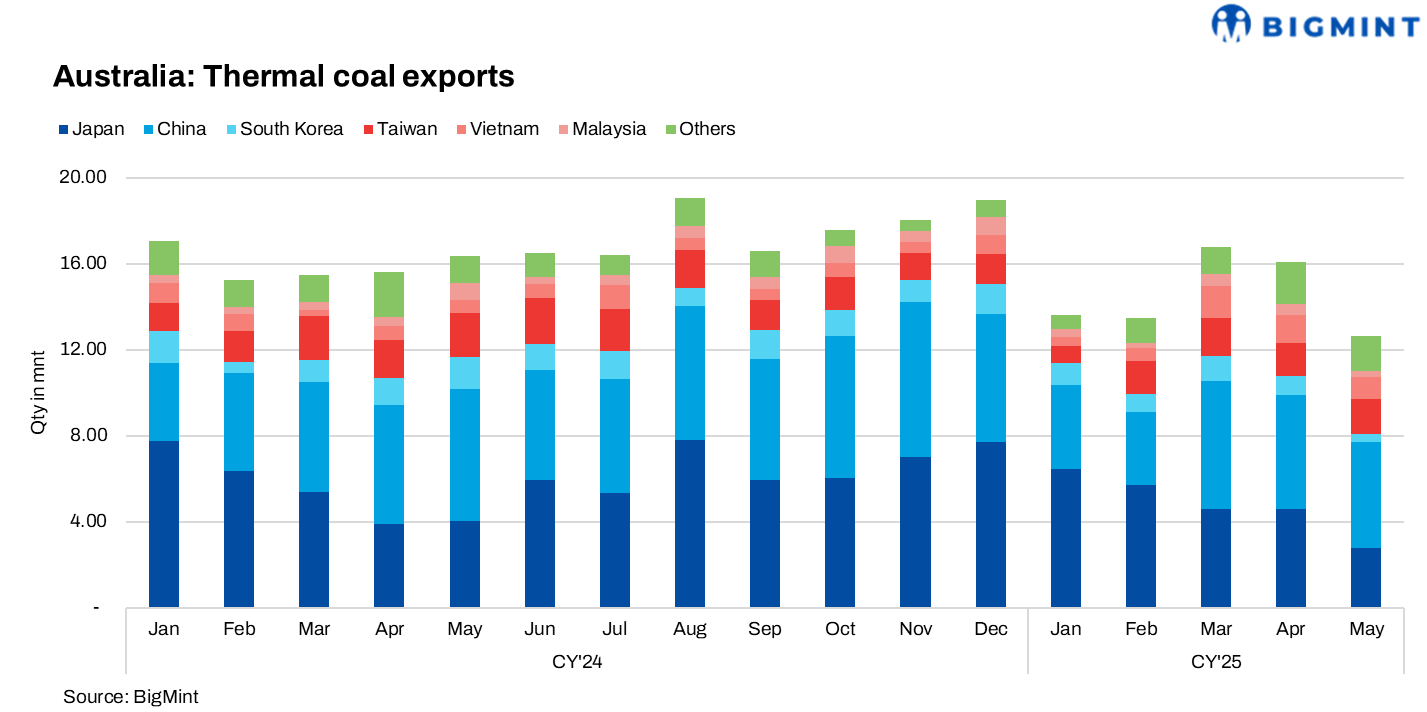
Australia’s non-coking coal exports witnessed a significant downturn in May’25, falling sharply to 12.62 million tonnes (mnt), a 21.5% drop from April’s 16.08 mnt. On a year-on-year (y-o-y) basis, the decline was even more pronounced at 22.8%, compared to 16.36 mnt recorded in May’24. The decline reflects a broader contraction in demand from major international markets, particularly across Asia.
Jan-May’25 export trends
In Jan-May 2025, Australia exported 73.22 mnt of non-coking coal, marking an 8.2% decrease from 79.76 mnt during the same period last year. This cumulative decline underscores the persistent weakness in global demand and indicates the challenges facing exporters amid shifting energy priorities and economic conditions in key importing countries.
Major Asian buyers scale back imports
The export slowdown in May was largely driven by reduced demand from major Asian buyers. Japan, one of Australia’s leading coal importers, slashed its intake by 40% compared to the previous month, with volumes dropping to 2.76 mnt. Vietnam also registered a sharp decline of 26.5%, importing 1.04 mnt.
China, while remaining the largest importer, reduced its intake by 9.1% to 4.96 mnt. South Korea recorded the most significant decline among major buyers, with volumes plunging by 70% to just 0.36 mnt. Malaysia followed suit with a steep 50.8% drop, receiving only 0.28 mnt in May.
In contrast to the overall regional downturn, Taiwan offered a glimmer of stability, increasing imports by 7% to 1.63 mnt, suggesting sporadic resilience in select markets.
Port-wise performance shows mixed results
Australian coal export terminals displayed mixed performance during the month. Newcastle Port, the nation’s largest coal exporting facility, handled 8.71 mnt in May’25 a steep 24.8% drop from Apr’25. However, not all ports followed this downward trend.
Gladstone Port rebounded strongly with a 23.8% increase in exports, reaching 1.33 mnt, while Abbot Point showed modest growth of 0.7%, totaling 1.29 mnt. On the other hand, several ports reported significant contractions.
Brisbane Port witnessed the largest fall, with exports down by 43.5% to 0.33 mnt. Dalrymple Bay Coal Terminal (DBCT) recorded a 41.8% decline, handling 0.72 mnt, and Port Kembla’s volumes dropped by 26.4% to 0.25 mnt.
Outlook: Headwinds persist for exporters
The continued m-o-m and y-o-y decline in export volumes highlights mounting challenges for Australia’s non-coking coal sector. Weakening demand in key Asian markets and inconsistent port performance signal a cautious outlook, with exporters needing to adapt to shifting trade dynamics and stricter environmental regulations across the region.
Leave a Reply