- CISA recommends mills optimise production schedules
- Steel inventories at CISA mills up 30% from start of 2025
Mysteel Global: Abundant supply and the risk of weakening demand are presenting more challenges for China’s steel industry, according to the latest monthly report of the China Iron and Steel Association (CISA), warning that the imbalance may threaten the stability of domestic steel prices in the weeks ahead.
Chinese steel producers should optimise their production schedules to prevent this mismatch from weakening steel prices further, the association also warned in the report on 28 May.
Domestic steel demand is likely to be constrained by the coming season of high temperatures and frequent rain in southern China. Meanwhile, the persistent weakness in real estate investment may trigger a faster contraction in steel demand, putting upward pressure on inventories, CISA noted.
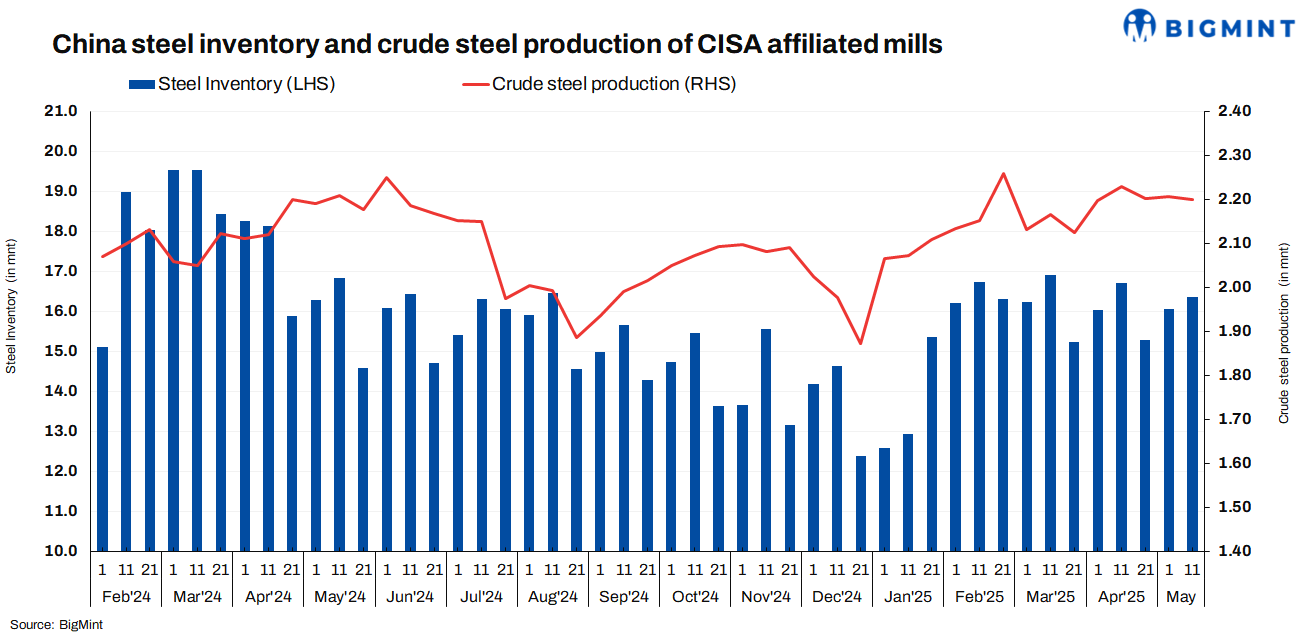
As of 10 May, inventories of the five major steel products comprising rebars, wire rods, hot-rolled coils, cold-rolled coils, and medium plates held by CISA’s member mills totalled 16.1 million tonnes (mnt), higher by 5% compared with late April and jumping by nearly 30% since the beginning of this year.
Although inventories of the five major steel items in the 21 Chinese cities under CISA’s regular tracking continued to fall during the first ten days of this month to 8.5 million tonnes (mnt), the rate of decrease had slowed to 4% as against the fall of 4.6% in late April.
However, crude steel output among Chinese steelmakers stayed high in early May, with the daily production among CISA’s member mills averaging 2.21 mnt/day, representing a slight rise of 0.2% from that for late April.
The association emphasised that supply-side factors would continue to drive domestic steel price movements, though earlier this month, the central government had taken a series of measures to boost demand. These included cutting the reserve requirement ratio to improve market liquidity and reducing loan interest rates to promote demand for house purchases.
CISA pointed out that over the medium to long term, production controls on crude steel may provide some support to domestic steel prices, considering the dual headwinds of demand moderation and mounting global trade volatility.
The latest World Economic Outlook (WEO) released by the International Monetary Fund (IMF) in April set the global growth forecast for 2025 at 2.8%, lower by 0.5 percentage points from its January projection. The IMF’s forecast for 2026 was also reduced to 3% as against the previous forecast of 3.3% issued in January.
China’s direct steel exports remain under pressure with the uncertainties surrounding the US Trump administration’s tariff policies and the rising tide of international trade protectionism, CISA also observed.
Though China and the US published a joint statement on 12 May aimed at easing trade tensions by pledging to temporarily cut tariffs, Chinese steel exports to the US continue to face elevated tariffs, as steel products are not included in the so-called “reciprocal” tariff list, the association noted. However, this move benefits the exports of electromechanical products such as automobiles and home appliances, which may stabilise indirect steel exports in the short term.
In the report, the association suggested that Chinese steel producers closely monitor changes in global steel demand and watch for the impact of rising trade protectionism on exports. Steelmakers should promptly adjust their export strategies to explore new market opportunities and develop emerging markets for risk diversification.
Meanwhile, Chinese steel mills should closely track demand volatility and optimise production allocation in response, the association recommended.
Note: This article has been written in accordance with a content exchange agreement between Mysteel Global and BigMint.
Leave a Reply