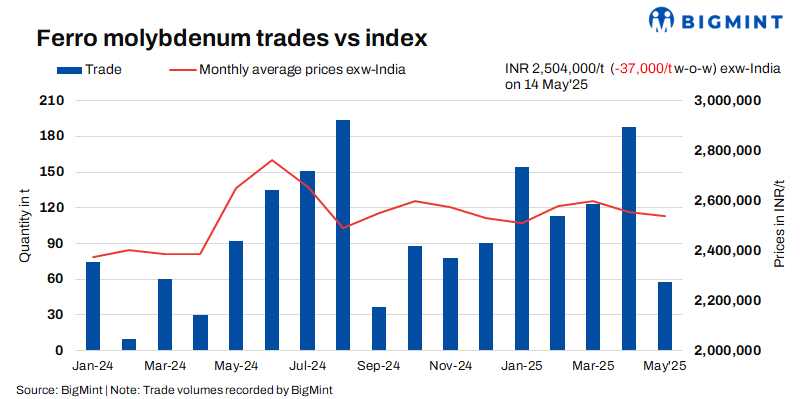
- Producers quote higher offers amid falling imports
- Chinese prices rise amid raw material shortages
Indian ferro molybdenum prices declined by INR 37,000/t ($433/t) in comparison to the previous assessment on 7 May. Prices fell, under pressure from bid-offer disparities.
Ferro molybdenum prices in India were at INR 2,504,000/t ($29,335/t) exw-India, as per BigMint’s assessment on 14 May 2025. Deals for around 25 t were recorded by BigMint in the price range of INR 2,490,000-2,550,000/t ($29,171-29,874/t) exw.
Market summary (8-13 May 2025)
Bid-offer gaps pressure market: Some producers in the domestic market quoted higher offers of up to INR 2,650,000/t ($31,046/t) due to the recent slowdown in imports of both molybdenum oxide and ferro molybdenum. However, limited acceptance was seen from buyers, and tradable levels largely stayed at INR 2,490,000-2,500,000/t ($29,171-29,288/t) exw.
A major seller informed BigMint, “The market seems to be range-bound. These kinds of price variations happen occasionally. Overall, market sentiment is stable.”
Chinese prices inch up: Ferro molybdenum (Mo:60%) prices in China edged up by RMB 2,000/t ($278/t) to RMB 230,000/t ($31,916/t) exw-Inner Mongolia. Prices rose amid a shortage of molybdenum concentrate, partly due to environmental restrictions in major production areas. Smelters kept prices high, as stainless steel production was strong. However, trading was slow after the holidays, which limited the price increase.
The supply crunch is unlikely to alleviate soon, and since steel demand is usually higher in May, prices might stay around RMB 228,000/t ($31,639/t) exw.
Prices in other regions hold firm: In the US and Europe (Mo: 70%), prices held steady w-o-w at $50/kg and $48/kg, respectively. Prices were stable on the London Metal Exchange (LME) platform as well, inching down slightly by $0.21/lb w-o-w to $19.8/lb on 13 May 2025.

Outlook
Given the bid-offer disparities, prices may fluctuate in the coming days. However, overall, they will remain range-bound in the near term.
Leave a Reply