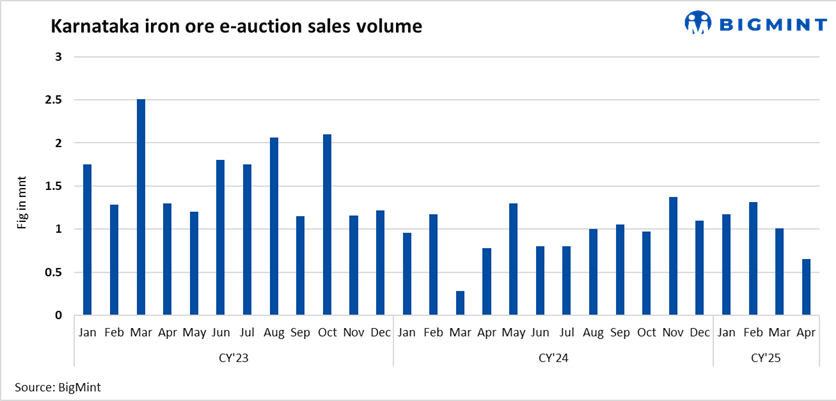
- NMDC’s e-auction sales drop over 50% m-o-m
- Miners increasingly favouring direct sales, LTAs
Iron ore e-auction sales volumes in Karnataka fell significantly by around 36% to 0.65 million tonnes (mnt) in April 2025 against 1.01 mnt in March 2025. Of the total volume sold in the month under review, fines accounted for 291,000 tonnes (t) (down 55% m-o-m), while lumps constituted 357,005 t (down 2% m-o-m). Notably, e-auction sales volumes fell to around a one-year low, according to data maintained by BigMint.
The decline in Karnataka’s iron ore e-auction sales was driven by a combination of strategic shifts by miners towards direct sales, a persistent gap between bids and high base prices, and buyer preferences for more favourable alternatives, including NMDC’s long-term agreements (LTAs), sources informed BigMint.
Additionally, raw material production was lower last month as FY’26 had just begun, and several miners remained out of the market, awaiting fresh environmental clearances (ECs). The volumes sold during the month largely comprised previously stockpiled lots, a miner told BigMint.

NMDC leads, but volumes drop sharply
- National Mineral Development Corporation (NMDC), India’s largest iron ore miner, sold around 320,000 t from Karnataka via auctions in April, a sharp decrease of 56% against 720,000 t in March. Of the total volume sold, 144,000 t were fines (down 71% m-o-m) and 176,000 t were lumps (down 23% m-o-m). However, the miner continued to maintain its status as the top auctioneer last month as well.
- Sandur Manganese and Iron Ores (SMIORE) sold 115,000 t of lumps and 32,000 t of fines, bringing its total sales volume to 147,000 t in April, a sharp hike of around 172% m-o-m from 54,000 t (only lumps) sold in March. The increase was mainly driven by the miner’s decision to offer fines and a higher volume of lumps in the merchant market.
- Karnataka State Minerals Corporation Limited (KSMCL) emerged as the third-leading miner, selling around 79,000 t of fines (down 48% m-o-m) and 52,000 t of lumps (down 12% m-o-m). This took its total sales volume via e-auctions to 131,000 t in April, a fall of 38% compared to 211,000 t in March.
Why did Karnataka’s iron ore e-auction sales plunge in Apr’25?
- Shift towards direct sales over e-auction: Miners are increasingly choosing direct sales over participating in e-auctions, driven by greater pricing flexibility. This shift allows them to negotiate terms directly with buyers, avoid the limitations of fixed base prices in auctions, and better align with market dynamics. As a result, participation in e-auctions has declined significantly, altering iron ore trading dynamics in Karnataka. A major miner told BigMint, “Karnataka-based miners are currently attempting to sell nearly 90% of their raw material through direct sales, as e-auctions are not receiving the expected response.”
- Reduced offered volumes from NMDC due to LTAs: As reported earlier by BigMint, in December 2023, NMDC put into place long-term agreements (LTAs) for iron ore sales from its Donimalai mines in Karnataka. Under these agreements, 80% of the iron ore was sold directly to Karnataka-based buyers, while only 20% was made available through auctions. While this approach aims to stabilise sales and offer price certainty through direct sales, it reduces the volumes available for e-auctions. This remains a key factor contributing to the decline in overall auction volumes from the region.
- Bid-offer disparities: The decline in auction volumes was also driven by a few miners setting prices significantly out of line with prevailing market rates, resulting in a notable bid-offer disparity. As a consequence, a substantial volume of material remained unsold. Furthermore, certain miners exited the market, and there were limited offers from those who remained.
- Arrival of imported cargoes: Recently, direct reduced iron (DRI) traders and manufacturers based in southern India secured imported high-grade iron ore lumps from South Africa, aiming to stabilise their raw material supplies amid fluctuating prices in Karnataka. Material was sourced from Kumba Iron Ore, a prominent South African supplier known for its high Fe content and low alumina and silica levels. This trend highlights a broader shift toward raw material diversification, as sponge iron producers explore alternatives from countries such as South Africa and Brazil to maintain cost-efficiency and operational stability.

E-auction lumps prices rise, fines stable m-o-m
The monthly weighted average e-auction prices of iron ore fines (Fe 60%) stood unchanged m-o-m at INR 3,400/t ($40/t). However, lumps tags (10-40 mm, Fe 63%) rose by INR 500/t ($6/t) to INR 4,900/t ($57/t) m-o-m. Prices are on ex-mines basis, excluding royalty, DMF, and NMET.
Although e-auction sales volumes declined m-o-m during the review period, prices remained firm compared to March 2025. This was supported by concerns over the availability of high-grade materials, prompting buyers to place premium bids in auctions.
Outlook
With major miners such as NMDC increasingly favouring LTAs over e-auctions, sales volumes in Karnataka are expected to remain low or decline further. As steelmakers explore alternative iron ore sources, the shift away from Karnataka’s ore is likely to continue in the short-to-medium term. Additionally, the proposed Mineral Resources Tax (MRT) is expected to significantly impact the state’s mining and steel industries. Industry sources warn that the bill could drive up mining costs, destabilise the market, and reduce the sector’s overall competitiveness. However, the bill is still pending approval. Despite these challenges, Karnataka remains India’s second-largest iron ore-producing state, with an estimated production of 46 mnt in FY’25.
Leave a Reply