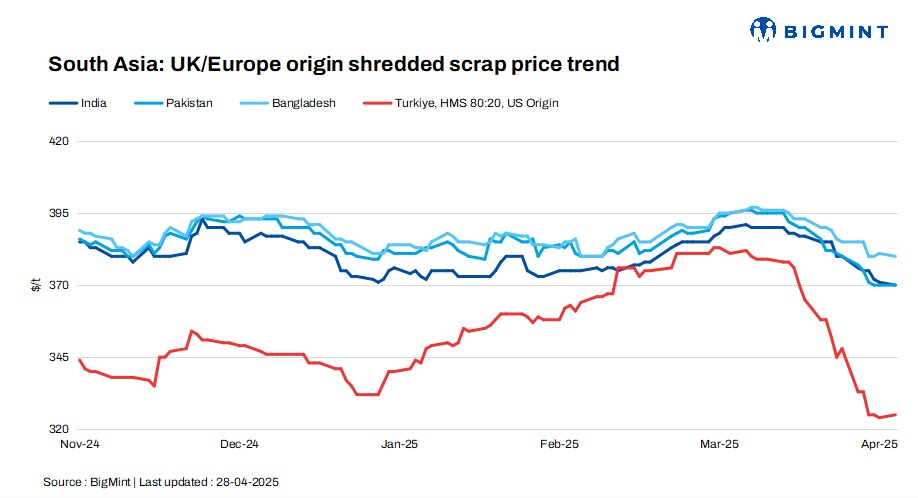
- Global uncertainties make buyers cautious
- Turkiye market shows slight price recovery
The South Asian imported scrap market remained largely subdued across key countries, with buyers adopting a cautious approach amidst global uncertainty and falling scrap prices.
In India, weak domestic demand, high freight costs, and full port inventories kept buyers on the sidelines, leading to a wide bid-offer gap. Similarly, Pakistan’s market showed limited activity as declining billet and rebar prices and global bearish trends, especially from Turkiye, dampened buyer interest.
Bangladesh also faced sluggish demand, with buyers postponing new bookings and focusing on stocks for later months. Meanwhile, Turkiye’s market remained range-bound, with some signs of stability but no clear price recovery.
UK-origin shredded scrap offers edged down by $1/t in India and Bangladesh, while remaining unchanged in Pakistan d-o-d. In contrast, US-origin bulk HMS 80:20 offers to Turkiye edged up by $1/t in comparison with the last closing on Friday.
Market overview
India: India’s imported scrap market remained subdued as buyers took a cautious stance in response to falling Turkish scrap prices and global market uncertainty.
Shredded scrap offers from the UK/EU were at around $370-375/t CFR Nhava Sheva, but bids were lower at $365-370/t, indicating a wide gap between buyers and sellers.
The market faced limited activity due to weak domestic demand, high freight costs, and full port inventories, with buyers preferring short-haul shipments or on-water cargoes.
Pakistan: Pakistan’s imported scrap market showed limited activity, influenced by weak local steel demand, falling billet and rebar prices, and global market uncertainty, particularly from Turkiye’s bearish trend.
Offers for shredded scrap from the UK/EU were at $370-375/t CFR Port Qasim, but buyers remained cautious, pushing for prices closer to $365-370/t. This led to a bid-offer stalemate, and only a few smaller container deals were concluded at $366-371/t.
With mills operating at reduced capacity and domestic prices of billets and rebar falling, the market remained subdued, and buyers held off on bookings, anticipating further price declines.
Bangladesh: Bangladesh’s imported scrap market remained sluggish, with buyers showing caution due to weak finished steel demand, rising production costs, and currency concerns.
Mills already had enough stocks for May-June and delayed fresh bookings, focusing instead on July shipments.
Shredded scrap offers from Australia at $380-385/t CFR struggled to gain interest, while HMS 80:20 bids were around $360/t CFR, lower than $365-370/t offers.
Bulk scrap purchases also dropped, with deals for HMS 80:20 from the US and Australia ranging between $350-$352/t CFR, reflecting a significant price decline.
The market faced a widening gap between bulk and containerised scrap prices, with rising freight costs dampening sentiment.
Turkiye: The Turkish imported scrap market remained rangebound, with sentiment showing signs of improvement. Bulk offers for HMS 80:20 from the US were assessed at $325/t CFR, a slight increase of $1/t from the previous day.
Sellers were hoping for stable or slightly higher prices, while mills focused on maintaining price stability to protect rebar margins. There was reluctance from both sellers and buyers to commit to lower prices, with some bids being rejected. Overall, market participants were cautious, waiting for clearer signals of a price recovery before making further transactions.

Price assessments
India: UK-origin shredded indicatives were assessed at $370/t CFR Nhava Sheva, down by $1/t in comparison with the last close on Friday.
Pakistan: UK-origin shredded indicatives stood at $370/t CFR Qasim, unchanged in comparison with the last close on Friday.
Bangladesh: UK-origin shredded indicatives were down by $1/t to $380/t CFR Chattogram in comparison with the last close on Friday.
Turkiye: US-origin HMS (80:20) bulk scrap prices edged up by $1/t to $325/t CFR Turkiye in comparison with the last close on Friday.
Leave a Reply