- Increased cargo movements from key suppliers
- Momentum in the Pacific supporting freights
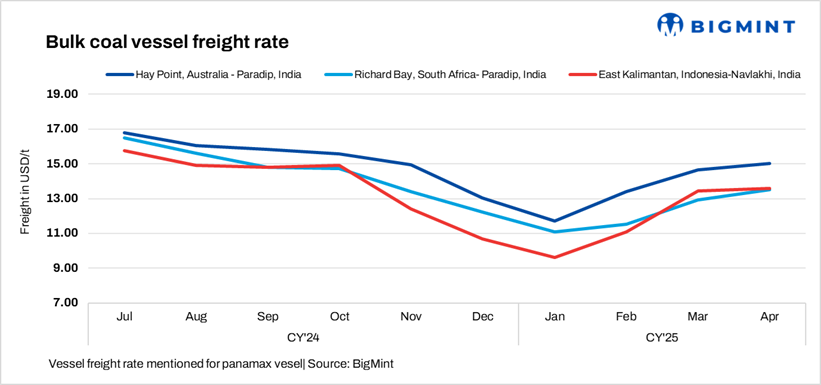
Coal freights in India rose w-o-w due to rising demand across the Asia-Pacific region, particularly in the Panamax segment. Market participants have observed increased cargo movements from East Australia and Indonesia, which are key suppliers of thermal coal to India. Tight vessel availability due to a healthy cargo list and firm fronthaul demand has resulted in heightened competition among charterers, thereby driving up freight rates.
Additionally, rising bunker fuel prices have further inflated voyage costs, which owners are passing on to charterers. These cost pressures, coupled with the improving macroeconomic outlook and steady coal import requirements from India, have collectively pushed coal freight rates northward.
The momentum in the Pacific basin, backed by increased commodity movements and a proactive chartering approach, has created a temporarily overheated freight environment.
Notably, thermal coal inventories at Indian ports remained largely stable w-o-w, edging up by 0.3% to 12.37 million tonnes (mnt) in week 16 of CY’25, from 12.33 mnt in the previous week, as per BigMint data.
Route specifications
- Australia-India rates remain stable: Freights from Australia to India remained steady w-o-w, with BigMint’s assessment indicating that rates for Hay Point Port to Paradip were at $14.6/dry metric tonne (dmt). Sources informed that NMDC Steel booked one Panamax vessel from Australia to Vizag at $14.10/t, with shipment scheduled for 20-29 May.
- South Africa-India freights rise: Freights from the Richards Bay Coal Terminal (RBCT) to Paradip increased by $0.7/t to $13.2/t, w-o-w. As per sources, one Panamax vessel was booked at $13.70/t from RBCT to Vizag for early May shipment.
- Indonesia-India freights climb: Freights for coal shipments from East Kalimantan to Paradip stood at $13.8/t, increasing by $0.5/t w-o-w, due to strong cargo replenishment in the Indonesian basin and bullish market sentiment across the Pacific. A shortage of available vessels, particularly on India’s west coast, added upward pressure on rates.

Leave a Reply