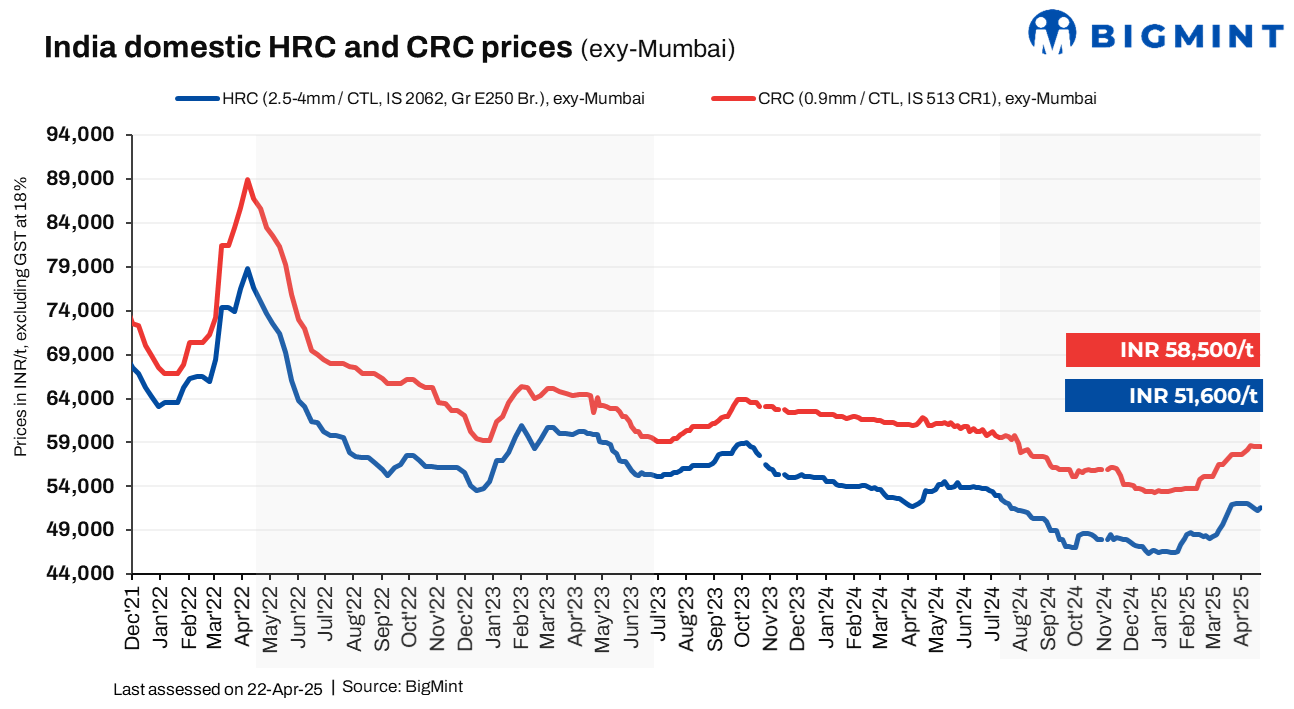
BigMint’s benchmark assessment (bi-weekly) for HRCs (IS2062, Gr E250, 2.5-8 mm/CTL) increased by up to INR 300/t ($4/t) w-o-w to settle at INR 51,600/t ($604/t) on 22 April 2025. However, CRC (IS513, Gr O, 0.9 mm/CTL) prices remained stable w-o-w at INR 58,500/t ($685t). These prices are quoted ex-Mumbai for the distributor-to-dealer segment and exclude 18% GST.

Market updates
Market remains cautious amid limited demand: Despite the implementation of the safeguard duty, distributors have not raised prices as they are exercising caution before quoting higher. Meanwhile, sluggish demand and buyers’ resistance to procure at higher price levels, have added to the woes of distributors.
Oversupply may restrict growth in export offers globally and hinder any sharp increase in domestic prices, despite the levy of a 12% safeguard duty. Meanwhile, the high threshold value of $675/t cost, insurance and freight (CIF) India for HRC under the duty regime allows some scope for local producers to raise prices. However, they are directly impacted by the weakness in offers prevailing in the major steel exporting countries.
With domestic producers having some legroom to increase prices in view of the threshold price for imported HRC, domestic MSMEs dependent on domestic steel are likely to be hit by increasing prices.
Govt assures export price parity for MSMEs: The steel industry has committed to supplying micro, small, and medium enterprises (MSMEs) with steel at export parity prices, addressing concerns over the impact of the newly imposed 12% safeguard duty on certain imports. These steel products are vital inputs for sectors such as engineering goods manufacturing.
According to a government official, this arrangement, developed in consultation with the Engineering Exports Promotion Council (EEPC), ensures MSMEs have access to steel at globally competitive rates, safeguarding them from potential cost pressures due to policy-induced price increases.
Export parity pricing refers to the adjusted international market price at which domestic producers sell steel abroad, after accounting for freight and export-related costs.
Import trends: India’s bulk imports of HRCs and plates touched 210,591 t as of 21 April, based on vessel line-up data from BigMint. Another 65,488 t are expected to arrive by the end of the month.

Export trends: Indian mills have increased their HRC (S275) FOB offers to Europe. However, trade activity in the region is currently slow due to the Easter holiday period. Indian HRC export offers to the EU have increased by $10-15/t w-o-w, reaching $645-650/t CFR Antwerp, compared to $630-635/t CFR the previous week. Indian mills are not actively offering to the Middle East due to price competition from Chinese suppliers and more favourable domestic prices.
Outlook
HRC and CRC prices have risen, but the market remains cautious as participants try to assess the safeguard duty’s impact. Oversupply and buyer resistance may limit further price increases. However, global steel prices may deteriorate further amid escalating trade wars and worsening oversupply. The safeguard duty, therefore, provides import parity. However, normalisation of the pricing dynamics will still take some time.
Leave a Reply