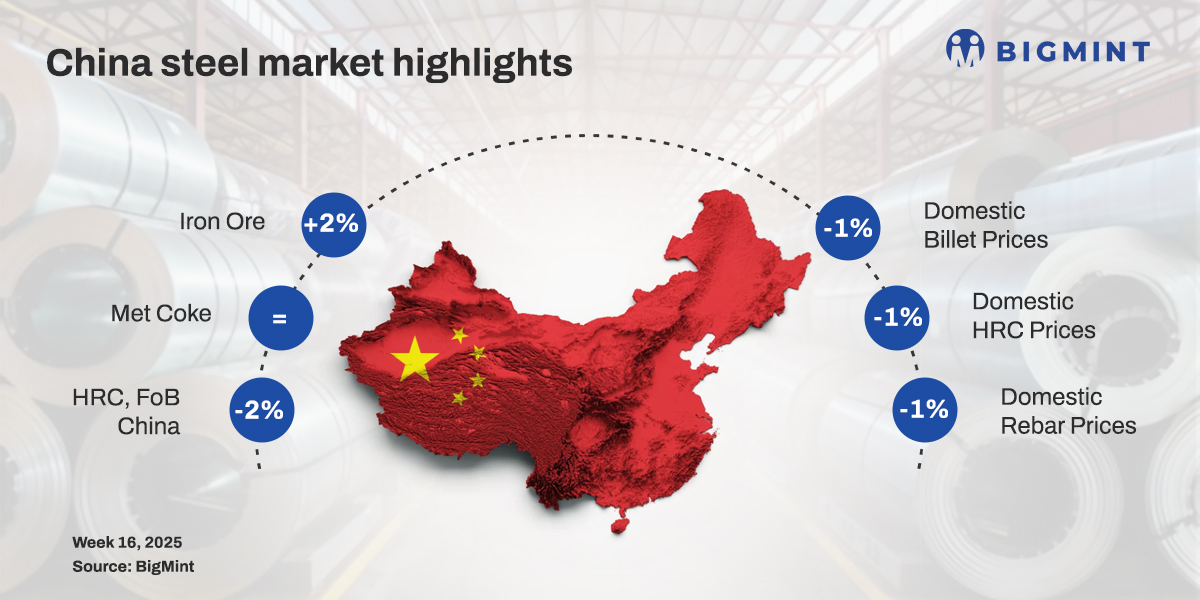
- Iron ore, coking coal prices rise
- Billet, HRC, rebar tags decline
China’s steel market witnessed a mixed trend this week, influenced by falling SHFE futures and global macroeconomic uncertainties. Domestic hot-rolled coil (HRC) and rebar prices dropped w-o-w, while billet tags also saw a decline. In the raw materials segment, spot iron ore prices inched up. Moreover, coking coal showed an upward trend.
The China Iron and Steel Association (CISA) revealed that the total steel inventory at key Chinese enterprises stood at 16.04 million tonnes (mnt) in early-April 2025. Inventory levels increased by 810,000 t or 5.3% from 15.23 mnt in late-March 2025.
China’s crude steel production in March 2025 stood at 92.84 mnt, reflecting a 4.6% y-o-y rise compared to 88.27 mnt in March 2024, according to data from the National Bureau of Statistics (NBS).
China’s steel exports for March 2025 stood at 10.456 mnt, up by 5.7% y-o-y, as per the General Administration of Customs.
1. Iron ore spot prices rise by $2/t w-o-w: The benchmark iron ore fines index gained $2/t w-o-w to $100/t CFR China on 17 Apr amid improved downstream steel demand in China, particularly for rebar and hot-rolled coils. Despite ongoing macroeconomic concerns and trade tensions with the US, demand growth outpaced supply, especially as rebar production saw a w-o-w decline while consumption surged. This created tighter market conditions, boosting sentiment and lifting seaborne prices.
a) Spot pellet premium falls w-o-w: The spot pellet premium for Fe65% grade pellets decreased by $0.35/t w-o-w to $12.90/t CFR China on 17 April.
b) Spot lump premium stable w-o-w: The spot lump premium remained stable w-o-w at $0.1450/dmtu on 17 April.
2. Coking coal prices up w-o-w: Australian PHCC prices recovered sharply after hitting a four-year low of $166/t FOB in March 2025. As of mid-April, prices stood at $188/t FOB Australia. Prices surged due to supply concerns following accidents at Australia’s two leading mines – Moranbah North and Appin – last week.
3. Chinese billet prices drop by RMB 30/t (4/t) w-o-w: Steel billet prices in Tangshan, China, dropped by RMB 30/t ($4/t) w-o-w to RMB 2,940/t ($403/t), including 13% VAT, on 18 April. The market remained fragile amid high crude steel output and ongoing rumours of a potential tariff hike from the US, which kept sentiment mixed. Daily trade volumes hovered at around 110,000-130,000 t, while inventories hit a two-month low. Prices remained largely range-bound throughout the week, fluctuating between RMB 2,970-2,940/t. Meanwhile, SHFE rebar futures (October 2025 delivery) declined by RMB 55/t ($8/t) to RMB 3,076/t ($421/t), signalling caution in the market amid sluggish trading and limited downstream demand.
4. Domestic HRC prices fall w-o-w: Chinese HRC offers fell by RMB 30/t ($4/t) to RMB 3,220/t ($441/t) from RMB 3,250/t ($445/t) a week ago, following the decline in SHFE futures. SHFE HRC futures decreased by RMB 48/t ($7/t) w-o-w to RMB 3,187/t ($437/t) as of RMB 3,235/t ($443/t) last week. This decline is attributed to escalating global trade disputes, which have dampened market sentiment and pushed down domestic prices in China. China’s HRC export offers dropped by $10/t w-o-w to $455/t as compared to $465/t a week ago.
5. Domestic rebar prices drop w-o-w: China’s rebar offers dropped by RMB 20/t ($3/t) w-o-w to RMB 3,210/t ($440/t) from RMB 3,230/t ($443/t) last week, mirroring the fall in SHFE rebar futures. Additionally, SHFE rebar futures (October 2025 contract) stood at RMB 3,088/t ($423/t) for the week, down by RMB 38/t ($5/t) from 3,126/t ($428/t) as of 11 April 2025. This decline is attributed to weak demand, as buyers adopted a wait-and-watch approach amid bearish sentiment and limited trading opportunities. Moreover, unfavourable weather also slowed down construction activity, further weighing on demand.

Outlook
The short-term outlook for China’s steel market remains uncertain, with prices likely to face downward pressure due to limited demand support and growing competition among mills. As the seasonal peak nears, cautious sentiment may persist, shaped by ongoing US-China trade tensions, domestic policy signals, and fading expectations of economic stimulus. Volatility may continue, prompting close market monitoring.
Leave a Reply