- Supply tightness seen as mills ship lesser volumes
- Market expects policy support in face of tariffs
- Is present rally a correction of previous decline?
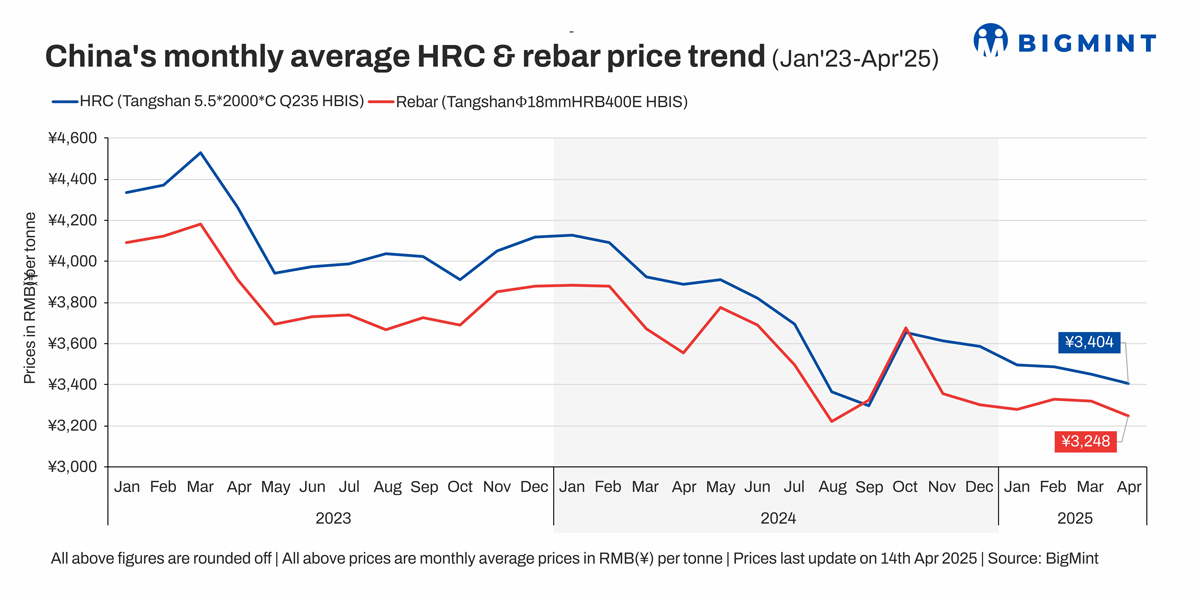
Morning Brief: Chinese steel prices started rebounding from April onwards. In fact, as per data maintained with BigMint, Tangshan’s benchmarked rebar was slightly volatile but began up-trending from early April itself, while the hot rolled coil (HRC) started recouping from early second week of this month.
The main 10-day rebar contract on the Shanghai Futures Exchange (SHFE), around 10 April, closed at RMB 3,139/tonne ($429/t), up 62 points from the previous trading day. The HRC contract closed at RMB 3,255/t ($445/t), up 64 points d-o-d. The main coke contract closed at RMB 1,550.5 ($213/t), up 29 points d-o-d while coking coal, at RMB 913/t ($125/t), was down 3.5 points d-o-d. Iron ore 10-day futures closed at RMB 707/t ($97/t), up 21 points from the previous trading day.
In many regions, prices rebounded by RMB 40-50/t ($5-7/t). A few markets even rose by RMB 60-70/t ($8-10/t).
What factors are boosting prices?
Supply tightness causes rally: Market participants said that they stepped back a little, wary of the price fluctuations. Sellers’ quotes had already been raised by RMB 40/t ($5/t). A tightness in supply could be attributed to the price increase. Large mills were unwilling to ship and were quoting relatively higher. In addition, although the increase in cold-rolled, section steel, and medium plate varieties was smaller, they also actively took the opportunity to recover. Some merchants took the opportunity to restock. From the perspective of the futures market, rebar and hot-rolled coils have rebounded by about 100 points from their last low point, and the main contracts have increased by more than 2% per day, showing a stronger momentum than the spot market.
Policy support expectations replace tariff worries: The current market scenario has reversed from one of panic caused by the tariff storm to expectations of support from policies. Traditionally, tariff wars have always had an impact on prices, resulting in increased volatility as well.
To illustrate this point, Baosteel rolled over its domestic prices of plates for May sales. Almost all plate varieties remained unchanged, which also reflects the group’s stable pricing idea despite the pressure of dumping duties and tariffs.
Tariffs- a bane or boon?
In response to the impact of the tariff war, it is being said, decision-makers will boost domestic consumption with extraordinary efforts to offset the reduction in overseas demand. But, from another perspective, the industry will realign: Product quality will be improved and special steels will be stressed upon, to meet the needs of the domestic high-end market. Furthermore, localisation will be accelerated to replace some imported high-end steel products. Overall, the tariff war has brought certain challenges to the Chinese steel market, but it has also prompted the Chinese steel industry to accelerate structural adjustments, transform and upgrade itself, and enhance its competitiveness and risk resistance. Thus, the current mood is one of positivity rather than panic.
Outlook
After the US fired its 125% tariff ceiling, the market’s concerns about uncertainties have been alleviated. Instead, it continues to rebound rapidly in step with rising global stock and commodities markets. At present, except for coking coal, which is relatively weak, other commodities have staged a strong rebound. However, experts warn that this rally is a correction of the decline seen previously, and not necessarily that the market fundamentals are strong. But, as of now, there are signs of a sustained upward swing.
Leave a Reply