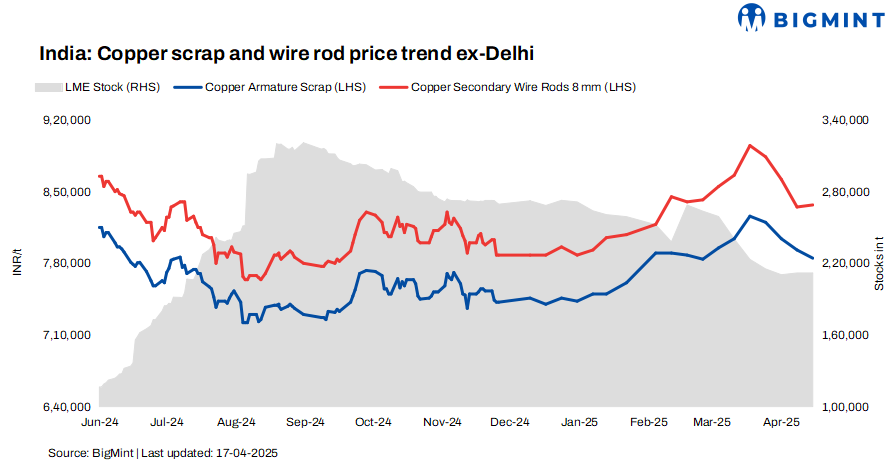
- LME prices climb up by $190-195/t w-o-w
- US tariff uncertainty weighs on sentiment
India’s copper scrap prices increased this week, amid supply shortages in the raw material as well as semi-finished segment. In recent times, there has been limited availability of copper cathodes, set off by the government’s imposition of a quality control order (QCO).
Copper armature scrap was assessed at INR 785,000/tonne (t) ex-Delhi, up by INR 11,000/t w-o-w, while motors mix tags moved up by $15/t w-o-w to $1,150/t. This followed a rise of $190-195/t w-o-w in London Metal Exchange (LME) futures to $9,174/t from last week’s $8,978/t. Meanwhile, copper stocks at LME-registered warehouses stood at 211,925 t, up by 1% compared to 209,425 t in the previous week.
Secondary continuously cast rods (CCRs) (99.90%) were assessed at INR 837,000/t ex-Delhi, reflecting a rise of INR 2,000/t w-o-w. Meanwhile, primary CCR prices stood at INR 850,000/t.
Market insights
A trader shared, “We have already sold a decent amount of armature scrap in the range of INR 750,000/t. However, we are now looking at the futures prices and holding on to material to maintain profit margins, as we expect tags to move up on low inventories.”
Another source stated, “The scrap market is currently facing a material shortage. Ongoing US tariff uncertainties have further weighed on sentiment, leading to a wait-and-watch approach among stakeholders and intensifying pressure on already tight copper supply chains.”
Hindustan Copper has resumed ore production at its Kolihan Copper Mine in Rajasthan after a suspension due to a fatal lift accident in May 2024. With 20.64 million tonnes (mnt) of reserves at 1.35% copper, HCL plans to expand the mine’s capacity to 1.5 mnt annually to meet rising domestic demand.
Impact of tariffs
The US has implemented a 125% tariff on Chinese copper imports, with China retaliating by imposing 84% tariffs on US goods. Additional tariffs on 60 countries were briefly activated but have been paused for 90 days, with a 10% universal tariff still in place, excluding copper. Copper is also under a Section 232 investigation, which could lead to further tariffs.
India’s QCO sparks supply shortages
India’s leading metals trade associations have taken legal action against the Centre, challenging the recently implemented a QCO on copper cathodes. They argue that the QCO, which came into effect on 1 December 2024, was not issued in the public interest and has led to acute shortages in copper supply.
Following its implementation, copper cathode imports dropped sharply in December and January. The decline is largely attributed to delays faced by foreign suppliers in obtaining the mandatory quality certification from the Bureau of Indian Standards (BIS), without which shipments are barred from entering the Indian market.
After the QCO took effect, downstream users warned of a 90-day copper shortage and requested a delay. Japan supplies 70% of India’s copper imports. By 15 April, nine foreign suppliers, including six from Japan, had received BIS certification. Despite this progress, compliance challenges persist, hindering smooth copper imports.
Only major primary players in the domestic market are BIS-certified to supply copper cathode in India. Despite rising domestic supply, the petition argues that demand will outstrip production capacity, potentially creating a monopoly and driving prices up. The QCO, initially delayed, became effective in December 2024 amid ongoing supply concerns.
Recent deals
Deals heard for Meatball (20%) were in the range of $1,800-1850/t, and some grades such as Millberry were heard traded at a premium to LME prices. Additionally, copper motors mix was traded at $1,130/t recently.
Other updates
Chile’s Codelco will supply copper concentrate to Adani’s $1.2 billion Kutch smelter in Gujarat, starting 2025. The plant, initially with a capacity of 500,000 t, will expand to 1 mnt. Codelco has also signed a preliminary deal with Hindustan Copper for mineral exploration and processing.
Outlook
Copper prices are expected to remain elevated due to ongoing material shortages and rising LME prices, with recent increases in both domestic and international markets. The ongoing uncertainty around US tariffs and India’s QCO is likely to continue affecting supply and pricing dynamics in the near term.
Leave a Reply