- US-China tariff war pressures seaborne market
- Exporters wait & watch, no deals seen from India
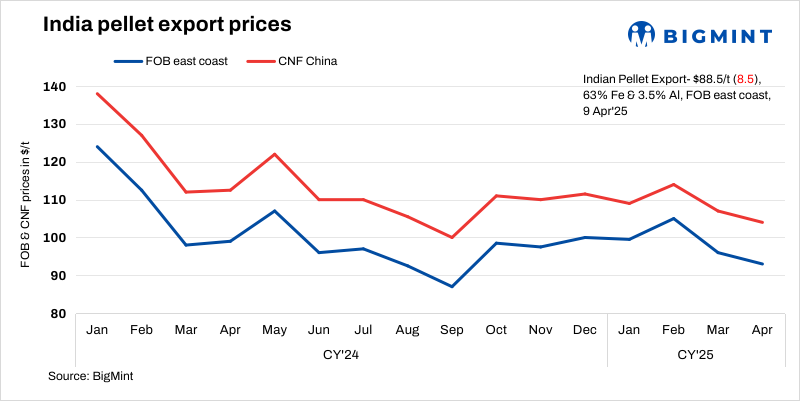
Pellet prices in the export market witnessed a sharp drop of $8-10/tonne (t) this week, driven by rising trade tensions between the US and China over tariff impositions. The sudden decline in global pellet prices has directly impacted the Indian export market, pushing exporters to rethink their strategies.
BigMint’s India pellet (Fe 63%, 3% Al) export index (FOB east coast) dropped by $8.5/t w-o-w to $88.5/t on 9 April 2025 against the previous assessment on 9 April. The pellet export index has dropped to its lowest level in over six-and-a-half months, with current prices as low as those seen in September 2024- a level not reached at any point in between. No trades were recorded this week from the east coast amid the huge gap in the bids and offers.
Market participants reported a significant downward shift in sentiment, with a $10-12/t price gap emerging between buyers and sellers. An exporter said: “The gap is too wide for any meaningful deals to be concluded at the moment. We are closely monitoring the global cues, but the current trend remains bearish.”
Domestic prices exceeded export offers by INR 2,400/t ($28/t), rising by INR 800/t ($9/t) w-o-w. Pellet (Fe63%) prices in Odisha’s Barbil were recorded at INR 8,150/t ($94/t) exw, firm w-o-w. Meanwhile, ex-plant realisation in exports from Barbil stood at INR 5,750/t ($66/t) exw.
Due to limited export inquiries and poor realisations, some Indian pellet producers have started diverting material to the domestic market, where prices and demand remain comparatively good in comparison to export offers.
Despite the pressure on exports, domestic pellet trading remains strong, supported by sponge iron manufacturers ramping up purchasing. Exporters are expected to continue gauging global developments, but with weak export sentiments, the domestic market may offer temporary relief in the coming weeks.
A seller informed, “We are getting decent inquiries in the domestic market, and even the realisations have a huge gap against exports. We actively sold the material to local buyers and will offer in the domestic market until there is an improvement in export prices.”
On the other hand, in the recent development the US imposed 104% tariff on Chinese goods. This escalating tariff battle is disrupting global trade, creating uncertainty in commodities markets, and raising concerns over economic prospects. The situation is bearish for the seaborne iron ore market, with low liquidity and cautious market participants sitting on the sidelines.
Rationale
- No confirmed deals from India’s east coast were recorded in this publishing window for T1 trade. Thus, this category was not taken into consideration for today’s price calculations and accorded 0% weightage in the index calculation. Click here for the detailed methodology.
- Nine (9) indicative prices were received, and seven (7) were considered for calculation of the index and given 100% weightage.
Factors impacting pellet exports
- Chinese iron ore fines prices fall w-o-w: The benchmark iron ore fines index fell a significant $8/t w-o-w to $96/t CFR China on 8 April. Seaborne iron ore prices experienced significant pressures due to escalating trade tensions between the US and China, which resulted in a substantial decline in the futures market. Reports indicated that the increasing trade tensions were creating uncertainty in global trade flows and contributing to a bearish outlook for the market.
- DCE iron ore futures decline w-o-w: Iron ore futures on the Dalian Commodity Exchange (DCE) for the May 2025 contract decreased w-o-w by RMB 102.5 ($14/t) to RMB 689/t ($94/t) on 9 April. On a d-o-d basis, futures remained stable.
Outlook
As per BigMint’s analysis, pellet export offers are expected to remain highly volatile in the coming days following the current tariff tensions and are unlikely to see any export deal concluded from India in the near term. The market will get better clarity in the upcoming weeks.
Leave a Reply