- Demand rises 1.2% in China, 5.5% in India
- Consumption falls by 4% in US, 10% in EU
Mysteel Global: Global coal demand grew at a slower pace in 2024, rising by 1.1% or 67 million tonnes of coal equivalent (Mtce) in energy terms, as intense heat fuelled electricity consumption but expanding renewable energy sources tempered overall coal usage, according to the latest Global Energy Review by the International Energy Agency (IEA).
The rise was only half of the previous year’s growth rate and the lowest since 2021, according to the IEA report.
While coal remains the world’s dominant power source, its share in the global electricity mix fell to 35%, the lowest since the IEA was founded in 1974.
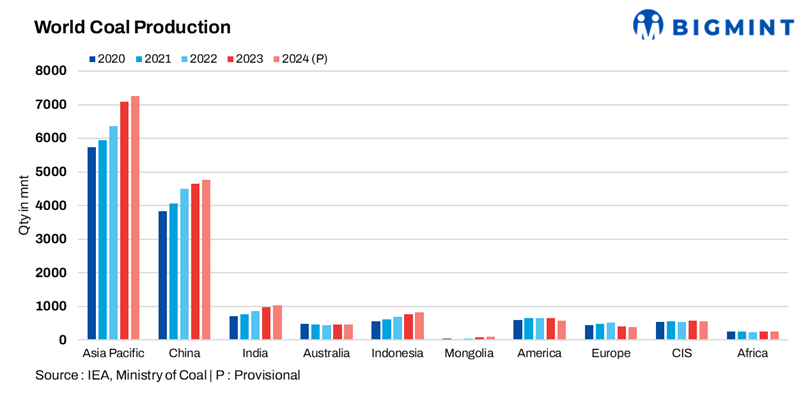
Developing Asia continued to lead global coal consumption, accounting for nearly 80% of total demand. China, the world’s largest coal consumer, saw a 1.2% increase (43 Mtce) in 2024, reaching an all-time high. The country now burns nearly 40% more coal than the rest of the world combined, with Chinese power plants accounting for over a third of global coal consumption.
China’s electricity demand surged by 7%, or 550 billion kilowatt hours (kWh) last year, driven by economic growth and extreme summer heat waves. Despite massive investments in solar, wind, and nuclear power, coal generation rose 1.2% to meet the growing electricity shortfall. However, industrial coal demand in China declined, as steel production fell by 1.7%, and cement output dropped by 9.5%, while coal use in the chemical sector increased.
India, the second-largest coal consumer globally, saw a 5.5% rise (40 Mtce) in demand, also setting a new record. Coal power generation increased by 5%, tracking rising electricity demand, while industrial coal use grew in line with a 6.3% rise in steel production.
Southeast Asia, which overtook the United States as the world’s third-largest coal-consuming region in 2023, saw an 8% increase (25 Mtce) in demand. Indonesia’s booming nickel industry was a key driver, while the Philippines and Vietnam ramped up thermal power generation using coal.
Coal demand in advanced economies continued to decline. In the United States, consumption fell by 4% (10 Mtce), though this was a slower decline than the 17% drop recorded in 2023. The shift was driven by recovering electricity demand, which limited further declines in coal use.
In the European Union, coal power generation fell 15%, pushing total coal demand down by over 10% (21 Mtce), as an increasing number of countries closed coal-fired power plants.
Despite coal’s continued dominance, the global energy transition is accelerating. While coal-based electricity generation grew by 90 billion kWh in 2024, power generation from wind, solar, and nuclear increased by 770 billion kWh.
Without this surge in renewables, coal demand growth would have been nearly twice as high, the IEA estimated.
In the report, the IEA also revealed the world’s energy consumption rose by 2.2% last year, lower than the growth rate of 3.2% in global GDP. Meanwhile, the world’s power consumption jumped by 4.3%, nearly doubling the annual average of the past decade, driven by record temperatures, rising industrial consumption, the electrification of transport, and the growing energy needs of artificial intelligence and data centres.
Note: This article has been written in accordance with a content exchange agreement between Mysteel Global and BigMint.
Leave a Reply