- MOIL hikes manganese ore prices for Mar
- Global miners raise offers for Mar sales
Indian manganese ore producers have raised prices for March 2025 deliveries, influenced by MOIL’s recent price hike. From 1 March 2025, prices for grades above Mn44% increased by 10%, while those below Mn44% saw a 6.5% rise m-o-m. SMGR grades (Mn30%, Mn25%, Mn20%) remained unchanged, while fines saw a 6.5% hike.
In response to MOIL’s revised pricing, major Indian producers have similarly raised prices of both high-grade (above 44% manganese) and low-grade (below 44%) manganese ore to align with market trends.
Region-wise price adjustments
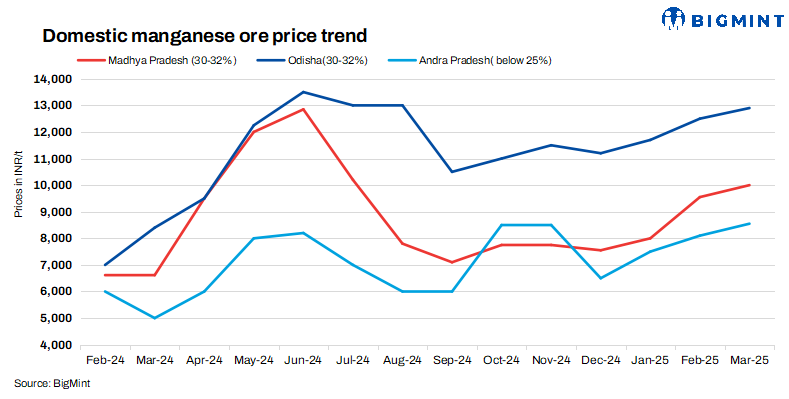
Madhya Pradesh: In Madhya Pradesh, manganese ore grades below 44% saw a 5% m-o-m price increase, while grades above 44% rose by approximately 9%. These price hikes align with MOIL’s revisions, with global manganese ore price increases also being a factor. However, the stagnant demand for manganese alloys in the region has raised caution among miners, prompting them to remain vigilant regarding potential future price adjustments.
A leading miner observed, “Though offers have risen, there is a significant gap in their acceptance, which is causing panic in the market. The disconnect between pricing expectations and actual demand is creating instability, making it challenging to gauge future trends.”

Odisha: Prominent Odisha-based miners increased prices of 30-32% grade manganese ore by 3% m-o-m, following MOIL’s recent adjustments. The 28-30% grade saw a 5% rise. This price increase is likely due to ongoing production curtailments and higher offers from global miners, influencing regional market dynamics.
A key miner told BigMint, “Market conditions appear stable for ore prices in the region, with a sharp increase unlikely due to weak demand. However, we expect further price hikes in the coming month, driven by potential supply constraints and global market trends.”
Andhra Pradesh: Miners in Vizag, an export-centric region and a key producer of low-grade manganese ore (below 25%), increased their offers by 6% m-o-m. The price uptrend is driven by increasing demand for manganese ore and constrained supply in the region, leading to lower inventories among alloy producers and reinforcing upward pricing pressure.
A miner from Vizag explained, “The rise in regional offers is primarily driven by slightly improved demand when compared to the last 2-3 months, with key miners raising their prices. The upward trend in imported ore prices has directly impacted domestic manganese ore pricing.”
Factors influencing manganese ore prices
Imported ore prices rise m-o-m in Feb: South African-origin manganese ore (37%) prices edged up by 8% to a monthly average of $4.55/dry metric tonne unit (dmtu) in February compared to $4.2/dmtu in January. Meanwhile, for manganese ore of Australian (46%) origin, prices rose by 12% to $5.1/dmtu in February as against $4.55/dmtu in January. Gabonese-origin ore (Mn44%) increased by 9% to $4.77/dmtu in February as against $4.37/dmtu in January.
Global miners raise ore offers for Mar: Eramet Comilog, a major manganese ore exporter from Gabon, has set its March shipment prices of Mn44.5% lumps at $4.75/dmtu and Mn43% grade chips at $4.55/dmtu, both CIF China, marking a $0.45/dmtu m-o-m increase.
Additionally, South32, a leading global miner, has announced a hike in prices of Mn37% grade South African semi-carbonated manganese ore lumps by $0.6/dmtu m-o-m for March shipments to $4.65/dmtu CIF China.
Domestic silico manganese price up m-o-m: Prices of Indian 60-14 grade silico manganese increased by INR 3,260/t ($37/t) m-o-m to around INR 73,160/t ($837/t) exw-Raipur in February 2025 compared INR 69,900/t ($800/t) in January, as per BigMint’s assessment. This increase is driven by higher export offers, fuelled by rising demand and constrained supply, which has resulted in domestic deals being concluded at elevated prices.
Outlook
The near term outlook for manganese ore prices remains bullish, driven by rising global prices, supply constraints, and increasing demand. However, weak alloy demand in certain regions may limit sharp price increases.
Leave a Reply