- Pakistani buyers cautious ahead of Ramadan
- Turkiye’s scrap market remains firm
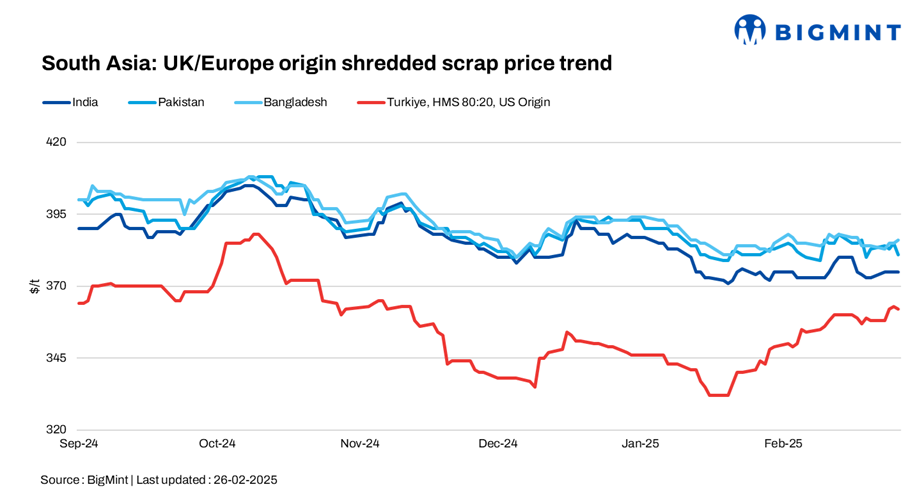
The South Asian imported scrap market remained subdued across regions, with sluggish demand, liquidity constraints, and economic uncertainties weighing on buying activity. In India, weak sentiment and ample domestic supply kept buyers on the sidelines, while Pakistan’s scrap market faced pressure from tight liquidity and cautious pre-Ramadan trade. Bangladesh struggled with high inventories and stalled government projects, leading to limited fresh bookings. Meanwhile, Turkiye’s scrap market showed resilience despite slow finished steel sales, with sellers holding firm on offers amid tight supply.
Overview
India: India’s imported scrap market remained sluggish due to weak demand, liquidity constraints, and a widening bid-offer gap. Buyers showed little interest in fresh offers, with UK/Europe-origin shredded quoted at $375-380/t CFR Nhava Sheva, while HMS 80:20 at $350-355/t CFR. Ample domestic scrap supply further limited imports, and a weakening rupee dampened sentiment. US bulk shipments faced delays of 60-70 days, discouraging purchases.
With market participants struggling to clear port inventories, many sought extended free days. Market sentiment remained bearish, with hopes for a revival post-March, closely tracking global trends, particularly Turkish scrap prices.
Pakistan: Pakistan’s imported scrap market remained sluggish as weak liquidity and subdued steel demand kept buyers cautious ahead of Ramadan. Shredded scrap from the UK/Europe was offered at $380-383/t CFR Qasim, but bids at $375-380/t CFR limited deals. However, buyers showed interest in UAE-origin scrap due to its shorter three-day transit time, with deals heard at $380-382/t CFR Port Qasim.
Local scrap stood at PKR 140,000-145,000/t ($501-519/t) exw, while rebar was at PKR 245,000-250,000/t ($876-894/t) exw. Market sentiment remained cautious, with further slowdown expected during Ramadan.
Bangladesh: Bangladesh’s imported scrap market remained subdued as weak steel sales, high inventories, and stalled government projects kept buyers cautious. With Ramadan approaching, mills showed little interest in fresh bookings.
Steel demand has nearly halved since February, with major projects either delayed or on hold, and no signs of revival. In Chattogram, rebar prices stood at BDT 85,000-86,000/t ($700-708/t) exw, with recovery looking uncertain. European shredded offers ranged between $385-388/t CFR Chattogram, but bids were lower at $374-375/t CFR. Australian shredded was offered at $378-380/t CFR, with buyers bidding $366-370/t CFR. PNS and Busheling stood at $388-392/t CFR, while bids remained at $380-382/t CFR.
Turkiye: The Turkish imported scrap market remained firm, despite slow finished steel sales. Prices dipped slightly, with US origin bulk HMS (80:20) offers assessed at $361/t CFR, down $2/mt. An EU-origin deal at $363/t CFR was heard.
Sellers held strong, supported by rising US scrap prices and tight supply. A Turkish mill noted a tradable range of $360-365/t CFR but highlighted weak rebar demand and squeezed margins. Baltic suppliers also maintained firm offers amid slow scrap flow in Europe. Turkish prices lagged behind US domestic levels, with expectations of further US price hikes in March.

Price assessments
India: UK-origin shredded indicatives were assessed stable d-o-d at $375/t CFR Nhava Sheva.
Pakistan: UK-origin shredded indicatives edged down by $4/t d-o-d to $381/t CFR Qasim.
Bangladesh: UK-origin shredded indicatives rose by $1/t d-o-d to $386/t CFR Chattogram.
Turkiye: US-origin HMS (80:20) bulk scrap prices were assessed at $362/t CFR Turkiye, down by $2/t d-o-d.

Leave a Reply