- Peru, Oman neighbouring Laos emerging as new suppliers
- West Africa to be bright spot for China’s iron ore imports
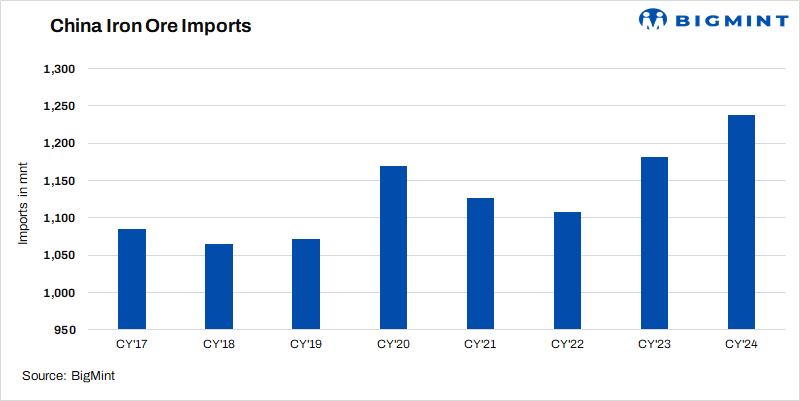
Mysteel Global: Data from China’s General Administration of Customs (GACC) show that during 2024, the country’s iron ore imports hit a record high of 1.24 billion tonnes and also topped the 1 billion tonne-level, as it has done every year since 2016. But far more significant in the GACC statistics is the degree to which China, the world’s largest iron ore consumer, is succeeding in diversifying its sources of supply, with countries such as Peru, Oman and even neighbouring Laos gradually enlarging their share of China’s vast market.
The world’s top two iron ore suppliers — Australia and Brazil — still command the lion’s share of China’s iron ore import business, together contributing more than 1 billion tonnes to its total ore purchases last year, Mysteel Global notes.
However, as China endeavours to reduce its reliance on the two countries for the steelmaking material, the past two years have seen the share of Australian and Brazilian ore imports in China’s total imports kitty shrink, with the Asian giant turning towards non-mainstream countries for more of its iron ore needs.
For example, the steady rise in ore imports from Peru in recent years saw that country last year become China’s fifth largest supplier of iron ore by delivering 22.4 million tonnes (mnt).
Chiefly responsible for the rise has been exports from the Marcona Iron ore Mine in Peru’s Nazca Province in the country’s west, operated by Shougang Hiero Peru, the wholly-owned subsidiary of China’s state-owned Shougang Group. Production at the mine, which boasts about 2.2 billion tonnes of proven reserves, was formally launched in August 2018. Its production capacity is nearly 20 mnt/year, according to Shougang.
Meanwhile, Sierra Leone in West Africa has been ramping up its ore exports to China as well, after shipments resumed in 2021 when the Tonkolili Iron Ore Project was restarted by project leader Leone Rock Metal Group, a subsidiary of Chinese mining and metals company China Kingho Energy Group. The Tonkolili mine houses reserves of 13.7 bnt.
In fact, West Africa will be a bright spot for China’s iron ore imports in the near future, as the Simandou project in the region, the world’s largest untapped deposit of high-grade iron ore located in Guinea, is in line to start production this year. The estimated output is 60 mnt by year-end, as reported.
Significantly, ore imports from Oman, an active participant in China’s Belt and Road initiative, have surged from just 81,000 tonnes in 2020 to 8.7 mnt last year. Moreover, the co-operation between China’s Jinnan Steel Group and Brazil’s Vale in building an iron ore concentration plant in the country, as Mysteel Global reported, will likely further boost its iron ore exports to China in the future.
On the other hand, China’s ore trade with some countries has suffered disruptions, the data showed. The slump in ore imports from Ukraine during 2022-2023, for example, was almost certainly a consequence of the Russia-Ukraine war, although the volume increased significantly last year thanks to the recovery of some shipment businesses.
Similarly, ore imports from Iran collapsed in 2020 after the country had aggressively hiked its export tariffs on iron ore from 10% to 25% in September 2019. After hovering at a low of 2-3% over 2020-2022, China’s purchase of Iranian iron ore has picked up in recent years as the tariffs eased, though the annual amount is still lower than the level prior to 2020.
The GACC will release the latest data for China’s iron ore imports late next month for the combined January-February period, Mysteel Global notes. Data for the first two months of the year are typically reported together to account for the weeklong Chinese New Year holiday that usually falls sometime during the two months.
“With global iron ore supply likely to continue rising in the coming years, the Chinese mills are eyeing iron ore projects outside Australia and Brazil to diversify the origins of their resources,” an iron ore analyst based in Shanghai observed. “This will help them mitigate supply risk while also bringing them more pricing power when bargaining with the leading ore miners,” she added.
Note: This article has been written in accordance with a content exchange agreement between Mysteel Global and BigMint.
Leave a Reply