- Strong demand expected in secondary market
- China focuses on increasing scrap imports
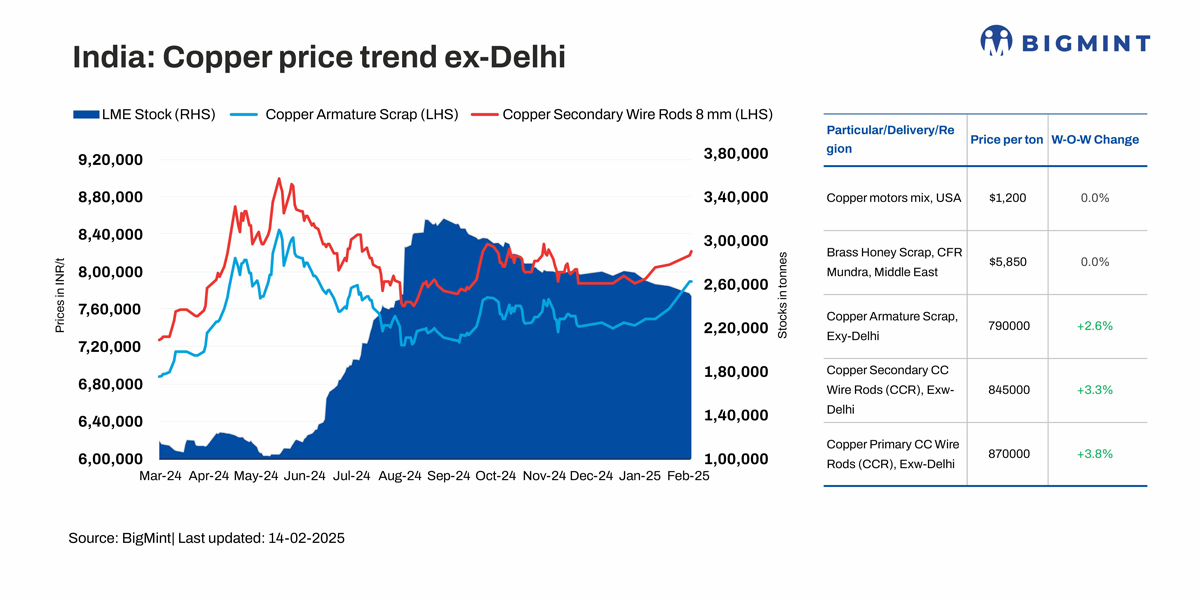
India’s domestic copper armature prices were assessed at INR 790,000/tonne (t) ex-Delhi, a 2.6% increase w-o-w. Meanwhile, copper motors mix scrap originating from the US remained stable w-o-w at $1,200/t, tracking London Metal Exchange (LME) tags, which stood at over $9,607/t, up by $300/t w-o-w.
Secondary continuous cast rods (CCR) (99.90%) were assessed at INR 845,000/t ex-Delhi, a 3.3% increase w-o-w. Meanwhile, primary CCR prices rose by 3.8% w-o-w to INR 870,000/t.
A market source stated, “Primary key players are transitioning to secondary production routes, significantly boosting demand in the secondary market.”
Another market participant noted that copper products, such as cathodes and wires, are in surplus in the local market, while aluminum talk scrap is also in excess.
Earlier this week, deals have been reported for Copper Druid scrap from Australia to CFR Chennai: high-grade (94% LME), mid-grade (91.5% LME) and low-grade (88.5% LME)
Global copper market overview
China continues to expand the use of secondary copper in its smelting operations by investing in new copper scrap recycling facilities and ramping up scrap imports. This strategy is aimed at reducing reliance on primary copper sources and promoting sustainability.
In 2023-24, copper scrap accounted for over 31% of China’s refined copper output, reinforcing its role as a crucial feedstock for cathode production. Due to rising copper concentrate costs, many refined copper producers are shifting towards scrap as their primary raw material. This shift has resulted in a 13% y-o-y increase in China’s copper scrap imports, surpassing 2.25 million tonnes (mnt) in 2024.
Additionally, China has introduced stricter regulations for new copper smelters, requiring companies to secure adequate mine supply through ownership or equity stakes. As part of its 2025-2027 copper industry plan, these restrictions may limit sector expansion to major players, potentially slowing copper production growth and impacting global supply dynamics.
Meanwhile, Candy Berry scrap from Australia was sold at 97% LME to China, while Birch Cliff scrap (94% LME) was also traded at competitive rates.
Outlook
The domestic copper market is expected to maintain an upward trend in the near term, fuelled by strong demand in the secondary market and increasing prices for certain copper grades.

Leave a Reply