- Capex-to-GDP ratio has been maintained at around 5.5%
- No reduction in BCD on aluminium scrap, despite lobbying
The Union Budget 2025-26, overall, had some positives with a pronounced focus on agriculture, MSME, investment and exports. It introduced personal tax relief measures aimed at boosting especially middle class consumer spending. Additionally, there were measures to support domestic manufacturing which will further support growth.
But, what did the Budget have for the steel and metals industry stakeholders?
The customs duty on several metal scrap items was removed. In fact, there was a duty elimination on scraps of 12 critical minerals (including copper), cobalt powder and lithium-ion battery scrap. In her Budget speech, finance minister Nirmala Sitharaman said import duty relaxations and policy interventions will help secure critical mineral availability for manufacturing and promote job creation.
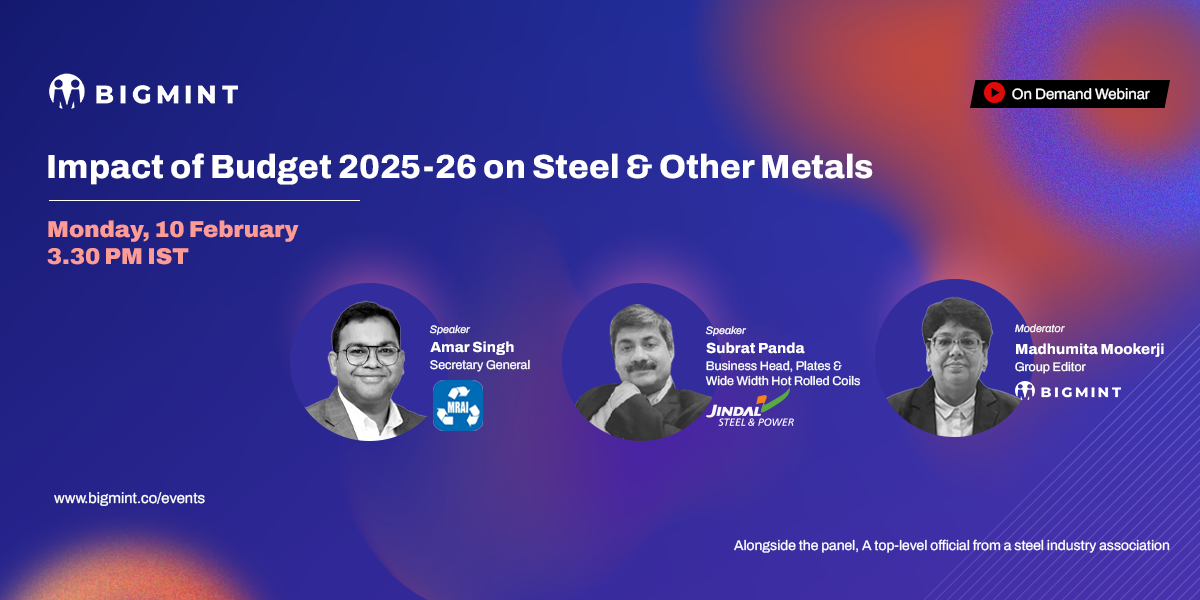
She also announced concessions for import of metal scrap to support the domestic recycling industry. BigMint organised a webinar on “Budget 2025-26 Impact on Steel & Other Metals” on 10 February, 2025 to get a better understanding of the proposals and also why some wish-list points were not addressed.
Key webinar takeaways:
- Non ferrous
Customs duty removal on non-ferrous scrap: Removal of the 2.5% Basic Customs Duty (BCD) on copper scrap is a major win for the industry.
Full BCD exemption on zinc and lead scrap: This will boost domestic recycling and industry competitiveness.
These moves align with India’s Net Zero 2070 goal and critical mineral policies and create a level playing field for Indian recyclers. Previously, India faced inverted duty structures due to Free Trade Agreements (FTAs), making imports uncompetitive. The new duty exemptions equalise costs, making the domestic secondary copper industry more viable and attractive for investments.
Support for clean energy & critical minerals: Lead, zinc, and copper are crucial for power transmission, lithium-ion batteries, and renewable energy storage. The government has finally recognised recycling’s role in securing raw material availability for clean energy initiatives.
Pending concerns on aluminium scrap: No reduction in BCD on aluminium scrap, despite strong lobbying from the recycling sector, informed Amar Singh, Secretary General of MRAI. India depends on 90% of imports for its secondary aluminium, impacting competitiveness. Singh remains hopeful of policy changes, emphasising that aluminium recycling saves 95% energy compared to primary production.
Non-ferrous scrap industry challenges: India’s non-ferrous sector relies heavily on imports:
Aluminium: 90% import-dependent
Lead: 80% import-dependent
Copper: 20% import-dependent
Zinc: 20-25% import-dependent
Domestic scrap supply remains insufficient, despite government efforts to formalise recycling through end-of-life vehicle policies and circular economy initiatives.
Market and investment outlook: Scrap-based manufacturing in India is 100% compliant with BIS standards, making it a strong alternative to primary production.
Singh sees huge potential in non-ferrous recycling, calling it the right time to invest, despite current market sluggishness.
- Ferrous
Infra focus sustained? Capex-to-GDP ratio has been maintained at around 5.5%. Industry expects it to be slightly lower at around 5.2% this financial year but government has retained it at 5.5% for next Budget which shows the sustained focus on infra. Infra capex allocation is at INR 11.10 lakh crore for next financial year. This fiscal will end around 8.3% lower at INR 10.20 lakh crore — this was expected being an election year.
Growth elasticity: Last calendar, India produced around 145 mnt of steel. This calendar, is at 155 mnt. The grow elasticity is at 1.2% to the GDP and that is being maintained. Net imports, 158 mnt of steel consumed this calendar compared to 144 mnt last calendar. This is a good growth.
INR 1 lakh crore Urban Challenge Fund will facilitate infra expansion and boost steel demand. This is for the next five years. Around INR 10,000 crore allocated for next year. Move to make cities a hub through a public-private partnership model which will allow cheaper funding access.
Asset monetisation plan for five years aims to monetise government lands and assets gainfully — especially those available with railways, roads and airports – through the PPP model — to avoid challenges of direct sales.
No well-defined green steel, decarbonisation or sustainability push? So far as decarb in the steel industry is concerned, all major mills are in an advanced stage of moving towards a low-carbon emission economy. The government is actually incentivising production and availability of green energy. And, that can always be utilised by mills to reduce carbon emissions to a substantial level.
The other emphasis is on coal gasification in which the in-built hydrogen percent is around 60%. Mills are trying to enrich that hydrogen to reduce steel-making at a much lower carbon emission. So, the overall thrust of the Budget is on green emissions.
Call for GST lowering ignored: The government is clear that it would like two rates of GST – 9% and 18%. Only individual house-builders or rebar portion of steel is where GST collection remains at 18%. Most of the mills’ supplies are to the process industry where GST is added. So the GST percentage does not make too much of a difference. “Considering the way the government is allocating to the social sector and capex for infra, we cannot expect it to maintain fiscal prudence and yet achieve that kind of capex,” said Subrat Panda, Business Head, Plates & Wide Width Hot Rolled Coils, at Jindal Steel & Power. He added: “Only at an individual house builder level or building segment where GST is affecting”.
Growth prospects: Even though the steel industry seems to be in a gloom in terms of profitability and prices, overall consumption has been growing at 8-9% every year over the last 3-4 years. Next year, GDP is expected to be at 6.5% and India’s steel consumption is expected to be 8% of this 6.5% — which translates into around 170 mnt next fiscal.
Overall Budget assessment
Non-ferrous
Rated 8/10 for the non-ferrous sector.
Positive: Duty reductions enhance competitiveness.
Negative: Aluminium scrap duty remains, limiting growth potential.
Ferrous
Rated 10/10, considering the intent of the Budget.
Positive: Steel sector growing for last 3-4 years. From around 110 mnt of crude steel production three years back to 150 mnt currently.
Negative: However, aim of 300 mnt by 2030 may fall short at 270-280 mnt.

Leave a Reply