- Billet prices drop, indicate lower finished demand
- Downturn in steel prices delay purchase decisions
The domestic silico manganese market witnessed a surprising downward trend this week, despite hike in imported manganese ore prices. Key producing regions witnessed a notable price correction of INR 2,000/tonne (approximately $24/t) on a w-o-w basis compared to the assessment ending 7 May, 2024. This price movement contradicts the ongoing upward pressure on raw material costs, suggesting an uncertain interplay of factors influencing market prices.
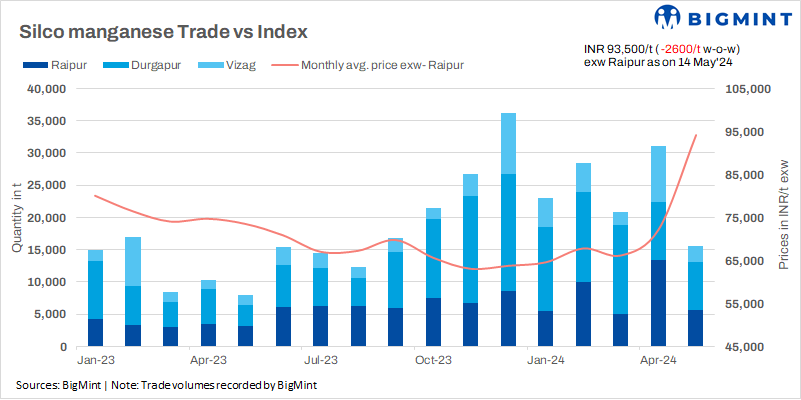
BigMint’s assessments on 14 May revealed a substantial w-o-w decrease of INR 1,700-2,600/t ($94-$116/t) for grade 60-14 silico manganese. Prices of this grade were assessed yesterday at INR 93,400-96,100/t ($1,120-$1,151/t) ex-works. Notably, offers in Raipur were at INR 95,000-96,100/t ($1,138-$1,151/t) exw.
The premium grade (60-15) has also witnessed a slight rise in prices, currently to INR 95,500-96,500/t ex-works ($1,143-$1,156/t) in Durgapur and Raipur.
Key producers from Raipur told BigMint that traders in the market are mainly squeezing the smelters’ quotations because raw material prices have skyrocketed and the trader quotations are lesser than cost of production in local markets. Additionally, Raigarh smelters’ quotes are between INR 91,000- INR 91,500/t exw ($1,090-$1,096/t), lesser than the Raipur prices, putting pressure on smelters to continue offering on the lower side.
Factors impacting Indian silico manganese prices
Silico manganese market navigates subdued demand: The silico manganese market is currently grappling with weaker-than-anticipated buying activity in both domestic and export markets. BigMint data revealed a significant decline in transaction volume, with total deals across key regions dropping by 2,200 t compared to the previous week. This softening in demand can be attributed to several potential factors:
Cautious end-user behaviour: Consumers might be exercising prudence, possibly expecting further price adjustments in the near future.
Strategic procurement decisions: Buyers could be strategically delaying purchases to potentially secure more favourable pricing in the coming weeks.
The current price decrease provides a welcome reprieve for end-users. However, it presents a challenge for silico manganese producers. Rising raw material costs continued to exert an upward pressure on margins. Without a corresponding improvement in demand, producers might be forced to implement price hikes to ensure profitability.
Drop in Indian billet prices w-o-w: BigMint’s daily steel billet index, a key benchmark for the Indian steel industry, registered a decline of INR 950/t w-o-w to INR 44,300/t ($511/t) exw-Raipur on 15 May, 2024. This downward movement reflects persistent negativity in both finished and semi-finished steel segments, leading buyers to adopt a cautious approach. Purchasing activity has contracted, with buyers limiting their orders to need-based requirements while observing ongoing market corrections.
This spillover effect from the steel market is impacting prices of silico manganese. While the precise impact on silico manganese pricing remains to be seen, the inter-connectedness of the steel supply chain suggests potential adjustments in the near future.
India’s imported manganese ore prices rise further as global offers edge up: Imported manganese ore prices to India increased up to 18% last week. Furthermore, global manganese ore suppliers are hiking prices for June shipments to China. UMK increased its 36% grade by $2.00/dmtu to $6.20/dmtu CIF China, while Jupiter Mines’ high-grade offering jumped to $6.30/dmtu, a significant rise from May’s price. These hikes suggest tighter supply or rising production costs, potentially impacting steel manufacturers.
Outlook
Given that domestic steel purchasers are moving towards a wait-and-see strategy and avoiding large holdings of manganese alloy material, domestic silico manganese prices might fluctuate in the near future. Close monitoring of both raw material price movements and buying activity across domestic and export markets are crucial to assess the future trajectory of silico manganese prices and navigate this evolving environment.