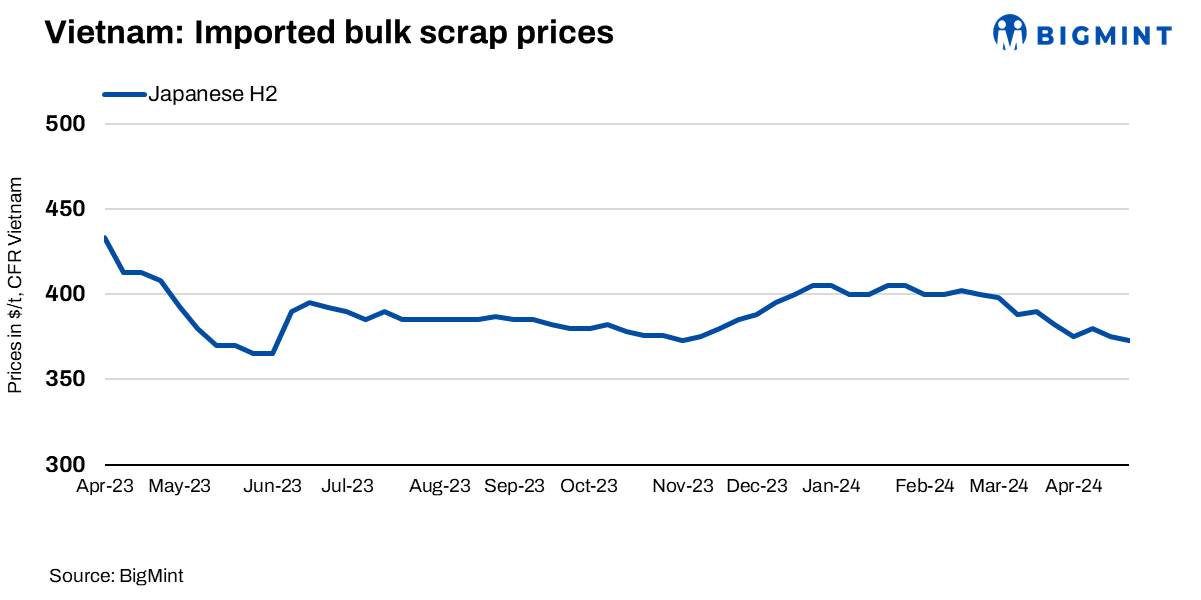
Imported ferrous scrap prices witnessed mixed trends w-o-w, as a slight rise was seen in US-origin HMS (80:20) bulk scrap prices. On the other hand, Japanese H2 offers decreased by $2/t w-o-w despite a slight uptick in domestic demand.
As per market sources, offers of Japanese H2 bulk scrap were quoted at $375-377/t CFR Vietnam, marking a $3-5/t drop from the previous week, driven by currency fluctuations. The workable level for this grade settled at $370/t CFR, though buyers had resisted prices above $365/t CFR in the previous week. High-grade Japanese scrap was priced at $400-405/t CFR.
US-origin deep-sea HMS (80:20) bulk was also offered at around $390-395/t CFR but failed to attract interest as workable levels still hovered around $380-385/t CFR. US-origin containerised HMS (80:20) saw a slight decrease to $365/t CFR, down $5/t from the previous week. Suppliers focused more on the Taiwanese market, where prices had stabilised at $360/t CFR.
BigMint’s weekly assessment for Japanese H2 scrap was reportedly in the range of $372-374/t CFR Vietnam, down by $2/t w-o-w from last week’s $375/t CFR.
BigMint’s weekly assessment for US bulk HMS (80:20) stood at a range of $385-387/t CFR Vietnam, which witnessed a slight rise by $2/t w-o-w.
Domestic market: Meanwhile, in Vietnam’s domestic market, scrap purchasing prices from northern mills increased by VND 100-200/kg ($4-8/t), reaching VND 9,400-9,600/kg ($369-377/t) DDP for H1 grade as of last weekend. One northern mill quoted H1 at VND 9,200/kg ($362/t) DDP, reflecting a lack of interest in acquiring more scrap due to prior imports. Local scrap is more attractive due to currency fluctuations and lower risks.
In the longs sector, the outlook remained uncertain, with mills reducing wire rod offers by VND 100/kg ($4/t) earlier this week. However, there was cautious optimism that long prices could stabilise in the coming week, with a possible uptick in construction activity.
IMF forecast: Vietnam is increasingly attractive to foreign investors thanks to its stable growth and large market, according to Paulo Medas, head of the IMF team for Vietnam. Despite global challenges, Vietnam’s economy grew by 5.66% in Q1. The IMF predicted that Vietnam’s economy will grow by nearly 6% this year, fuelled by domestic demand and government support. However, to maintain stability, Vietnam should adopt a flexible fiscal approach to manage risks.
