- Production cuts keep induction based billet prices supported
- Higher coal auction prices, tight scrap supply propel prices
- Weak global sentiments to weigh on domestic steel tags
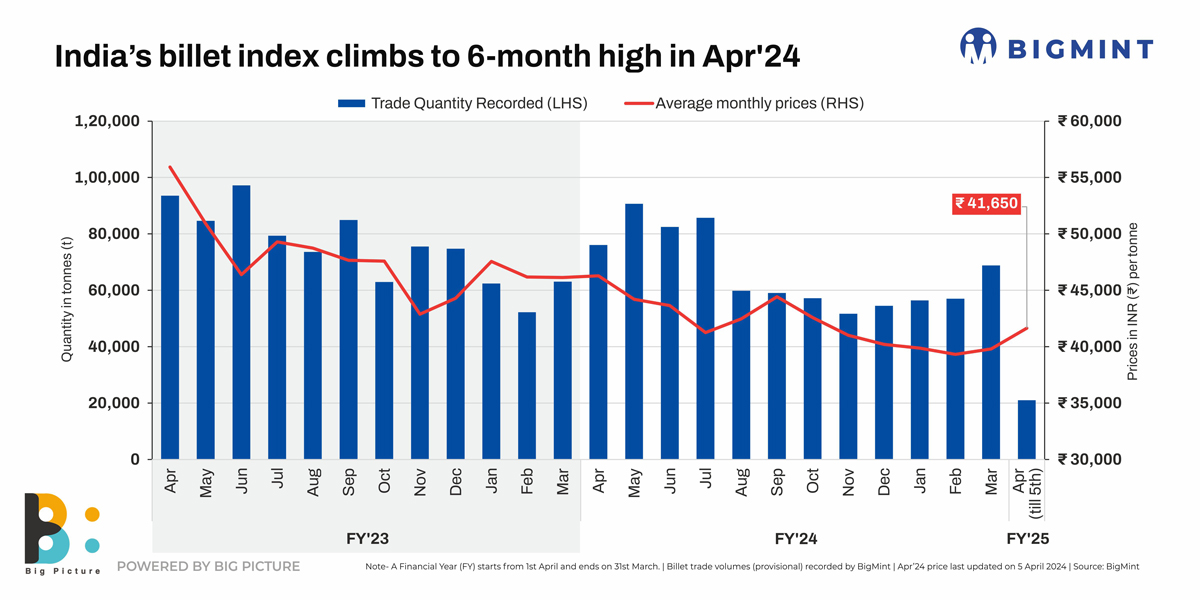
Morning Brief: In a significant recent development, India’s induction furnace billet index, monitored by BigMint for the key secondary steel market of Raipur in central India, has drifted up to a 6-month high, as per latest available data.
The index is on the ascendant due to a melange of factors, notably momentary supply tightness and sudden swings in raw materials prices, BigMint notes. It rose by INR 1100/t settling at INR 43,200/t exw ($519/t) exw Raipur as on 5 April, 2024, surpassing the rally of the last six months, driven by continuous buying support from the semi-finished and finished steel segments.
Market dynamics & billet prices
1. Thin margins for IF-based producers: Production cuts driven by thin margins for induction furnace (IF)-based operators kept supplies constrained, potentially supporting price levels. Cuts in BF-route long steel production was also provided a fillip to this trend.
2. Coal prices surge: Increase in demand from the power sector fuelled a rise in coal prices. CIL auction prices have risen amidst restocking demand anticipated during the summer season. Non-coking coal prices have increased by around INR 1,000/t in last one month both for domestic and imported cargoes. Even a slight rise in coal prices affects India’s secondary steel producers reliant as they are on the coal-dependant DRI sector.
3. Low finished steel inventory: Production cuts by mills have resulted in reduced inventories of finished steel. Despite relatively soft demand and depletion in inventory has driven prices higher. Generally, IF-based mills maintain a finished steel inventory of 8-10 days, which in most of the mills have come down to 5-6 days. This is naturally supporting prices.
4. Expected power price hike: With the government renewing power prices annually, any escalation in coal prices could prompt a revision in power tariffs. This potential increase in energy costs could further influence steel prices, especially steel produced through the IF-EAF route in which electricity costs account for around 35-40% of total production costs. The market has factored in this potential hike and, therefore, a rise in prices is justified.
5. Limited scrap availability: Booking of imported scrap due to price differential with domestic material has slowed down leading to reduced inventories. This scarcity in scrap availability has tightened the market, exerting upward pressure on steel prices. According to BigMint estimates, scrap imports are expected to fall to 300,000-400,000 t per month from an average of 1 mnt over the last few months.
6. Impact of GST raids: Recent GST raids in north India, common during the implementation of the model code of conduct before elections, are likely to reduce unaccountable/unbilled sales. This crackdown could stabilise prices by bringing more transactions into the formal sector.
Outlook
While these factors have propelled prices to their current highs, several considerations suggest a cautious outlook. These are enumerated as under:
Resistance at higher offers: Despite witnessing decent volumes in recent days, resistance is evident at current price levels from buyers, indicating potential market scepticism.
Supply-demand imbalance: Supplies still outstrip demand in the market, suggesting that sustained price rise may face challenges without a significant shift in market fundamentals.
Global market subdued: The subdued state of global markets could also weigh on Indian steel prices, limiting the potential for significant price appreciation.
In conclusion, while cost pressures persist and various factors have given Indian billet prices a shot in the arm, a sustained upward trajectory may face road bumps due to supply-demand dynamics and global market conditions. Active trade volumes reported in the last few days. This will give some support as mills have forward booking for next few days. Trade volumes of 21050 tons were recorded in the last five days as per Bigmint’s assessments. As such, prices are expected to remain rangebound in the near term.
