- Overseas buyers demand over 20% discount
- Chinese domestic portside prices under pressure
- Steel demand yet to improve in China
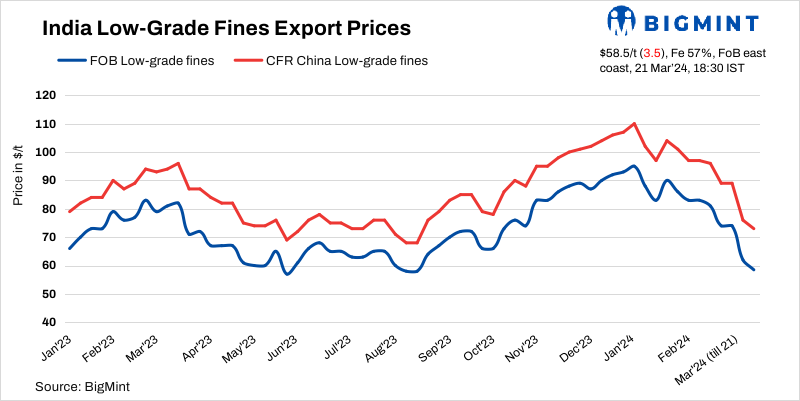
BigMint’s weekly Indian low-grade iron ore fines (Fe 57%) export index fell by $3.5/t w-o-w to $58.5/t FOB east coast on 21 March 2024. No deals were heard for Fe 57% fines as buyers demanded around the range of 18-20% discount to conclude the deals. The lower-grade fines prices in the export market witnessed a drop amid a lack of buying interest from buyers. The overseas buyers were looking for cheaper material following a sluggish import margin, which was not feasible for Indian sellers. The discount had widened for Fe 57% fines.
A miner from eastern India commented on the current market: “We are receiving a few inquiries for lower-grade fines in the sea market, but bids were not viable for us as they remained lower $8-10/t against last offers. We have port stock at eastern ports and are ready to sell material, but following the other costs, we are holding the material and waiting for price improvement.”
An exporter said, “The iron ore fines prices suppose to rise $10-15/t in the seaborne market suit the Indian sellers. The dampened end-user steel demand in China continued, and no improvement has been seen in the prices in the last one week. However, mills are gradually increasing their iron ore buying, but their focus is still on cheaper material and they booked material wherever they can get a decent discount.”
The benchmark Fe 62% fines index remained largely stable w-o-w at $107/t CFR China on 20 March. Iron ore prices recovered at the start of this week due to a slight improvement in buying activity. A few end-users were seen restocking iron ore at seasonally low prices. However, the recent hike in prices raised concerns over their sustainability because of dull downstream demand.
Another seller said, “Export market prices have continuously declined after the Lunar holidays, and no one was willing to buy at decent offers from India. Indian sellers had been waiting since the lunar holidays for iron ore export prices to improve but the market went against all expectations. Before deciding whether to start shipping cargoes to the Chinese market again, it is critical that we pay close attention to the iron ore prices’ steady movement.”
On the other hand, a few Chinese steel sources reported that portside offers in China for Indian iron ore fines (Fe57%) remained stable w-o-w on 21 March. The offers were recorded at around RMB 620/t ($88/t) at Qingdao Port inclusive of all import taxes and port charges.
The portside prices in China remained under pressure amid an excess of supply against demand. The steel makers are buying the iron ore on a need basis, and domestic traders are also holding the offers and not showing aggression in the buying.
Notably, iron ore inventories at China’s major ports inched down by 0.5 mnt to 140.4 mnt on 21 March compared to the last week, according to SteelHome data.

Other highlights:
- DCE iron ore futures rise w-o-w: The iron ore futures on the Dalian Commodity Exchange (DCE) for the May 2024 contract increased by RMB 51.5/t ($7/t) w-o-w to RMB 849.5/t ($118/t) on 21 March compared to last week. However, on a d-o-d basis, prices rose by RMB 26/t ($4/t) today.
- India iron ore shipment falls w-o-w: India’s iron ore export shipments were recorded at 744,679 t in the second week of March, compared to 820,760 t in the first week of March, as per vessel line-up data maintained with BigMint.

Price indicators:
- No deal was reported this week for fines Fe 57% from the East Coast and not taken into consideration for calculation. Thus, given 0% weightage. For detailed methodology Click here.
- BigMint received sixteen (16) indicative prices in the current publishing window and thirteen (13) were considered for price calculation as T2 inputs and given a 100% weightage.
Outlook:
The seaborne export market for Indian iron ore fines may remain volatile amid uncertainty in the Chinese market.